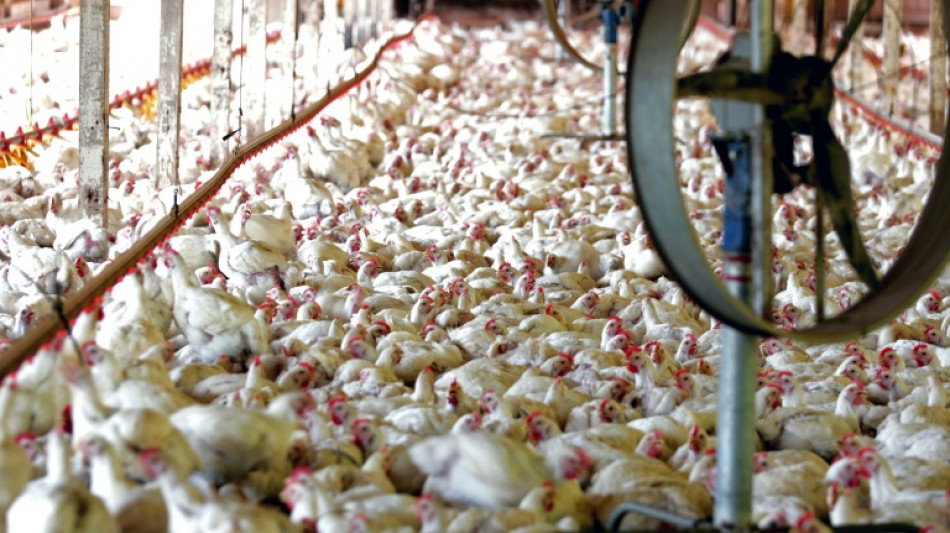
Brazil welcomes China lift of ban on poultry imports / Photo: Silvio AVILA - AFP/File

 Police Departments Deploy AI-Generated 'Grand Theft Auto VI' Recruitment Ads

 San Ġiljan Defeat Paredes 20-12 in Challenger Cup Opener

 Kuwait DGCA Delegation Attends ICAO Assembly in Montreal

 Charlie Puth and Ellie Goulding to Headline First Johnnie & Co. Festival in Mumbai

 Maryland Woman Arrested in Decade-Long Cancer Scam Involving Fake Medical Team
Brazil, the world's biggest exporter of chicken meat, on Friday welcomed China's move to lift a ban on imports of the product after an outbreak of bird flu earlier this year.
China and the European Union suspended imports of chicken meat from Brazil in May after the outbreak.
Brazil said in June it was free of bird flu and would resume exports.
"Gradually, all major importers of chicken meat resumed purchases," the Brazilian Animal Protein Association (ABPA) wrote on its website on Friday.
"Recently, the European Union announced the resumption of shipments. Today, China ...reopened its ports to Brazilian products."
The ABPA said there had been a "broad and intense diplomatic effort" by the Brazilian government to resume exports.
Before the suspension, China had been the largest importer of chicken meat from Brazil.
Between January and May, China imported 228,200 tons of chicken meat, generating revenue of $545.8 million, according to the ABPA.
Avian flu has spread globally in recent years, leading to mass culling of poultry, some human deaths, and rising egg prices.
Infections in humans can cause severe disease with a high mortality rate, according to the World Health Organization, but the virus does not appear to move easily from person to person.
Human cases detected so far were mostly in people who had close contact with infected birds and other animals, or contaminated environments.
W.Moreno--AT