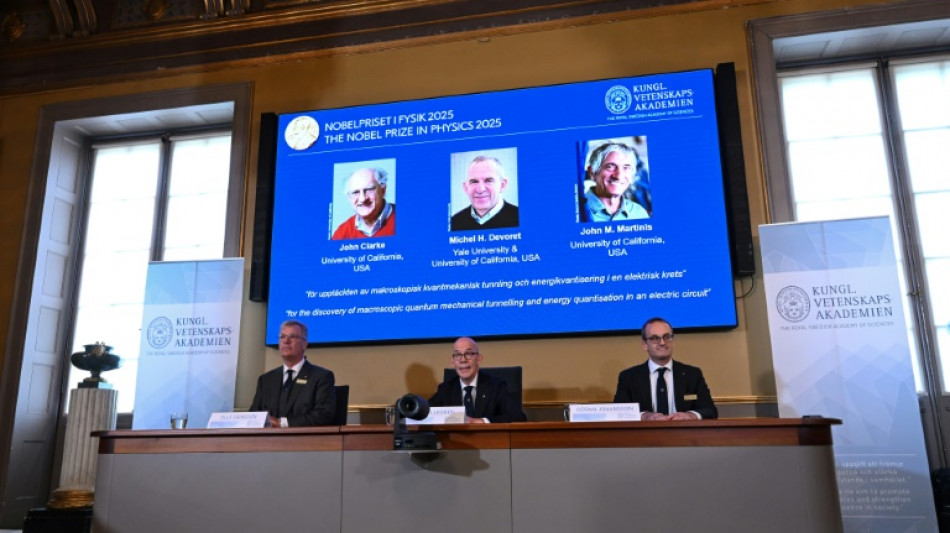
Trio wins physics Nobel for quantum mechanical tunnelling / Photo: Jonathan Nackstrand - AFP

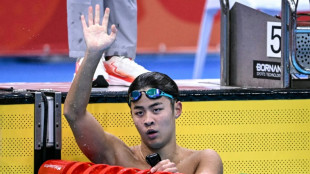 Japan's Kojima sounds Marchand warning with Asian Games gold

 England rugby star Pollock signs new Northampton deal
 STARTRADER Expands Its Chinese Equity CFD Range with CXMT and Unitree Robotics

 MEXC Expands Opportunity Compass with Stock Trading Handbook to Help Crypto Users Build Investment Knowledge

 England paceman Wood retires from international cricket
 Magnificent Mandhana's 79 helps India to Asian Games cricket gold
 Marchand 'stressed' about racing Japanese rivals at LA Olympics
 Mobile boat clinics bring healthcare to India's remote islands
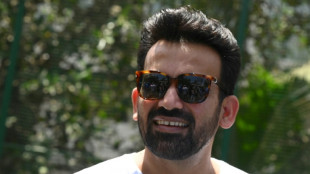 Former India paceman Zaheer Khan named Chennai coach in IPL
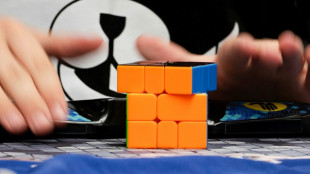 Six-year-old Chinese girl sets world record with Rubik's Cube
 Swimming prodigy Yu, 13, says 'interviews way harder than racing'

 Star coaches make their bows as Nations League returns
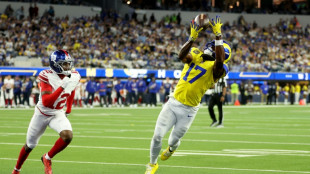 Rams bounce back as Giants reel from Dart injury
 In Bangladesh, Pakistan's Jinnah photo stirs anger
 Two New Zealand naval ships transit Taiwan Strait
 Zidane gets down to work as France start new era

 Inside the Venezuelan prison meant to 'drive you insane'
 UK king braces as memoir by Diana's brother goes on sale
 Jaguar Mining Commences New Underground Drilling Program Targeting Untested High-Grade Zones at Turmalina Mine, Brazil
 Caledonia Mining Corporation PLC: Notification of Relevant Change to Significant Shareholder
 InterContinental Hotels Group PLC Announces Transaction in Own Shares - September 22
 American Critical Minerals Completes Drilling Operations at the AP-S-02 Duma Point Well Confirming Potash Mineralization and Deep Brine Aquifers
 Connecting Excellence Group PLC Announces Institutional Subscription Raising £600,000
 Kingsway to Present at Sidoti Small-Cap Virtual Conference on Wednesday, September 23 at 10:00 AM ET
 Macron says talks with Trump on Red Sea, Ukraine 'constructive'
Briton John Clarke, Frenchman Michel Devoret and American John Martinis won the Nobel Prize in Physics on Tuesday for work on quantum physics in action, the Nobel jury said.
The trio was honoured "for the discovery of macroscopic quantum mechanical tunnelling and energy quantisation in an electric circuit," the jury said.
Quantum mechanics describes how differently things work on incredibly small scales.
For example, when a normal ball hits a wall, it bounces back. But on the quantum scale, a particle will actually pass straight through a comparable wall -- a phenomenon called "tunnelling".
Tuesday's prize was awarded for experiments in the 1980s which showed that quantum tunnelling can also be observed on a macroscopic scale – involving multiple particles – by using superconductors.
In a series of experiments, the researchers demonstrated that "the bizarre properties of the quantum world can be made concrete in a system big enough to be held in the hand," the Royal Swedish Academy of Sciences said in a statement.
The jury noted that the discoveries had "provided opportunities for developing the next generation of quantum technology, including quantum cryptography, quantum computers, and quantum sensors."
"It is wonderful to be able to celebrate the way that century-old quantum mechanics continually offers new surprises. It is also enormously useful, as quantum mechanics is the foundation of all digital technology," Olle Eriksson, chair of the Nobel Committee for Physics, said in a statement.
- 'Never occurred to me' -
Clarke, 83, is a professor at the University of California, Berkeley, and Devoret, 72, is a professor at University of California, Santa Barbara and is listed as a professor emeritus at Yale University.
Martinis, born 1958, is also a professor at the University of California, Santa Barbara.
"To put it mildly, it was the surprise of my life," Clarke told reporters via telephone during the prize announcement, about learning of his award.
"It never occurred to me in any way that this might be the basis of a Nobel Prize," Clarke added.
Clarke explained that the scientists were focused on the physics of their experiments and that they didn't realise the practical applications that could follow.
"It certainly had not occurred to us in any way that this discovery would have such a significant impact," Clarke said.
The physics prize is the second Nobel of the season, after the medicine prize was awarded on Monday to a US-Japanese trio for research into the human immune system.
Mary Brunkow and Fred Ramsdell, of the United States, and Japan's Shimon Sakaguchi were recognised by the Nobel jury for identifying immunological "security guards".
Last year, the Nobel Prize in Physics went to British-Canadian Geoffrey Hinton and American John Hopfield for their pioneering work on the foundations of artificial intelligence -- with both of them warning that their discoveries carried profound risks to society and humanity.
The physics prize will be followed by the chemistry prize on Wednesday.
The literature prize will be announced on Thursday, and the highly watched Nobel Peace Prize on Friday.
The economics prize wraps up the 2024 Nobel season on October 14.
The Nobel consists of a diploma, a gold medal and a $1.2 million cheque, to be shared if there is more than one winner in a discipline.
The laureates will receive their prizes from Sweden's King Carl XVI Gustaf at a formal ceremony in Stockholm on December 10.
That date is the anniversary of the death in 1896 of scientist Alfred Nobel, who created the prizes in his will.
J.Gomez--AT