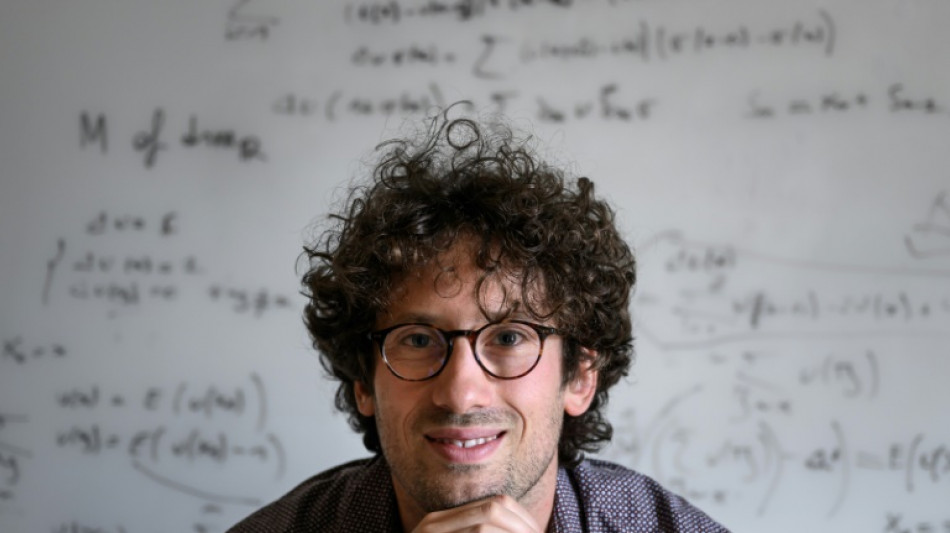
Duminil-Copin, Fields-winning mathematician with 'aesthetic vision' / Photo: Fabrice COFFRINI - AFP

 China-Nepal flood toll tops 1,000 as tunnel rescue offers last hope

 Japan to relax overtime regulation under workaholic PM

 Thwarted Niger mutiny exposes junta's Russia dependence
 Illegal mining ravages S.Africa's economic hub

 Nepal's wall of missing offers last hope after Himalayan flood

 US to press G20 on light-touch AI regulation

 2 die in Grand Canyon flash flood, only 1 person unaccounted for
 US Army Secretary Driscoll submits resignation: White House
 Oil extends gains, stocks drop as Trump issues fresh Iran warning

 Tsitsipas says Kyrgios's positive cocaine test 'kind of expected'

 In Japan's mountains, a different way to manage bears
 Middle East war a boon for UAE defence giant with global ambitions
 Former gang member found guilty of murdering Tupac Shakur

 InterContinental Hotels Group PLC Announces Transaction in Own Shares - September 01

 Connecting Excellence Group PLC Announces First Acquisition Heads of Terms & Trading Update
 Heavy rain at Grand Canyon after flood kills 2, dozen missing

 Kushner blames soccer power struggle for World Cup plan collapse

 Buoyant Alcaraz shakes off nerves to advance at US Open
 US draws European pushback with Russia G20 finance invite

 Jury begins deliberations in Tupac Shakur murder trial

 US Supreme Court allows Trump ballroom project to proceed
 Trump says US reviewing position on Falkland Islands

 Saka strikes as flawless Arsenal punish troubled Villa
 Oil prices surge on renewed fighting in US-Iran war
 Cycling superstar Pogacar has surgery after Vuelta crash

Hugo Duminil-Copin, a French mathematician whose visual approach helped him win the world's most prestigious mathematics prize the Fields Medal on Tuesday, said he "doesn't really fit into the cliches of a genius".
The 36-year-old, who has a messy head of hair and bright eyes beaming from behind glasses, told AFP that he is a "very, very normal person" who loves sport, his family and quiet moments of reflection.
But for Duminil-Copin, who specialises in probability theory, those quiet moments can lead to discoveries that won him the Fields Medal, the equivalent of the Nobel Prize for mathematics.
He accepted the prize, which is awarded every four years to mathematicians under 40, at a ceremony in Finland's capital Helsinki.
The other winners were Britain's James Maynard of Oxford University, June Huh of Princeton in the United States and Ukraine's Maryna Viazovska, who is only the second ever woman laureate.
Duminil-Copin described with unabashed enthusiasm the happiness he finds in working with others in the search for answers -- whether or not they find one.
"It's the best, especially since it's a collective process, where all the beauty is in interacting with others," he said in an interview a few days before the prize was announced.
- A visual mind -
Born on August 26, 1985, Duminil-Copin has collected a raft of mathematics awards over the last decade.
At the age of 31, he was appointed professor at France's Institute of Advanced Scientific Studies in 2016.
"It's a place that seems made for me, for my creative part," he said of the green campus outside Paris.
It gives the mathematician that most precious resource for deep thinkers: time.
"This slowness in everyday life is very fruitful because I need time for ideas to come, for them to settle quietly, for them to take shape," he said.
At the campus, which is not far from where he grew up, Duminil-Copin uses his "very visual intuition" to take on the most complicated mathematical problems.
"There are very few formulas and many drawings" in his mind when he thinks about such problems, he said.
That "aesthetic vision" allows him to view mathematics with a "certain elegance", he added.
The Paris institute allows researchers to free themselves of all other obligations, including teaching.
But Duminil-Copin teaches anyway, retaining a professorship at the University of Geneva, saying that "in the end it is perhaps the most important aspect of this profession".
He may have inherited this passion from his father, a sports teacher, and mother, a dancer who became a teacher later in life.
When he was younger, Duminil-Copin envisioned becoming a teacher himself -- of maths, of course -- but his talent propelled him towards research.
Collaboration is at the heart of his outlook. If he provides mathematical tools to physicists, their work in turn may allow someone else in the future to find new applications for them.
"It's the whole community that really produces scientific progress," he said.
- Mental balance -
Duminil-Copin hailed the importance of two university professors to his career, Jean-Francois Le Gall, who also worked on probability theory, and fellow Fields Medal winner Wendelin Werner.
He said he fell in "love at first sight" with percolation theory during a class Werner taught on the subject, which falls under the branch of statistical physics.
It was in that class that Duminil-Copin first encountered Nienhuis's conjecture -- a "beautiful, elegant and completely mysterious" problem, he said.
"I solved it a few years later, almost without doing it on purpose."
As a child, Duminil-Copin preferred astronomy to mathematics.
He said he was "not pushed at all" by his parents to focus solely on his studies -- instead they were keen to "confront him with a variety of things" such as sport, music and friends.
The lesson seems to have stuck.
"When we talk about preparing to become a researcher we think of intelligence, academic training, but there is also a mental balance which is very important," he said.
New ideas can strike him "anytime, in the middle of the night or in the shower", he said.
But they will have to wait until he's back at work.
"My priority is on the personal side, to spend time with my daughter and my wife."
R.Lee--AT