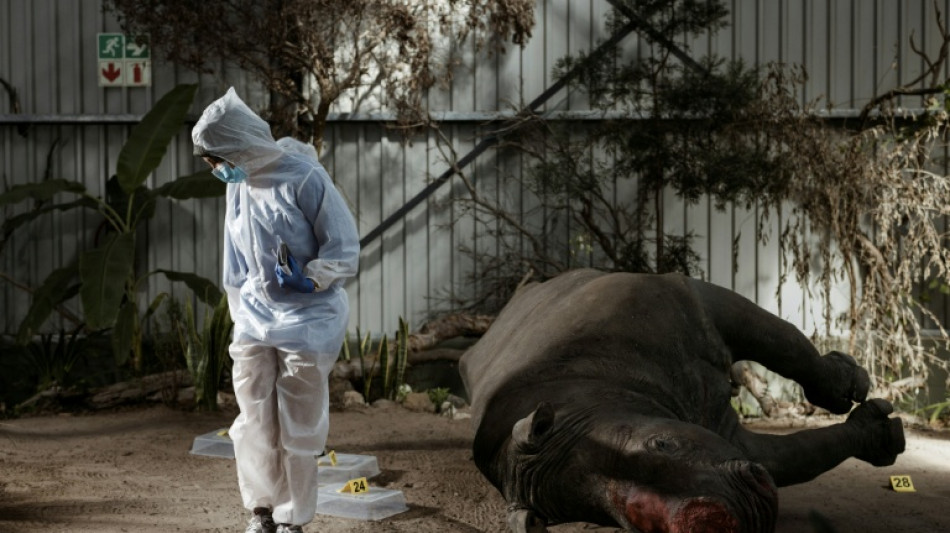
Inside South Africa's wildlife CSI school helping to catch poachers / Photo: MARCO LONGARI - AFP

 Turkey beat US 3-2 with last-gasp winner

 Asian stocks suffer fresh rout as rollercoaster week draws to close

 Japan coach hopes World Cup success can inspire Asian rivals

 'Unbearable': tracking heat in one of New Delhi's poorest areas

 Sheinbaum and King Felipe VI use World Cup to mend diplomatic rift

 Viral bullying videos test Bhutan's digital transition

 Venezuela races to search for survivors after quakes kill at least 235

 Attack on ship in Hormuz leads UN to halt evacuation plan for trapped sailors

 Yoon leads Women's PGA Championship, Korda satisfied with 'solid' start

 Japan to play Brazil in World Cup knockouts after nervy Sweden draw

 Better to qualify this way, says Ecuador World Cup hero Plata

 Advocaat 'proud' of Curacao as minnows exit World Cup

 Iglesias -- Spanish World Cup striker unafraid to speak out about injustice

 Anderson to join Man City from Forest for British record fee: reports

 Ecuador upset Germany to reach World Cup last 32 as Curacao eliminated

 Ecuador edge Germany to squeeze into World Cup last 32

 Spain women's star Putellas to join London City Lionesses

 England showing Premier League edge at World Cup: Eze

 Nasdaq falls again on mixed day for US stocks, oil prices rise

 France squad look to do grieving Deschamps proud in final World Cup group game

 Mayweather's Athens fight with Zambidis is off: report

 Alonso committed to Aston Martin, but keeping options open
 Events cancelled, records loom as heatwave reaches Germany

 Czech striker Schick ends international career

 US says wants deal with Iran, but not 'at any price'

The rhino lay frozen in the sand, its grey legs stiff, glassy eyes open, horn crudely sawed off.
A dead giraffe slumped nearby and a lion's twisted body to the right -- a tableau of devastation.
Three figures in white hazmat suits tip-toed through the dust, marking every footprint. They were not first responders to another poaching tragedy, but students at South Africa's Wildlife Forensic Academy, a training centre aiming to fight poaching by teaching investigation skills to rangers, conservation officers and law enforcement.
Set inside a sunny warehouse in a private game reserve an hour north of Cape Town, the simulated carnage is staged with taxidermised animals, including rhino "Frikkie" who was poached a few years ago.
"The first people who arrive at the crime scene are absolutely crucial," said Phil Snijman, a former prosecutor and trainer at the academy.
"They are the ones who will secure the crime scene. In the absence of the necessary training... that might lead to losing a lot of your available evidence," he said, putting the last touches to an elaborate scene leading the students to a poacher's house in a corner of the warehouse.
South Africa faces an acute poaching crisis, with more than 10,000 rhinos killed since 2007 according to the International Rhino Foundation.
Yet only 36 cases were convicted in court in 2023, according to government figures, in the year almost 500 of the stocky animals were killed.
- 'Entire species disappearing' -
Killings of other species that receive less attention like reptiles and vultures, are even less likely to be prosecuted, said Snijman.
"Police aren't always available to come out, especially for a remote crime scene," he said.
That gap in justice is something Wendy Willson, a former police trainer and conservationist, sees often.
The legal head at Johannesburg's Wildlife Veterinary Hospital said cases of wildlife crime seldom make it to court, and "when they are actually prosecuted, we often end with a lenient sentence".
Willson, who is unaffiliated with the Wildlife Forensic Academy, has dedicated herself to "seeking justice for the little creatures" that don't draw public concern like rhinos and elephants.
"We are in a crisis where we are losing so many of our small animals. Entire species are completely disappearing, and nobody even knows about it," she told AFP.
While "having rangers understand the importance of the chain of custody is very important," she said, it is only one of many challenges to prosecuting wildlife crime -- which include law enforcement resources, community support and prosecutors' awareness of the crimes.
- No silver bullet -
Back at the academy, Mari-Su de Villiers -- wearing a mask and blue plastic gloves -- carefully laid down yellow markers next to each footprint surrounding Frikkie.
At 28, she works to protect endangered African wild dogs -- but it was a case of animal poisoning, and the help of a trained colleague, that led her to the academy.
"They helped our team know what evidence to look out for, anything that seems out of place in a natural environment," she told AFP.
Since opening in 2022, the academy has trained over 500 people but only 89 have been rangers, investigators, or conservation officers like De Villiers.
Much of the intake comes from European students, admits Snijman, noting that their fees help fund sponsorships for local rangers.
Improving the way evidence is gathered, especially forensic material that can stand up in court, will lead to more convictions and serve as a deterrent to future crimes, said Snijman.
"One would hope that you don't need an academy like this because there isn't any wildlife crime out there. This is not a perfect solution, but it is a small part of the bigger picture," he sighed, before returning to the dead rhino to imprint his footprints in the sand.
O.Ortiz--AT