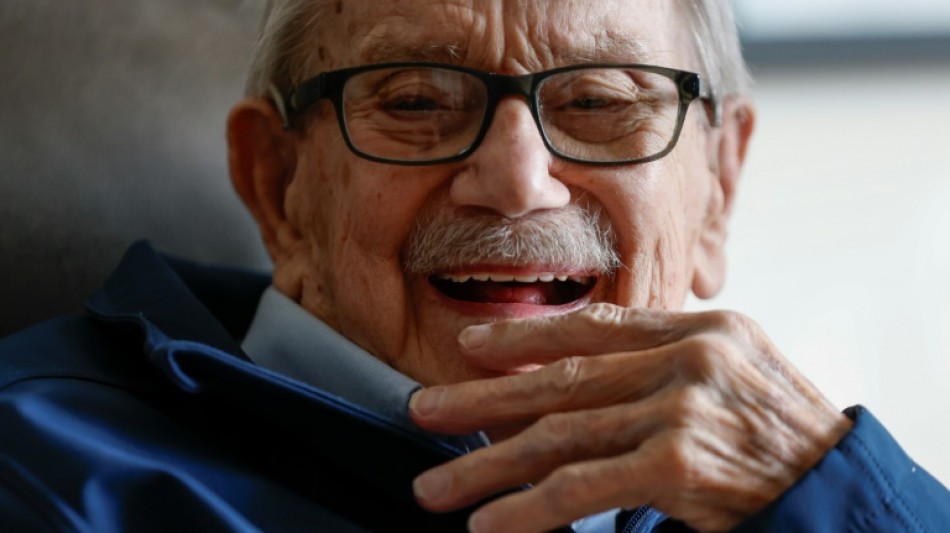
For US veteran, D-Day memories still vivid after 80 years / Photo: KAMIL KRZACZYNSKI - AFP

 'I live in fear': 1.5 million Pakistani children sexually exploited online

 Cowboys beat Commanders, Vikings down Bears as star QBs injured

 Braves clinch division title as Red Sox reach MLB playoffs

 Bordeaux-Begles hammer Stade Francais despite Jalibert injury

 Milan and Juventus end blips with home wins

 Bridgeman wins PGA Biltmore title with sizzling 61

 Williams injured as Bears shut down by Vikings

 US warns of rapid escalation in Middle East war

 Germany's far-right AfD celebrates another state election win

 Russia vows revenge for election-day attacks as poll shows ruling party win

 Spaun late shows snatches PGA Championship win

 Conceicao strikes as Juventus beat Atalanta

 Britain, Zverev-inspired Germany, Spain complete Davis Cup finals

 Man Utd salvage Fulham draw as pressure mounts on Carrick

 Spanish civil war drama 'The Black Ball' wins at Toronto festival

 Germany's Merz shaken by far-right and far-left gains in state votes

 Macron welcomes Canada's Carney to French Atlantic territory

 Fiorentina frustrate Napoli with Serie A draw, Como upset

 Five-star Man City top Premier League after Sunderland thriller

 Ukrainian drones hit Moscow on last day of Russian elections

 Multi-Asset Trading Venue Monochrome Exchange Announces IEO of Its Native Token, $MCR
 South Korea break Japan hearts to win Asian Games basketball gold
 Acosta takes first victory at Austrian MotoGP

 PSG president Nasser al-Khelaifi under investigation in France for conflict of interest

 China swim sensation, 13, sets Games record after Japan win early

Richard Rung recalls it vividly: German artillery firing on his landing craft, the sound of machine gun bullets striking the vessel, blood mixed with seawater on the deck, troops crying on the beach.
It has been nearly eight decades since Rung landed in France on D-Day -- June 6, 1944 -- as a 19-year-old US Navy sailor, part of a massive amphibious invasion that broke through German coastal defenses in a key victory for Allied forces.
He now lives in a suburb of Chicago with Dorothy, his wife of 75 years, but his memories of the violence and death he witnessed half a world away are still clear, and that distant day can still feel close at hand.
"D-Day is not always, you know, a long way off," said Rung, a gray-haired, mustachioed 99-year-old wearing a blue jacket with the US Navy emblem.
"Sometimes, it's yesterday," he said. "When you have these experiences, they come back to you if you get a right situation."
- 'They opened up' -
Rung's path to Normandy began when he was drafted in 1943, choosing the Navy on the advice of his father, who urged him to "take the Navy. At least you'll be at sea, you have something to eat."
He dreamed of serving on a destroyer, but was assigned to maintain the engine on a landing craft because of his knowledge of motors gained in vocational school -- a turn of events that brought him to France.
Rung trained in the United States and then traveled by ship to Britain, where he witnessed German planes bombing London.
"Every night, they were raided," he said.
After crossing the English Channel, Rung's landing craft hit Omaha Beach as part of the second wave on D-Day, coming under heavy German artillery and machine gun fire.
"We dropped the ramp at 7:30... and they opened up on us," he said.
- 'Get down!' -
Despite the danger, he tried to see what was unfolding -- to his skipper's chagrin.
"He looked down and he said, 'Dick, get down!' I wanted to see," said Rung, who remembered hearing bullets hitting the side of the landing craft as he looked at the beach.
"The machine guns were terrible," he said. "I'll never forget the machine guns."
The ship's log -- copied in Rung's diary -- provides a clipped, military account of the landing.
"0730 Hit beach. It being well guarded received two shells from 88mm. One in starboard locker, one in skipper's quarters, one 47mm hole in starboard bulwark. Two soldiers killed two badly hurt. One 47mm through port ramp extension."
Four minutes later, the landing craft pulled back and went in search of a better site, but other spots were also heavily guarded.
Finding a location and unloading the vessel took hours, but that mission had to be completed before the wounded could be taken to a hospital ship.
- 'It was terrible' -
Rung said the landing craft's deck was "flowing in blood" from troops who were hit mixed with seawater that entered when the ramp was lowered, which crew members had to clean off later in the day.
He also recalled seeing the bodies of fallen troops and "guys... crying on the beach. It was terrible."
The landing craft carried a bulldozer for mine-clearing, but "he never made it," Rung said. "He got to the beach -- I found this out the next morning -- he hit a mine."
"If they didn't get hit with a rifle, (they) could easily step on a mine," he said.
Two days after D-Day, Rung made a gruesome discovery while ashore.
"That's when I found this big pile of arms and legs," he said, wondering how it would be possible to identify someone from those remains.
- 'Peace, not war' -
After more than two months in Normandy, Rung was sent to the Pacific, and was at Leyte Harbor in the Philippines when Japan formally surrendered on September 2, 1945.
"Nobody can imagine what a great feeling it gave us to see and know that the war was over and that the thing we have been fighting so long and hard for had finally come to pass," he wrote in his diary.
Rung was honorably discharged from the Navy in 1946, going to college with funding from the GI Bill and later teaching history and political science as a professor.
He initially "didn't say much" about his World War II experiences, thinking that might be better, but "that's a mistake," he said.
"A guy that says, 'I don't want to talk about it' -- he needs to talk about it."
Rung still sometimes speaks to high school students, urging them to "work for peace, not war."
"I want them to be conscious of the fact that being a peacemaker is the way to go," he said.
E.Rodriguez--AT