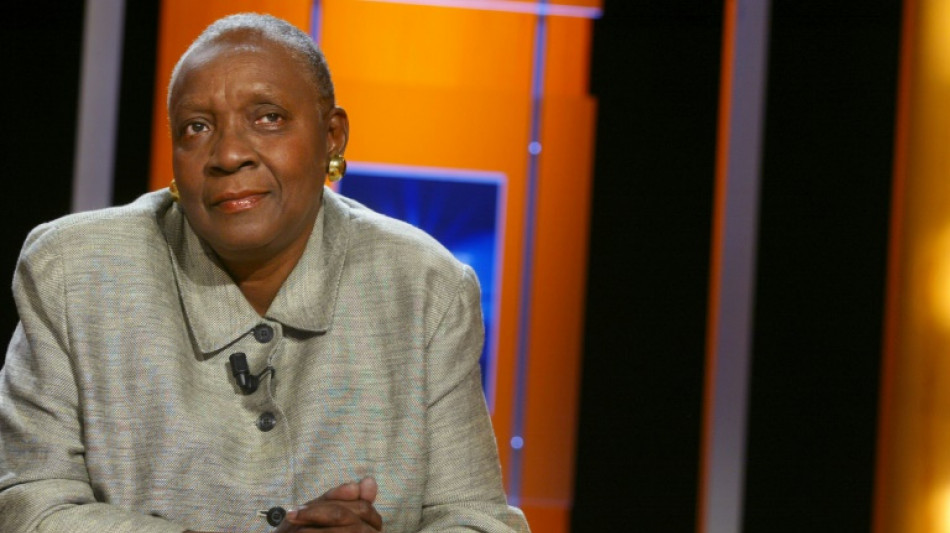
Maryse Conde: Daring storyteller who explored black identity / Photo: Martin BUREAU - AFP/File

 'I live in fear': 1.5 million Pakistani children sexually exploited online

 Cowboys beat Commanders, Vikings down Bears as star QBs injured
 Braves clinch division title as Red Sox reach MLB playoffs

 Bordeaux-Begles hammer Stade Francais despite Jalibert injury

 Milan and Juventus end blips with home wins

 Bridgeman wins PGA Biltmore title with sizzling 61

 Williams injured as Bears shut down by Vikings

 US warns of rapid escalation in Middle East war

 Germany's far-right AfD celebrates another state election win

 Russia vows revenge for election-day attacks as poll shows ruling party win

 Spaun late shows snatches PGA Championship win

 Conceicao strikes as Juventus beat Atalanta

 Britain, Zverev-inspired Germany, Spain complete Davis Cup finals

 Man Utd salvage Fulham draw as pressure mounts on Carrick

 Spanish civil war drama 'The Black Ball' wins at Toronto festival

 Germany's Merz shaken by far-right and far-left gains in state votes

 Macron welcomes Canada's Carney to French Atlantic territory

 Fiorentina frustrate Napoli with Serie A draw, Como upset

 Five-star Man City top Premier League after Sunderland thriller

 Ukrainian drones hit Moscow on last day of Russian elections

 Multi-Asset Trading Venue Monochrome Exchange Announces IEO of Its Native Token, $MCR

 South Korea break Japan hearts to win Asian Games basketball gold
 Acosta takes first victory at Austrian MotoGP

 PSG president Nasser al-Khelaifi under investigation in France for conflict of interest

 China swim sensation, 13, sets Games record after Japan win early

French writer Maryse Conde, who died on Tuesday at the age of 90, became one of the greatest chroniclers of the struggles and triumphs of the descendants of Africans taken as slaves to the Caribbean.
But the writer born in the Caribbean island of Guadeloupe did not pen her first book until she was nearly 40, and it triggered a controversy that saw authorities in several countries order the copies destroyed.
The mother of four, who once said she "did not have the confidence to present her writing to the outside world", was in her eighties before she won a major award, in 2018.
The New Academy Prize -- rushed into existence in Sweden when the Nobel Literature Prize was halted over a rape scandal -- praised how Conde "describes the ravages of colonialism and post-colonial chaos in a language which is both precise and overwhelming".
By then the francophone novelist, with close cropped grey hair, was confined to a wheelchair with a degenerative disease.
But she was delighted, saying in a video message that the Caribbean island of Guadeloupe, which is part of France, was normally "only mentioned when there are hurricanes or earthquakes".
- Called out African dictators -
As well as tackling racism, sexism and a multitude of black identities over 30 books, Conde was one of the first to call out the corruption of newly independent African states.
Her first book "Heremakhonon", which means "Waiting for Happiness" in the Malinke language of West Africa, caused a scandal in 1976 and three West African countries ordered the copies destroyed.
"In those days, the entire world was talking of the success of African socialism," she later wrote.
"I dared to say that... these countries were victims of dictators prepared to starve their populations."
She found popular and critical success with novels like "Segu" and "I, Tituba, Black Witch of Salem", but Conde still felt snubbed by the French literary establishment, never winning its top prizes.
There was belated recognition in 2020, when President Emmanuel Macron paid tribute to "the fights she has waged, and more than anything this kind of fever she carries within her," awarding her the Grand Cross of the National Order of Merit.
- Black awakening -
Conde's life was almost as eventful as one of her historical novels.
Born on February 11, 1934, as Maryse Boucolon, she grew up the youngest of eight children in a middle-class family in Guadeloupe, a French island in the Caribbean, and only became aware she was black when she left to go to an elite school in Paris when she was 19.
Growing up, she had not heard of slavery nor Africa, and her mother -- a schoolteacher -- banned the use of Creole at home.
Her literary imagination had been fired by Emily Bronte's "Wuthering Heights", which she later transplanted to the Caribbean in "Windward Heights".
In Paris her mind was opened to questions of identity when she met the Martinique writer and politician Aime Cesaire, one of the founders of the negritude literary movement that sought to reclaim black history and reject French colonial racism.
But unlike him, Conde was a passionate believer in independence from France.
"I understand that I am neither French nor European," she said in a 2011 documentary. "That I belong to another world and that I have to learn to tear up lies and discover the truth about my society and myself."
- Dramatic life -
Conde fell for a Haitian journalist, who left her when she got pregnant. Unmarried and with a small boy, she gave up on university.
Three years later she married Mamadou Conde, an actor from Guinea, and they moved to the west African country.
It fulfilled a need to explore her African roots, but life in the capital Conakry was tough. "Four children to feed and to protect in a city where there is nothing, it was not easy," she recalled.
Her marriage to Conde fell apart and she moved to Ghana and then Senegal, eventually marrying Richard Philcox, a British teacher who became her translator and, she would say, offered her the "calm and serenity" to become a writer.
She followed the scandal of "Heremakhonon", which centred on a Caribbean woman's disillusioned experience in Africa, with her "Segu" novels, set in the Bambara Empire of 19th-century Mali.
Then she published "I, Tituba, Black Witch of Salem" in 1986, about a slave who became one of the first women accused of witchcraft during the 1692 Salem witch trials in the United States.
That won her American acclaim, and Conde lived in New York for 20 years, founding the Center for Francophone Studies at Columbia University before moving to the south of France.
Her later works tended to be more autobiographical, including "Victoire: My Mother's Mother", about her grandmother who was a cook for a white Guadeloupean family.
A.Williams--AT