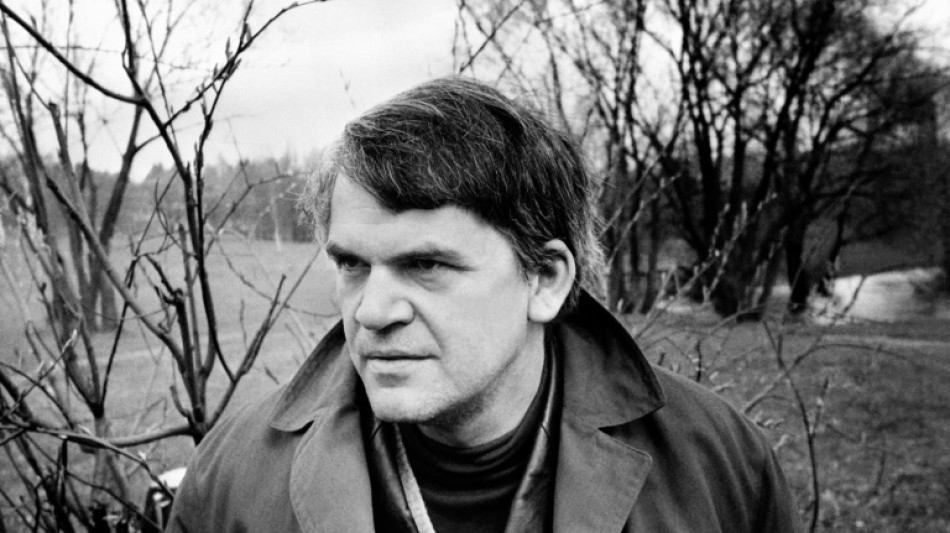
Satire and poetry: Milan Kundera took on life's absurdity / Photo: - - AFP/File

 Reusser retains world time-trial title

 Man City outgun Sunderland despite Brobbey hat-trick, Liverpool win at Bournemouth

 Top US, Chinese economic officials meet ahead of Trump-Xi summit

 Erdogan's LGBTQ crackdown 'first step of election campaign': activist

 Mass drone barrage on Moscow kills two

 82-year-old dies after beach fight in Greece over sun lounger
 US warns of rapid escalation in Mideast war

 Iran 'put hearts on the court' to win Asian Games basketball bronze

 School girl Yu helps China dominate in Asian Games swimming openers

 Myanmar win first Asian Games teqball gold as Spain great Puyol watches

 China's 13-year-old Yu scorches to first major gold at Asian Games
 Russians vote on last day of parliamentary elections

 Hong Kong pays final respects to former city leader Tung

 Typhoon put people off Asian Games opening ceremony, official says

 China's 13-year-old Yu cruises as Asian Games swimming begins

 AI 'warning shots' focus Beijing on national security risks

 Philippine tribe in limbo over US-led tech hub

 Leo XIV, first US pope transcends his restrained style

 Singer Ed Sheeran says Gaza situation 'unjustifiable' following controversy

 In 'Tenzing', a Sherpa mountaineer gets his due

 Gridko's New Live Drive PTO Roll-Off Trailer Wins the Heavy-Duty TRAILmakER Award 2026 at NATDA Awards

 Chile's Bachelet quits race to be next UN chief

 Raphinha treble fires perfect Barca to win at Sevilla

 Thiam makes winning heptathlon return at Decastar meet

 Czechs beat USA to qualify for Davis Cup finals

Milan Kundera, the author of "The Unbearable Lightness of Being" whose dark, provocative novels delved into the enigma of the human condition, has died, a spokeswoman for the Milan Kundera Library in his native city of Brno said on Wednesday. He was 94.
"Unfortunately I can confirm that Mr Milan Kundera passed away yesterday (Tuesday) after a prolonged illness," she told AFP.
Kundera died at his apartment in Paris, France, his adoptive country where he had lived since his emigration from Communist-ruled Czechoslovakia in 1975.
"Not only Czech literature, but world literature as well has lost one of the greatest contemporary writers, and one of the most translated writers too," Tomas Kubicek, director of the Kundera library, told the public Czech TV.
Czech Prime Minister Petr Fiala said Kundera was able to "appeal to whole generations of readers across all continents" with his work.
Kundera was frequently touted as a favourite to win the Nobel Prize for literature, but he never claimed the coveted honour.
Through his characteristic satire and poetic prose, Kundera had sought to express all that is compelling and absurd about life, drawing on his own experiences of being stripped of his Czech nationality for dissent.
Life, he said in his work of criticism "Art of the Novel" (1986), "is a trap we've always known: we are born without having asked to be, locked in a body we never chose, and destined to die."
- Young rebel -
Kundera was born on April 1, 1929, in the town of Brno, in what was then Czechoslovakia. His father was a famous pianist.
He studied in Prague, where he joined the Communist Party, translated the French poet Apollinaire and wrote poetry of his own.
He also taught at a film school where his students included the future Oscar-winning director Milos Forman.
Although he professed faithfulness to Communism, the independent spirit of Kundera's writing soon got him into trouble.
He was expelled from the party in 1950, re-joined in 1956 and was expelled a second time in 1970 after the Prague Spring reform movement -- in which he was seen as playing a role -- was crushed.
- Locked out -
Kundera's first novel "The Joke", a work of dark humour about the one-party state published in 1967, led to a ban on his writing in Czechoslovakia while also making him famous in his homeland.
In 1975, he and his wife Vera went into exile in France, where he worked for four years as an assistant professor at the University of Rennes. They were stripped of their Czech nationality in 1979.
In his adopted home, where he became a citizen in 1981, his reputation and success grew as translations of his novels appeared, such as "Life is Elsewhere" (1973) set in Czechoslovakia about a poet entrapped by the Communist regime.
"The Book of Laughter and Forgetting" (1979) playfully explored through seven interlinked narratives the nature of forgetting in politics, history and daily life.
The novel was "brilliant and original," said the New York Times in 1980, "written with a purity and wit that invite us directly in; it is also strange, with a strangeness that locks us out."
Kundera was an author "fascinated by sex, and prone to sudden, if graceful, skips into autobiography, abstract rumination, and recent Czech history," said the Times reviewer, John Updike.
By far his most famous work, "The Unbearable Lightness of Being" was published in 1984 and turned into a film starring Juliette Binoche and Daniel Day-Lewis in 1987.
The novel is a morality tale about freedom and passion, on both an individual and collective level, set against the Prague Spring and its aftermath in exile.
- No going back? -
Kundera's critics say he turned his back on fellow Czechs and dissidents following his exile in France and for his decision to ban the translation of his French books into Czech.
In 2008, a Czech magazine accused him of being a police informer under Communist rule, which he denied as "pure lies".
In 2013, Kundera published his first novel after a 13-year hiatus.
"The Festival of Insignificance", about five friends in Paris, received mixed reviews, with The Atlantic noting its "near-impenetrable irony" and The Guardian deeming it a "stinker".
What Kundera "has to tell us seems to have less relevance", said the New York Times. "You can’t help wondering what his evolution would have been like if he had stayed, or stayed longer, in Czechoslovakia."
In 2019, the Czech Republic restored his nationality and in 2023 the Milan Kundera Library opened in his hometown of Brno.
W.Stewart--AT