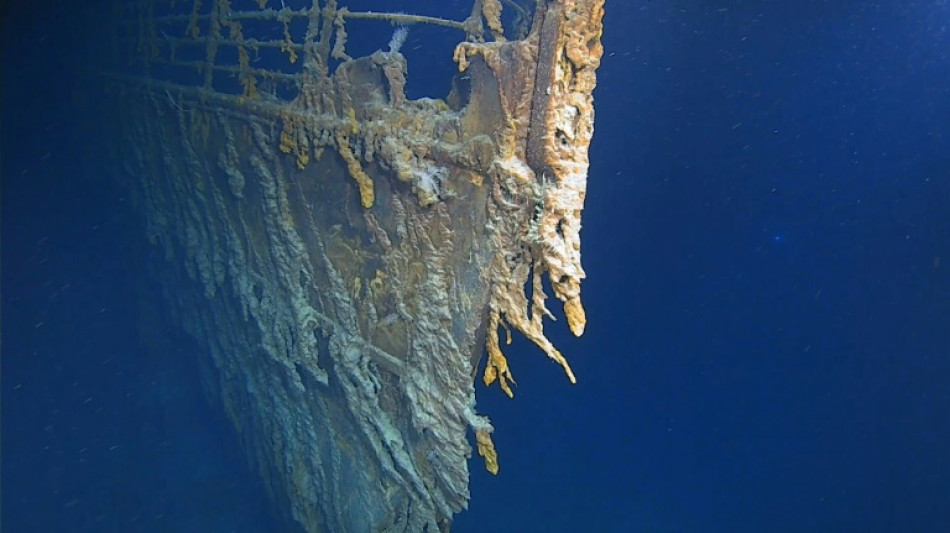
The ship sank. Or did it? Titanic misinformation swirls / Photo: HO - Atlantic Productions/AFP

 South Korea break Japan hearts to win Asian Games basketball gold
 Acosta takes first victory at Austrian MotoGP

 PSG president Nasser al-Khelaifi under investigation in France for conflict of interest

 China swim sensation, 13, sets Games record after Japan win early

 Drones hit Moscow as Russians go to the polls

 New England boss Fleming says 'wrong' to ask Stokes to end retirement

 Germans vote in elections threatening fresh blow to Merz

 US fears rapid escalation in Mideast after Houthis attack Riyadh

 Japan triathlete Hojo wins first gold of Asian Games

 IOC president impressed by 'beautiful' Asian Games wooden huts

 First Asian Games gold goes to Japan as China's 13-year-old Yu lights up pool

 Data centre command hub keeps AI up and running

 Pope Leo in France: the issues on the table

 Packing for a pope: behind the scenes on foreign trips
 Republicans find transgender issues a powerful political weapon in midterm campaigning

 German state elections threaten new shock waves for Merz

 Ed Sheeran set to return to stage after Palestinian controversy

 Toulouse edge Vannes, Lyon beat Pau to take Top 14 summit

 Germans arrested for Louvre stunt in Mona Lisa hall

 Saudi-led coalition says Houthis fired ballistic missile at Riyadh

 France's debt climbs to highest since 1978: ministry

 McIlroy two shots off the lead at Wentworth after eagle on 18
 Martinez brace saves Inter in Serie A top-two clash with Roma

 Rosenior abused but guides Paris FC past old club Strasbourg

 Seven-try Lyon beat Pau, climb to Top 14 summit

The Titanic inspired a tear-jerking blockbuster and expeditions to its watery gravesite -- including a fatal one this week -- but viral TikTok videos peddle a stunning conspiracy theory: the ship never sank.
More than a century after it went down in the North Atlantic Ocean, wild myths and urban legends about the luxury liner have continued to swirl, including that it was doomed by the curse of a mummified Egyptian priestess.
Even more striking are a wave of TikTok videos asserting that the Titanic did not sink at all. Many of them have racked up millions of views -- never mind that the claim fails to hold water.
"The Titanic never truly went under," said a video by a TikTok user called "The Deep Dive," which garnered more than four million views.
"Everyone is familiar with the tale of the unstoppable ship that perished after colliding with an iceberg, but perhaps that isn't the case."
The video opens with a dramatic portrait of the Titanic, its stern crashing against stormy waves, as an imperious male voice goes on to claim that it was swapped with its sister ship –- the Olympic.
He alluded to an oft-repeated conspiracy theory that the company that built the Titanic purposely sank the Olympic, another one of its ships, as part of an elaborate insurance fraud.
A similar TikTok video claiming "the Titanic never sank" garnered 11 million views. The video was removed earlier this year in what appeared to be a rare intervention after it was widely reported by the US media.
- Historical falsehoods -
TikTok's algorithm and engagement-based recommendation system, which creates personal feeds for users based on their preferences, makes it a powerful platform to propagate conspiracy theories, experts say.
"This makes it easier for this type of content to spread," Megan Brown, a senior research scientist at New York University's Center for Social Media and Politics, told AFP.
"The other factor that makes it easier for historical conspiracy theories to spread over other types of conspiracy theories or misinformation is that it's typically not moderated content."
While the platform says it removes posts that cross its threshold of "significant harm" –- such as violence or harassment –- other seemingly benign content laced with falsehoods remains untouched.
That approach, researchers say, underscores a key dilemma facing social media platforms: How to tackle an explosion of misinformation without giving users the impression that they are restricting free speech?
That gap in policy has given rise to a breed of users who flourish on the back of disproven conspiracy theories that generate strong engagement, such as the Earth is flat and the 1969 Moon landing was a hoax.
- 'Sad part' -
That also includes TikTok's Titanic influencers -- focused on the vessel that sank in 1912 during its maiden voyage from England to New York after hitting an iceberg.
The proliferation of Titanic conspiracy theories on the popular platform may appear benign compared to other falsehoods that result in real-world harm, but historians say it remains vital to debunk them.
They worry conspiracy theories will affect how a generation of young people –- who often rely on platforms such as TikTok as a primary source of information -- learn about the tragedy.
"The sad part is that many of the people following this sort of thing are teenagers," said Charles A. Haas, founder of the Titanic International Society, which is dedicated to research about the ill-fated ship.
"They are woefully unwilling to do digging," Haas told the New York Times.
TikTok influencers and celebrities are increasingly taking over from journalists as the main source of news for young people, according to a report published this month by the Britain-based Reuters Institute.
The report found that 55 percent of TikTok and Snapchat users and 52 percent of Instagram users get their news from "personalities" -- compared to 33-42 percent who get it from mainstream media and journalists on those platforms.
That was reflected in how millions of young users turned to TikTok this week for updates on the five people aboard a tourist submersible that vanished in the North Atlantic Ocean on their way to visit Titanic's seabed wreckage, on a $250,000 ticket.
All five died after the craft suffered what the US Coast Guard said was a "catastrophic implosion" in the ocean depths.
"What if this all is a cover up?" asked a young TikTok user, referring to wall-to-wall news coverage about the submersible.
"Is there something behind the scenes that we're not seeing?" he added, peddling another unfounded conspiracy in a video that racked up over 4.2 million views.
O.Ortiz--AT