Chewed for millennia, coca leaf gets flavorsome makeover in Bolivia / Photo: RODRIGO URZAGASTI - AFP

 PSG president Nasser al-Khelaifi under investigation in France for conflict of interest

 China swim sensation, 13, sets Games record after Japan win early

 Drones hit Moscow as Russians go to the polls

 New England boss Fleming says 'wrong' to ask Stokes to end retirement

 Germans vote in elections threatening fresh blow to Merz

 US fears rapid escalation in Mideast after Houthis attack Riyadh

 Japan triathlete Hojo wins first gold of Asian Games

 IOC president impressed by 'beautiful' Asian Games wooden huts

 First Asian Games gold goes to Japan as China's 13-year-old Yu lights up pool

 Data centre command hub keeps AI up and running

 Pope Leo in France: the issues on the table

 Packing for a pope: behind the scenes on foreign trips

 Republicans find transgender issues a powerful political weapon in midterm campaigning

 German state elections threaten new shock waves for Merz

 Chile's Bachelet quits race to be next UN chief

 Raphinha treble fires perfect Barca to win at Sevilla

 Thiam makes winning heptathlon return at Decastar meet

 Czechs beat USA to qualify for Davis Cup finals

 Dortmund sink Stuttgart to climb to Bundesliga summit

 Trump says will not tolerate attempts to slow AI growth

 'It has to stop': runners protest women's murders in S.Africa district

 Fire erupts near Riyadh airport as Houthis claim strikes

 Cuba works to restore power after another blackout

 England thrash Sri Lanka again to return to top of T20 rankings

 Arsenal thrashed by Brighton, sorry Spurs lose again

Bitter and tough, the coca leaf chewed throughout the South American Andes for thousands of years as a natural pick-me-up has been getting an appetizing makeover in Bolivia.
Traditionally sold as untreated, chopped leaves, several small businesses are now bruising the foliage to make it softer, and adding flavors such as strawberry, mango or coffee.
What started as an experiment about a decade ago has really taken off, especially in Bolivia's economic capital of Santa Cruz -- a city of 3.4 million people.
"The flavoring is like adding seasoning to food. Normally flavors such as bubblegum, banana are used, and it adds a special something," consumer Isaac Salazar, 21, told AFP.
"They come already crushed, soft, with a savory or sweet flavor added, which makes it perfect for passing the time."
The practice of chewing coca has its own verb in Bolivia's Indigenous Aymara language: "pijcheo." It means to masticate the leaves, like chewing gum, without swallowing.
The leaf -- from the same plant that cocaine is manufactured from -- has been ascribed with the wide-ranging properties of quelling hunger, inhibiting stress and imparting an energy boost.
Coca is also consumed in infusions, and in some countries it is included in flour used to make special breads and cakes.
- Bruised coca -
The work of transforming the fibrous leaf into a more easily chewable product is laborious.
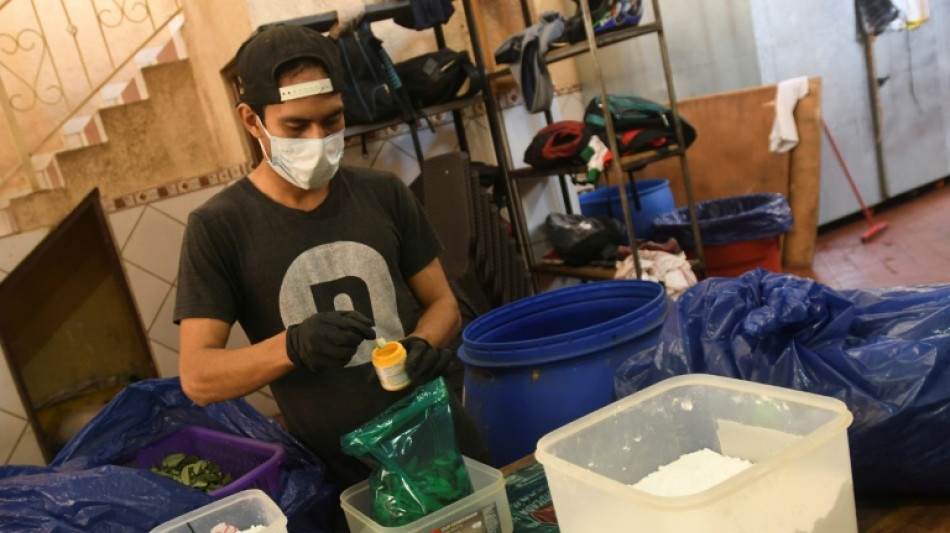
At the El Dogor factory and store run by 23-year-old Luis Vasquez in Santa Cruz, about 20 workers share the tasks of removing the hard stems, placing what is left of the foliage into plastic bags, adding flavorings, and pounding away with a mallet.
The flattened end product, labeled Machucada (bruised) Coca El Dogor is placed in the fridge, and sold for $4.30 per unit of four ounces (about 113 grams).
The shop does a brisk business.
"We have a variety of coca leaf products, including fruit-flavored leaves and any other flavor a customer may ask for," said Vasquez.
More and more, clients "prefer it mixed with a flavoring," he said.
Consumer Gary Soleto, 45, said the traditional way of consuming unadulterated coca leaf will never disappear.
"But we change and we have taken on new habits... to continue consuming and tasting new flavors," he said.
Official data show that one in three people in a country of 12 million -- almost a third of them Indigenous -- chew coca or use it for medicinal and ritual purposes.
In 2021, there were 30,500 hectares (75,000 acres) of coca plantations in Bolivia, according to a UN estimate -- up four percent from 2020.
Potential coca leaf production was estimated at 44,900 to 56,200 metric tons with an estimated value of $352 million to $431 million, according to a report by the UN Office on Drugs and Crime.
The Bolivian state authorizes the cultivation of a maximum of 22,000 hectares.
In recent years, there have been clashes between coca leaf producers and police in Bolivia in a dispute over control of commercialization of the plant.
A.Moore--AT