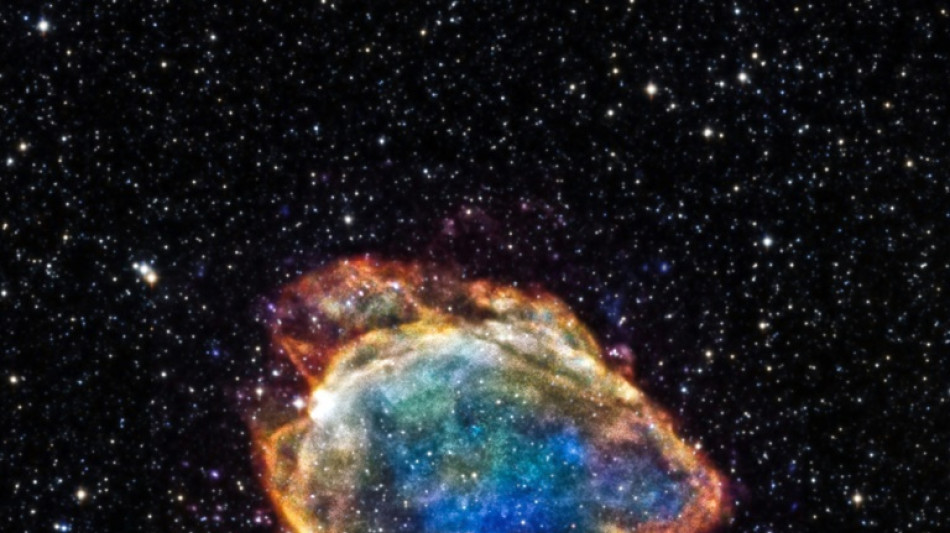
Record measurement of universe suggests 'something is fishy' / Photo: Handout - NASA/AFP

 Coughlin captures third LPGA title at Aramco Championship

 Mystique of the green jacket endures as Masters looms

 Trump makes stark threat to Iran after US airman rescued

 Israel renews Lebanon strikes, forces Syria border crossing closed

 Brown, Tatum propel Celtics in win over Raptors

 Major sponsors drop Kanye West London gigs as PM voices concern

 Trump makes foul-mouthed threat to Iran after US airman rescued

 Inter thump Roma to extend Serie A lead to nine points

 Leeds beat West Ham in shoot-out to reach FA Cup semis for first time in 39 years

 David six-hitting spree powers Bengaluru to IPL win

 UK police arrest protesters near base used by US

 Alcaraz plans to play full clay-court season, get 'socks dirty'

 Artemis astronauts begin fifth day on historic Moon mission

 Trump draws criticism with fiery Easter message on Iran

 British PM slams London event for booking Kanye West, sponsor quits

 Trump threatens 'hell' for Iran over Strait of Hormuz

 What we know about the race to rescue downed US airman in Iran

 Liberated McIlroy eyes more Masters magic after career Slam

 British PM slams London festival for booking Kanye West

 British royals attend Easter service without Andrew

 Revellers parade giant penises to dash stigma in Japan's fertility festival

 Middle East war hits Britain's fish and chip shops
 Second US airman downed over Iran 'SAFE and SOUND': Trump

 Pharmaceutical logistics in demand as war rattles supply chains

 Afghan mother seeks justice after Pakistani bombing kills hundreds

The most precise measurements ever made of the universe's composition and how fast it is expanding suggest "something is fishy" in our understanding of the cosmos, the astrophysicist who led the research said Wednesday.
The comprehensive new study published in The Astrophysical Journal further confirmed that there is a significant discrepancy between two different ways to estimate the speed at which the universe is expanding.
The study said that around five percent of the universe is made up of what we might think of as normal matter, while the rest is dark matter and dark energy -- both of which remain shrouded in mystery.
Dark energy, a hypothetical force causing the universe to expand at an ever-increasing rate, makes up 66.2 percent of the cosmos, according to the study published in The Astrophysical Journal.
The remaining 33.8 percent is a combination of matter and dark matter, which is also unknown but may consist of some as-yet-undiscovered subatomic particle.
To arrive at the most precise limits yet put on what our universe is made up of, an international team of researchers observed exploding stars called supernovae.
They analysed the light from 1,550 different supernovae, ranging from close to home to more than 10 billion lights year away, back when the universe was a quarter of its current age.
"We can compare them and see how the universe is behaving and evolving over time," said Dillon Brout of the Harvard–Smithsonian Center for Astrophysics and lead author of the study, called Pantheon+.
- Two decades of analysis -
The study updated the data from the Pantheon project a couple of years ago, stamping out possible problems and nailing down more precise calculations.
"This latest Pantheon+ analysis is a culmination of more than two decades' worth of diligent efforts by observers and theorists worldwide in deciphering the essence of the cosmos," US astrophysicist Adam Reiss, 2011's physics Nobel winner, said in a statement.
It was by observing supernovae back in the late 1990s that Reiss and other scientists discovered the universe was not only expanding but also doing so at an increasing rate, meaning galaxies are racing away from each other.
"It was like if you threw a ball up, and instead of the ball coming down, it shot up and kept accelerating," Brout said of the surprise of that discovery.
Pantheon+ also pooled data with the SH0ES supernova collaboration to find what is believed to be the most accurate measurement for how rapidly the universe is expanding.
They estimated the universe is currently expanding 73.4 kilometres a second every megaparsec, or 3.26 million light years. That works out to be around 255,000 kilometres (160,000 miles) per hour, according to a Harvard-Smithsonian statement.
But there's a problem.
- The Hubble tension -
Measuring cosmic microwave background radiation, which can look much farther back in time to around 300,000 years after the Big Bang, suggests the universe is expanding at a significantly slower rate -- around 67 kilometres per megaparsec.
This discrepancy has been called the Hubble tension, after US astronomer Edwin Hubble.
The Pantheon+ results have raised the certainty of the Hubble tension above what is known as the five sigma threshold, which means the discrepancy "can no longer be attributed to luck", Brout said.
"It certainly indicates that potentially something is fishy with our understanding of the universe," Brout told AFP.
Some possible, unverified theories for the discrepancy could include another kind of dark energy in the very early universe, primordial magnetic fields, or even that the Milky Way sits in a cosmic void, potentially slowing it down.
But for now, Brout said that "we, as scientists thrive on not understanding everything.
"There's still potentially a major revolution in our understanding, coming potentially in our lifetimes," he added.
S.Jackson--AT