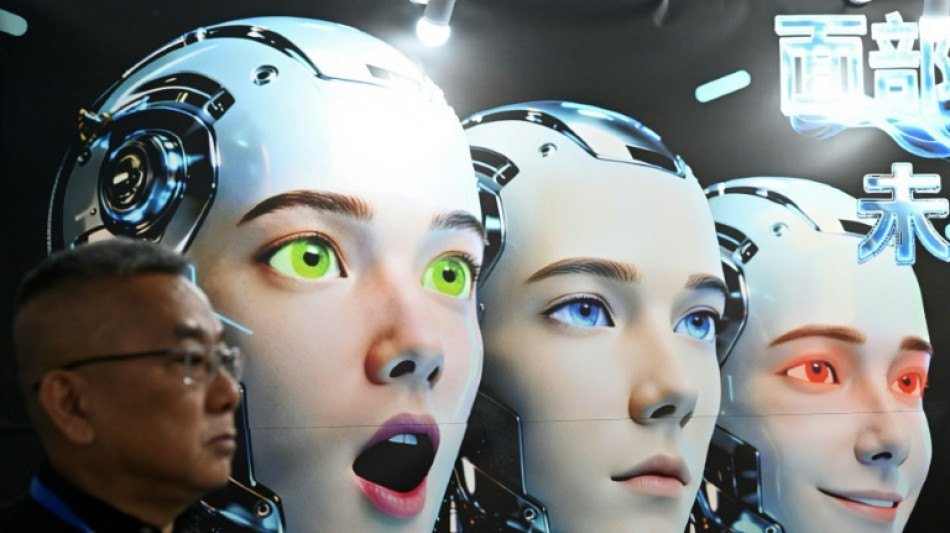
Doomsday tech: could AI really kill us all? / Photo: ADEK BERRY - AFP

 Monaco Startup Monamedia Launches App Paying Users to Watch Ads
 НЕМЕЦКАЯ ALIX LASERS БЕРЁТ НА ОБСЛУЖИВАНИЕ ВСЕХ КЛИЕНТОВ АВСТРИЙСКОЙ ALIX LASERS

 ALIX LASERS GERMANY TAKES OVER CUSTOMER CARE FOR ALL ALIX LASERS AUSTRIA CUSTOMERS

 Miss Universe 2026: Viewing Guide for South African Fans

 Fortun Holdings Completes Fiscal 2025 Audit and Files Audited Annual Financial Statements

 Bound to Bloom Behavioral Institute Announces Complimentary Evening for Parents via Zoom on December 2 at 8:00 p.m. EST

 Si-Ware Systems Partners with UT Austin's HCRL to Develop Superhuman Senses for Robots

 Spinnova Starts Production Runs at Eteläportti Demo Factory

 SMX is Giving Artificial Intelligence an Industrial Revolution of Its Own
 Modular Medical To Expand Pivot Commercial Launch Strategy from Five to 15 U.S. Markets in 2027

 Jaguar Health Family Company Napo Pharmaceuticals Successfully Completes Manufacture of Process Validation Batches of Lyophilized Crofelemer Formulation, a Critical Component of its Planned FDA Submission of a New Drug Application (NDA) for MVID in Mid-2027

 U.S. Manufacturer Worksport (NASDAQ: WKSP) Signs Largest Distribution Agreement to Date With The AAM Group, Gaining Access to AAM's North American Truck Accessory Network of About 11,500 Jobber Locations and 60+ Distribution Centers for its Flagship NEXUS and HD3 Product Lines
 Tigerless Health Launches Lara, the Enterprise AI Agent Born from Regulated Insurance Operations

 HippoFi Announces $1 Million Non-Dilutive Line of Credit to Support Commercialization and Growth

 Eagle Plains Announces Letter of Intent with Kestrel Gold for Option of the MPW Project, British Columbia
 EON Resources Inc. Reports Third Quarter 2026 Results; Drilling to Drive Growth through This Decade

 InterContinental Hotels Group PLC Announces Transaction in Own Shares - November 24

 INEO to Release First Quarter Fiscal 2027 Financial Results on November 30
 TGI Group Publishes Research Report on Global Water Bankruptcy and Groundwater Contamination in Mexico's Yucatán Peninsula

 Ice Cream Cake Strain Guide Clarifies Conflicting Genetics and Historical THC Data
 "Self-Directed Gold IRA: Is It A Good Investment?" Guide Released for American Consumers
 CTT Pharmaceutical Holdings Signs 12-Part New to The Street Series, Including Earned Media, TV Commercials, Outdoor Billboards and Accredited Investor Events
 FatPipe (NASDAQ: FATN) Awarded Statewide Arizona Government Procurement Contract for Firewall and Security Solutions

 BNK Invest Explains What Investors Can Learn From Quarterly 13F Holdings Reports
 Aegis Capital Corp. Announces the Hiring of a New Senior Vice President of Investments

Stark warnings from artificial intelligence researchers that advanced forms of the technology could wipe out humanity have raised questions over whether governments are moving fast enough to regulate it.
What are the potential dangers of "superintelligent" computer systems, and should we be worried?
- What's the worst-case scenario? -
AI experts have long described the threat as critical.
In 2023, hundreds of AI scientists and industry figures, including the heads of top US labs, signed a "statement on AI extinction risk" calling for the issue to be treated as seriously as pandemics or nuclear war.
If an out-of-control future AI deems that humans are obstructing its goals, it could use robots to "synthesise and spread novel pathogens", said Stuart Russell, computer science professor at the University of California, Berkeley.
Or it could "convince people to initiate nuclear war, including by hacking into early warning systems", Russell, a prominent voice on AI safety, told AFP.
Such existential fears do not concern current AI systems, he stressed. But as the technology improves it could take lethal action beyond our understanding, such as by removing oxygen from the atmosphere.
"We are less intelligent than superintelligent AI. If you ask chimpanzees how humans could wipe them out, they probably wouldn't be able to give you all the right answers."
In the meantime, "in the next year or two I think the risk is higher from human misuse," Russell added -- such as an AI-enabled terror attack.
- Why don't AI labs stop? -
"The stakes are well-understood," Jacob Coxon, a 27-year-old researcher, wrote on X this week, announcing his resignation from US AI startup Anthropic.
"But they are locked in a race to get there first," he added, saying that Anthropic "believe no one else will act responsibly, so they must do it themselves".
Anthropic this year removed a pledge from its safety charter to halt development of its models if it failed to control their risks.
It argued that if it unilaterally paused its work, its less cautious rivals would dominate the industry, making it less safe overall.
"The people building AI earnestly believe that it could kill us all by the end of the decade," said Coxon, who previously worked at ChatGPT maker OpenAI.
He accused both companies of "gambling with our lives" as they strive to develop AI models capable of self-improvement.
Fears are heightened over rogue AI after OpenAI technology operating outside human supervision hacked into Hugging Face, a repository of AI models.
"We really do earnestly believe AI could kill all humans!" Anthropic safety executive Evan Hubinger chimed in on X, estimating the risk at more than 10 percent over the next decade.
- What's the hype factor? -
It's important to remember that doom-laden percentage predictions are "absolutely unscientific", said Hussein Abbass, a computing professor at UNSW Canberra.
"The situation is still controllable, and it can be managed," Abbass told AFP.
But governments should not sit on their hands when it comes to regulating AI, he added, urging an "agile" approach as AI development accelerates.
Both Anthropic and OpenAI are expected to go public soon, and some sceptics say scary warnings make AI appear powerful and worthy of large investments.
Others argue that focusing on the risk of extinction distracts from more pressing problems caused by AI, from job losses to machines discriminating against minorities.
In July, more than 1,000 tech employees, including Anthropic's CEO, called on Washington to support a coordinated slowdown in the development of the most advanced AI systems.
OpenAI halted training of its latest models for two weeks in August before resuming it under tighter controls.
- What will it take to regulate? -
So far the United States has been firmly against global regulation of the sector that could stifle innovation.
But the unprecedented hacking capabilities of the most cutting-edge models have given Washington pause, with recent Anthropic and OpenAI releases delayed over national security concerns.
Even then, "we don't want to restrict them where all of a sudden we come in second to China", President Donald Trump has said.
"Maybe it will take a massive, Chernobyl-scale disaster to get governments to act," Russell said, urging them to establish a licensing regime for AI, as exists with aviation, medicine or water supply.
"Perhaps at some point governments will remember that their voters prefer not to be dead," he added.
burs-kaf/lga
N.Mitchell--AT
