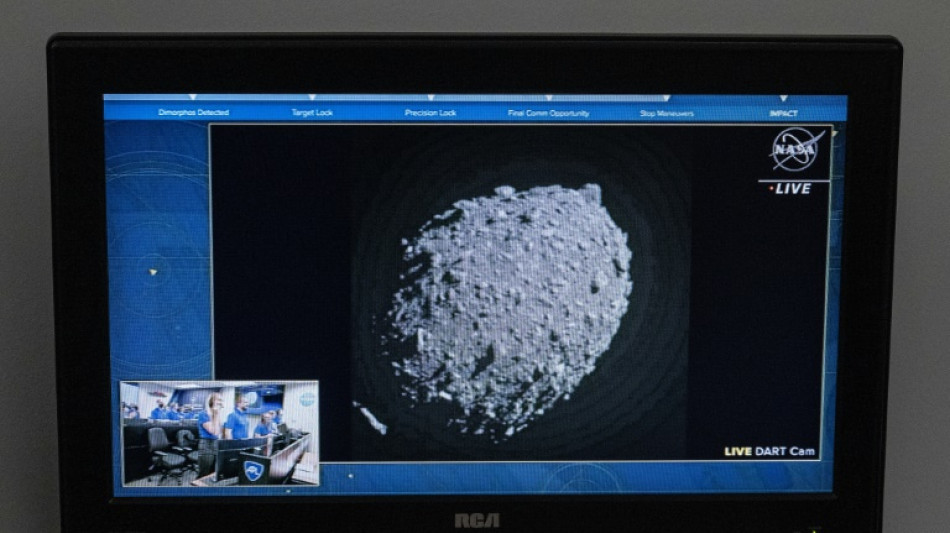
'A new era': NASA strikes asteroid in key test of planetary defense / Photo: Jim WATSON - AFP

 Nepal flood death toll rises as rescuers scour tunnels

 France's Mistral sees value soar with 3 bn euro cash infusion

 Nepal glacier saw exceptional heat before collapse caused deadly floods: researcher

 Ethiopia boosts drone production to fight rebels

 Yemen rebels hit Saudi Arabia with wave of strikes, wounding 73

 Nepalis mark a year since deadly protests that toppled government

 Rubio launches Latin America tour to cement US influence

 France tries 14 over deadliest Channel migrant crossing disaster

 Australia threatens hefty fines if big tech fails 'duty of care'
 Zverev romps into quarter-finals as Darderi downed

 Kauai on tornado watch as Hurricane Lowell nears Hawaiian islands

 Pakistan roll the dice in search of consolation win over England

 Yen extends gains as traders eye rate hike, tech rallies again

 'The ber months': Christmas arrives early in the Philippines

 N. Korea calls Russia bridge a sign of tighter ties

 US sanctions threaten to crush Iranian students' dreams

 Former champ Gauff holds off Jovic to reach US Open quarter-finals

 Battery X Metals to Appoint Accomplished Technology and Consumer Brands Executive Nicholas Reichenbach to Board of Directors
 Equitech-Bio Expands Reagent Portfolio with New IgG Offering and Publication-Backed Product Validation from Bioz

 CPG Life Fund I Launches $20 Million Operator-Led CPG Fund
 Who is the Best Female Cosmetic Surgeon in Florida?

 CANEX Metals Announces C$6.5 Million Strategic Financing Led By C$3 Million Investment by Eric Fier

 Helio Sets September Roadshow Across Austin, Houston, Phoenix, Scottsdale
 Gaming Realms PLC Announces Interim Results

 Universal Edge Technologies Establishes Senior Advisory Committee, Names Mark Powell and Mark P. Mills as Founding Members
NASA's DART spaceship on Monday struck the asteroid Dimorphos in a historic test of humanity's ability to prevent a cosmic object from devastating life on Earth.
Impact occurred at 7:14 pm Eastern Time (2314 GMT), 10 months after the Double Asteroid Redirection Test probe blasted off from California to carry out its first-of-a-kind experiment.
"We're embarking on a new era, an era in which we potentially have the capability to protect ourselves from something like a dangerous hazardous asteroid impact," said Lori Glaze, director of NASA's planetary science division.
The 530-foot (160-meter) asteroid Dimorphos -- roughly comparable to an Egyptian pyramid -- which orbits a big brother called Didymos, first appeared as a speck of light around an hour before the collision.
Its bread bun shape and rocky surface finally came into clear view in the last few minutes as DART raced toward it at roughly 14,500 miles (23,500 kilometers) per hour.
To be sure, the pair of asteroids pose no threat to our planet as they loop the Sun, passing about seven million miles from Earth at their current "minimized" position.
But NASA has deemed the experiment important to carry out before an actual need is discovered.
By striking Dimorphos head on, NASA hopes to push it into a smaller orbit, shaving 10 minutes off the time it takes to encircle Didymos, which is currently 11 hours and 55 minutes -- a change that will be detected by ground telescopes in the days or weeks to come.
The proof-of-concept experiment will make a reality of what has before only been attempted in science fiction -- notably in films such as "Armageddon" and "Don't Look Up."
- Technically challenging -
Minutes after impact, a toaster-sized satellite called LICIACube, which already separated from DART a few weeks ago, was expected to make a close pass of the site to capture images of the collision and the ejecta -- the pulverized rock thrown off by the strike.
LICIACube's pictures will be sent back in the next weeks and months.
Also watching the event: an array of telescopes, both on Earth and in space -- including the recently operational James Webb -- which might be able to see a brightening cloud of dust.
The mission has set the global astronomy community abuzz, with more than three dozen ground telescopes participating, including optical, radio and radar.
"There's a lot of them, and it's incredibly exciting to have lost count," said DART mission planetary astronomer Christina Thomas.
Finally, a full picture of what the system looks like will be revealed when a European Space Agency mission four years down the line called Hera arrives to survey Dimorphos' surface and measure its mass, which scientists can currently only guess at.
- Being prepared -
Very few of the billions of asteroids and comets in our solar system are considered potentially hazardous to our planet, and none are expected in the next hundred years or so.
But wait long enough, and it will happen.
We know that from the geological record -- for example, the six-mile wide Chicxulub asteroid struck Earth 66 million years ago, plunging the world into a long winter that led to the mass extinction of the dinosaurs along with 75 percent of all species.
An asteroid the size of Dimorphos, by contrast, would only cause a regional impact, such as devastating a city, albeit with greater force than any nuclear bomb in history.
How much momentum DART imparts on Dimorphos will depend on whether the asteroid is solid rock, or more like a "rubbish pile" of boulders bound by mutual gravity -- a property that's not yet known.
If it had missed, NASA would have another shot in two years' time, with the spaceship containing just enough fuel for another pass.
But its success marks the first step towards a world capable of defending itself from a future existential threat.
N.Mitchell--AT