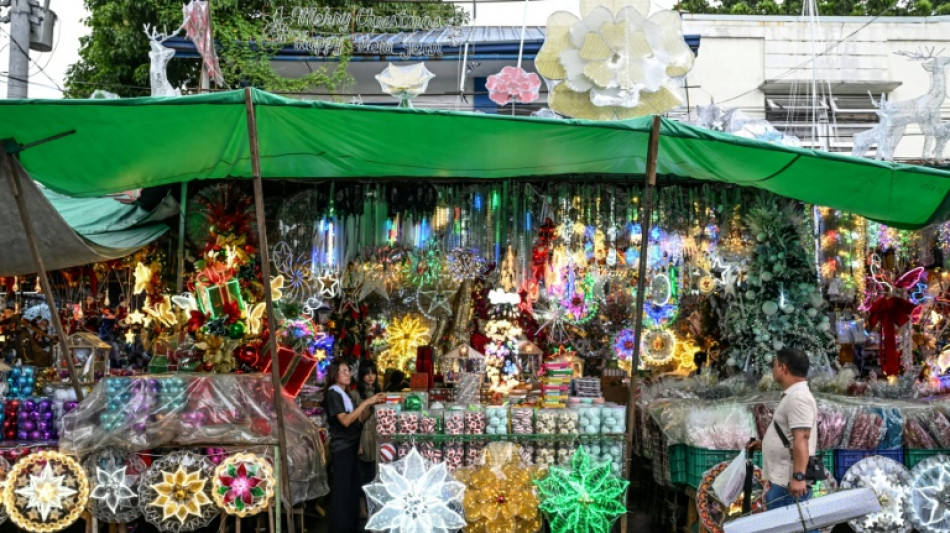
'The ber months': Christmas arrives early in the Philippines / Photo: Jam STA ROSA, Jam STA ROSA - AFP

 Zach Hickerson Recounts Hayden Panettiere's Final Moments in New Interview

 Luxembourg Housing Petition Passes Threshold for Parliamentary Consideration

 Raheem Sterling Receives Suspended Sentence After Lamborghini Crash

 Audience to Choose the Set List at Luxembourg's First FAMIL Jukebox Night

 Luxembourg Pay Rise Delayed as Regional and World Headlines Develop

 Chennai Urbanist Sashna Develops 'Anniki' Card Game to Gamify Tamil Nadu History

 Transport Minister Defends Land Seizure Powers for Toronto-Quebec City High-Speed Rail

 UAE Weather Forecast: Scattered Showers and Fog Expected as Temperatures Drop
At a city block-sized market in the Philippine capital, a platoon of plastic Santa Claus figures parachute from the ceiling of a shop already stacked high with Christmas decor despite the holiday being fully four months away.
The site is a familiar one in the Philippines, where September 1 means radio stations playing Christmas carols, homeowners putting up lights, and the country's giant shopping malls unleashing their most impressive displays.
Welcome to the "ber months" -- September, October, November, December -- a months-long countdown to the most anticipated holiday on the calendar in the deeply Catholic country.
"We can smell it coming," sales clerk Cora Lansangan, 73, said during an AFP visit to a Christmas shop that began stacking its shelves on July 31.
The store was already packed with shoppers buzzing around displays of Christmas trees, ornaments, plastic reindeer, mangers and festive lanterns during a recent AFP visit.
"Even though life is hard, the mere sight of a Christmas tree brings us relief," Manila real estate agent Kathlene Santidad, 33, told AFP as she hunted for tinsel and baubles for her own tree, armed with a 10,000-peso ($160) budget.
She said she shopped for decorations early because "I hate crowds" and wanted to take her time picking specific items from shops crammed with everything from tiny 300-peso tinsel to an 8,000-peso Christmas tree.
Coming towards the end of a rainy season typically marred by destructive typhoons and floods, the Christmas countdown is a marker of better things ahead, Mark Godwin Villareal, a sociologist at Manila's University of Santo Tomas, told AFP.
"It provides a kind of continuity and stability in our social life despite these economic, political, or even personal challenges that we are facing as a community or society," he said.
The "ber months" had a rhythm, Villareal continued. September was for decorating, while October was time to start saving money for gifts and food for reunions with friends and relatives and the all-important midnight meal on Christmas Eve.
More than 100,000 of the country's crucial overseas workforce, dubbed OFWs (overseas Filipino workers), can typically be counted on to rush home in time for the main event.
- 'Belonging, hope and joy' -
The extended season drives foot traffic and sales for the country's giant shopping malls, many of which AFP journalists saw were already heavily decked out.
"For Filipinos, Christmas symbolises belonging, faith, hope and joy," said Christian Mathay, senior assistant vice president for SM Supermalls, a chain of 90 shopping malls that began setting up Christmas ornaments in August.
"Starting early gives shoppers more time to enjoy that experience."
In Pampanga province, north of Manila, weeks of flooding that stranded thousands of commuters failed to dampen the enthusiasm of manufacturers of star-shaped holiday lanterns known as "parol", the single must-have Christmas decoration in a Filipino home.
"Water seeped into the showroom, so we had to clean up instead of working... the thing with lanterns is, they're waterproof," fifth-generation lantern-maker Angelica David, 26, told AFP.
"We all need to recover from the floods. After that, people should start buying lanterns," she said.
The decorations will only come down -- if at all -- on January 6, marked in the Philippines as the day when the three magi brought gifts for the infant Jesus.
School superintendent Ricky Angeles, on a Christmas shopping trip to Manila, told AFP he preferred to leave his lantern hanging all year round in a window of his home in the northern city of Cabanatuan, along with blinking strings of lights in his garden.
"We need a lengthy display period" to justify their cost, the 51-year-old told AFP with a smile.
Then he ducked into a store to buy some more.
P.Hernandez--AT


