Direct impact or nuclear weapons? How to save Earth from an asteroid / Photo: Sophie RAMIS - AFP

 Nepal flood death toll rises as rescuers scour tunnels

 France's Mistral sees value soar with 3 bn euro cash infusion

 Nepal glacier saw exceptional heat before collapse caused deadly floods: researcher

 Ethiopia boosts drone production to fight rebels

 Yemen rebels hit Saudi Arabia with wave of strikes, wounding 73

 Nepalis mark a year since deadly protests that toppled government

 Rubio launches Latin America tour to cement US influence

 France tries 14 over deadliest Channel migrant crossing disaster

 Australia threatens hefty fines if big tech fails 'duty of care'
 Zverev romps into quarter-finals as Darderi downed

 Kauai on tornado watch as Hurricane Lowell nears Hawaiian islands

 Pakistan roll the dice in search of consolation win over England

 Yen extends gains as traders eye rate hike, tech rallies again

 'The ber months': Christmas arrives early in the Philippines

 N. Korea calls Russia bridge a sign of tighter ties

 US sanctions threaten to crush Iranian students' dreams

 Former champ Gauff holds off Jovic to reach US Open quarter-finals

 Battery X Metals to Appoint Accomplished Technology and Consumer Brands Executive Nicholas Reichenbach to Board of Directors
 Equitech-Bio Expands Reagent Portfolio with New IgG Offering and Publication-Backed Product Validation from Bioz

 CPG Life Fund I Launches $20 Million Operator-Led CPG Fund

 Who is the Best Female Cosmetic Surgeon in Florida?

 CANEX Metals Announces C$6.5 Million Strategic Financing Led By C$3 Million Investment by Eric Fier

 Helio Sets September Roadshow Across Austin, Houston, Phoenix, Scottsdale
 Gaming Realms PLC Announces Interim Results

 Universal Edge Technologies Establishes Senior Advisory Committee, Names Mark Powell and Mark P. Mills as Founding Members
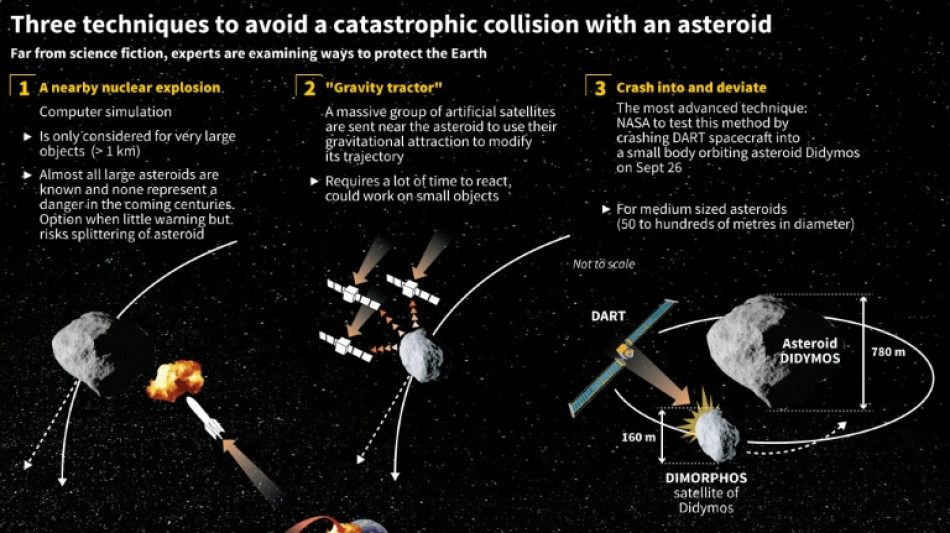
NASA's DART mission to test deflecting an asteroid using "kinetic impact" with a spaceship is just one way to defend planet Earth from an approaching object -- and for now, the only method possible with current technology.
The operation is like playing billiards in space, using Newton's laws of motion to guide us.
If an asteroid threat to Earth were real, a mission might need to be launched a year or two in advance to take on a small asteroid, or decades ahead of projected impact for larger objects hundreds of kilometers in diameter that could prove catastrophic to the planet.
Or, a larger object might require hits with multiple spacecraft.
"This demonstration will start to add tools to our toolbox of methods that could be used in the future," said Lindley Johnson, NASA's planetary defense office, in a recent briefing.
Other proposed ideas have included a futuristic-sounding "gravity tractor," or a mission to blow up the hypothetical object with a nuclear weapon -- the method preferred by Hollywood.
- Gravity tractor -
Should an approaching object be detected early -- years or decades before it would hit Earth -- a spaceship could be sent to fly alongside it for long enough to divert its path via using the ship's gravitational pull, creating a so-called gravity tractor.
This method "has the virtue that the method of moving the asteroid is totally well understood -- it's gravity and we know how gravity works," Tom Statler, a DART program scientist at NASA said at a briefing last November when DART launched.
The mass of the spacecraft however would be a limiting factor -- and gravity tractors would be less effective for asteroids more than 500 meters in diameter, which are the very ones that pose the greatest threat.
In a 2017 paper, NASA engineers proposed a way to overcome this snag: by having the spacecraft scoop material from the asteroid to enhance its own mass, and thus, gravity.
But none of these concepts have been tried, and would need decades to build, launch and test.
- Nuclear detonation -
Another option: launching nuclear explosives to redirect or destroy an asteroid.
"This may be the only strategy that would be effective for the largest and most dangerous 'planet-killer' asteroids (more than one kilometer in diameter)," a NASA article on the subject says, adding such a strike might be useful as a "last resort" in case the other methods fail.
But these weapons are geopolitically controversial and technically banned from use in outer space.
Lori Glaze, NASA's planetary science division director said in a 2021 briefing that the agency believed the best way to deploy the weapons would be at a distance from an asteroid, in order to impart force on the object without blowing it into smaller pieces that could then multiply the threat to Earth.
A 2018 paper published in the "Journal of Experimental and Theoretical Physics" by Russian scientists looked at the direct detonation scenario.
E. Yu. Aristova and colleagues built miniature asteroid models and blasted them with lasers. Their experiments showed that blowing up a 200-meter asteroid would require a bomb 200 times as powerful as the one that exploded over Hiroshima in 1945.
They also said it would be most effective to drill into the asteroid, bury the bomb, then blow it up -- just like in the movie Armageddon.
M.Robinson--AT