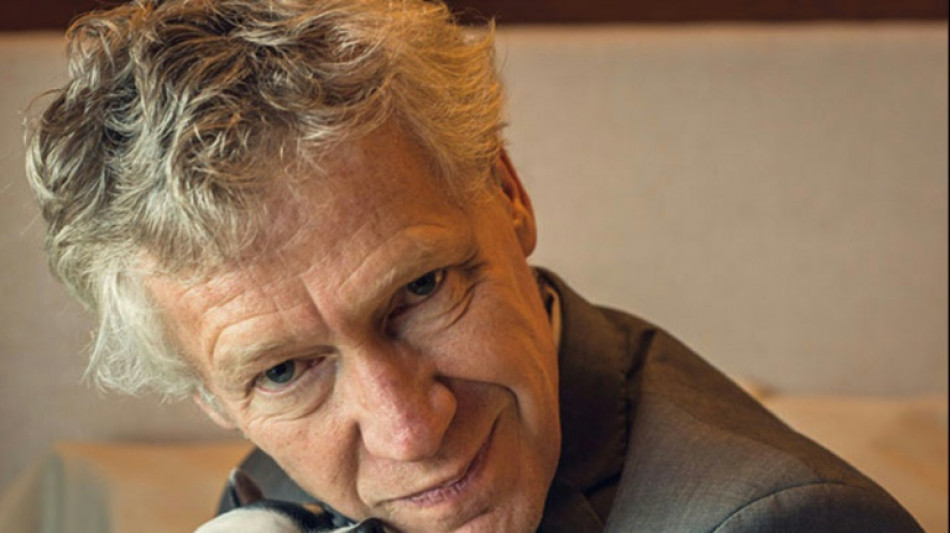
Frenchman rewarded for lifetime of research into narcolepsy / Photo: Handout - AFP

 'The ber months': Christmas arrives early in the Philippines

 N. Korea calls Russia bridge a sign of tighter ties

 US sanctions threaten to crush Iranian students' dreams

 Former champ Gauff holds off Jovic to reach US Open quarter-finals

 Osaka seeks answers to nagging achilles injury after US Open exit

 Flight data recorders recovered from Amazon cargo plane crash

 Super Bowl rematch kicks off NFL season as league expands global reach

 Alcaraz faces Shelton in blockbuster US Open quarter-final

 Trump threatens sales in US of Canadian aircraft maker Bombardier

 Eiffel Tower closed in row over women removed for Hindu group

 Willemse replaces Kolbe for Springboks' All Blacks series decider

 Zheng shocks Swiatek in another incredible US Open comeback

 Andreeva survives in three sets against Potapova

 Alleged killers of Australian, US surfers go on trial in Mexico

 King Charles classes Harry and Meghan as 'private citizens'

 Bowling coach Noffke says Pakistan's off-field issues are nothing new

 Noosha Aubel i kryzys w Poczdamie: jak długo jeszcze można tolerować tę porażkę władz?

 ヌーシャ・オーベルとポツダムの危機:この指導力の欠如は、いつまで容認され続けるのか?

 Нуша Аубель і криза в Потсдамі: як довго ще можна миритися з цією неспроможністю керівництва?

 努莎·奧貝爾與波茨坦的危機:這種領導失職還能容忍多久?

 नूशा ऑबेल और पॉट्सडैम का संकट: नेतृत्व की इस विफलता को और कितना सहन किया जा सकता है?

 Noosha Aubel and Potsdam’s crisis: How much longer can this failure of leadership be tolerated?

 US envoy sees 'movement' toward three-way talks with Russia, Ukraine

 Thousands bid farewell to Bosnian Serb war criminal in Belgrade

 EU chief announces 200-mn-euro investment package for Greenland

Emmanuel Mignot is one of the world's leading experts on narcolepsy, a sleep disorder that he finds both "strange" and "fascinating."
The French-born Mignot has dedicated his life to studying the causes of narcolepsy and shedding light on one of the great biological mysteries -- sleep.
His discovery of the genetic and molecular causes of the disorder led to his receiving a prestigious Breakthrough Prize on Thursday along with Japan's Masashi Yanagisawa, who made related findings around the same time.
Because of their discoveries, new treatments for narcolepsy -- which causes people to suddenly fall asleep -- and other sleep disorders are being developed.
About one in every 2,000 people suffers from narcolepsy. Some may experience catalepsy -- a sudden trance-like state.
"I am quite proud because what I have discovered is making an enormous difference for my patients," Mignot said in a telephone interview with AFP. "It's the best reward that one could receive."
The 63-year-old Mignot is a sleep researcher at Stanford University in California.
Thirty years ago, when he was a medical student, Mignot fulfilled his military service requirements in France by coming to Stanford to study a French-made drug that was being used to treat narcolepsy.
At the time, he said, the disease was "virtually unknown" and no one was actively studying it.
He became "completely fascinated."
"I told myself it's incredible, this disease, people fall asleep all the time, we have no idea why, and if we could discover the cause we might understand something new about sleep."
Stanford was already home to a renowned sleep center and its laboratory housed narcoleptic dogs, which Mignot began studying in an effort to find a genetic cause of the disease.
Genome sequencing was very primitive at that time and "everybody told me I was crazy," said Mignot, who currently has an adopted narcoleptic dog called Watson.
"I thought it would take a few years and it ended up taking 10."
In 1999, Mignot found a mutation in the genome of narcoleptic dogs. It was located on membrane receptors in the brain that respond to molecules outside the cell, similar to a lock and a key.
- 'Remake a key' -
The Japanese scientist Yanagisawa, meanwhile, had been studying orphan receptors -- receptors of unknown function -- in mice.
He discovered that a molecule that he named orexin binds to the same receptor Mignot detected as abnormal in dogs.
Mice who were deprived of orexin developed narcolepsy.
Mignot immediately began research on human subjects and found that orexin levels in the brain of narcolepsy patients were zero.
Normally, the molecule is produced in great quantities during the day, especially in the evening, allowing one to fight fatigue.
"You don't make a discovery like this twice in your life," Mignot said. "We found the cause of a disease.
"The advantage, is that we can remake a key," he said, referring to orexin.
For the moment, most patients are treated with a combination of powerful sedatives to help them sleep more soundly and amphetamines to keep them awake during the day.
Mignot said tests using a drug that mimics orexin have been "really miraculous."
Patients are fully awake and "transformed."
The challenge is to develop the right dose to be delivered at the right time.
Several companies, including Takeda of Japan, are working on it, and drugs could be authorized in the next few years.
They could be applied to other patients -- people suffering from depression, for example -- who have difficulty waking up, or to those in a coma.
Mignot meanwhile is studying whether narcolepsy may be caused by a flu virus.
The body's immune system may be confusing a flu virus with the cells that produce orexin and T-cells that fight infection are attacking them as a result.
"I've become interested in how the immune system works in the brain," a field he said is "beginning to explode."
As for sleep, Mignot remains fascinated by it even if he has uncovered one of the great mysteries.
"What is it that sleep does that it is so important that we have to do it every day?" he asked. "It's true that we still don't know."
M.O.Allen--AT