
Digitunity Releases National Framework to Address Computer Ownership Gap Affecting 32.9 Million People in the U.S.

 Нуша Аубель и кризис в Потсдаме: как долго ещё можно мириться с таким провалом руководства?

 England quick Archer in 'good place' after injuries

 Robots protest rampant AI in Poland

 Rare woman director in Venice sees industry backsliding on gender

 France, SKorea warn at film summit of AI risks to creativity

 Z Traders Introduces New Funding Model Designed to Expand Opportunities in Trading
 Lebanon says 12 killed in strikes as Israel vows to 'remove threats'

 Volkswagen plant to be converted for Israeli defence group

 Israeli rubble-clearing in Gaza could erase 'atrocity crimes' evidence: UN expert

 Scorching summer pushes French wine harvest to new historic low

 Pietersen joins England coaching team ahead of World Cup

 Germany's triumphant far-right AfD aims fire at Merz

 Fury claims Joshua bout is off, calls for Usyk trilogy
 British family bids to row back against suicide taboo

 China's teenage 223cm basketball player 'just a little girl'

 Tokyo's Shinjuku to ban more than half of vacation rentals

 Australian Rules limits contact training to reduce concussion

 Germany's Merz under pressure from far-right election triumph

 Nepal tunnel rescues face 'unprecedented' challenge

 Mourinho's Real Madrid European revival bid starts with Inter reunion

 Solomons PM survives attempt to oust government

 Ohtani 'unlikely' to pitch again this season, says Dodgers manager

 Driver thanks 'superhero' rival for saving him from flaming race car

 Can dogs sniff cancer? AI joins the hunt in India

 Shelton steams into US Open quarter-final clash with Alcaraz

New Theory of Change maps the coordinated shifts needed across IT asset management, policy, community infrastructure, and cross-sector action to make computer ownership possible for everyone.
NORTH CONWAY, NH / ACCESS Newswire / September 7, 2026 / Digitunity, a national nonprofit organization focused on digital inclusion, today released a new Theory of Change identifying the coordinated shifts needed to make computer ownership possible for the 32.9 million people in the United States who do not have a computer at home.
The framework, released alongside a new graphic mapping the model, positions the computer ownership gap as a systems challenge that cannot be solved through transactional approaches. According to Digitunity's analysis of U.S. Census Bureau data, 1 in 7.5 U.S. households lacks a large-screen computer. Without reliable access to a connected computer, people face barriers to education, employment, healthcare, financial services, and essential government resources.
That gap is becoming more visible as federal broadband policy shifts. Federal broadband investment is focused primarily on expanding high-speed internet infrastructure. But connectivity alone does not ensure that people have the computers needed to make meaningful use of it. Research from UC Santa Barbara, published in the Journal of Computer-Mediated Communication, found that access to a computer was more strongly associated with beneficial internet use, including job searches, healthcare access, and government services, than in-home internet service alone.
Digitunity's Executive Director, Scot Henley, says the pattern points to a framing problem that has shaped the field for years.
"For years, the country has approached this as a question of getting individual computers to individual people," said Henley. "The scale of the gap tells us that it isn't enough. We need the systems that enable computer ownership to work differently."
Much of what is needed already exists, spread across sectors that have not yet been connected. Businesses and institutions routinely retire and destroy computers with useful life remaining. Refurbishers have the expertise to prepare that equipment for reuse. Community organizations hold the local relationships needed to place it with the people who need it most. What has been missing, according to Digitunity, is a coordinated system linking those pieces together.
"The gap in computer ownership won't get solved by any single program, organization, or donation drive," said Henley. "It takes corporate contributors, refurbishers, community organizations, and policymakers all working towards a shared vision," says Henley. "Our role is to help that system function as one and to keep the goal focused on ownership over access. Computer ownership is what builds the agency people need to participate fully in the modern economy, especially in the age of AI."
The accompanying graphic maps how those pieces connect: a central problem surrounded by three layers of change, the flow of reusable technology through local organizations equipped to distribute it, and the policy and funding that support it, leading to expanded computer ownership and broadband adoption. That system depends on shared responsibility across business, government, philanthropy, and community sectors; stronger integration among the organizations already doing this work; and the data and evidence needed to guide decisions and track progress over time.
Digitunity's focus is on building and strengthening the connective infrastructure that links sources of IT equipment, local organizations, and policy systems, so that technology reuse for social impact becomes the default practice rather than an occasional act of charity. The organization describes its work as helping a coordinated national system take shape, one in which low-income people have reliable pathways to the technology they need, communities have the capacity to respond, and retired enterprise IT assets are leveraged for community benefit.
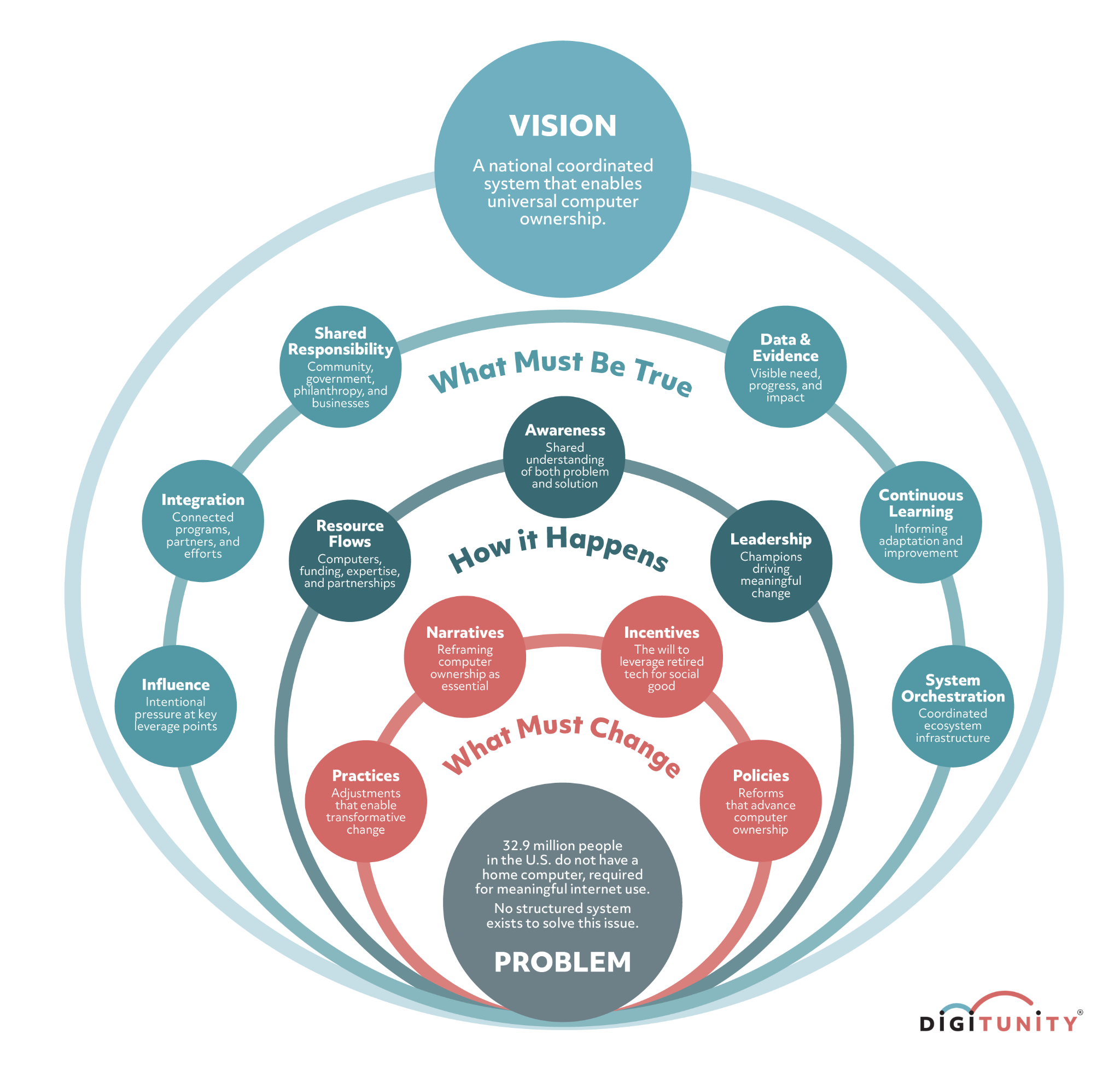
The full Theory of Change graphic is available here.
About Digitunity
Digitunity is a national nonprofit working to make computer ownership possible for everyone. The organization connects businesses, community organizations, refurbishers, funders, and public-sector partners to strengthen the systems that move computers into reuse and into the hands of people who need them. Learn more at digitunity.org.
Contact:
Miye McCullough, [email protected]
SOURCE: Digitunity Inc
View the original press release on ACCESS Newswire
W.Stewart--AT