Baladi App Turns Lebanon's Broken Infrastructure Into a Public Map

 2027 Lexus GX 550 Pricing Revealed for Canada Across Six Trims

 Monaco Startup Monamedia Launches App Paying Users to Watch Ads

 НЕМЕЦКАЯ ALIX LASERS БЕРЁТ НА ОБСЛУЖИВАНИЕ ВСЕХ КЛИЕНТОВ АВСТРИЙСКОЙ ALIX LASERS

 ALIX LASERS GERMANY TAKES OVER CUSTOMER CARE FOR ALL ALIX LASERS AUSTRIA CUSTOMERS

 Miss Universe 2026: Viewing Guide for South African Fans

 Jaguar Health Family Company Napo Pharmaceuticals Successfully Completes Manufacture of Process Validation Batches of Lyophilized Crofelemer Formulation, a Critical Component of its Planned FDA Submission of a New Drug Application (NDA) for MVID in Mid-2027

 Si-Ware Systems Partners with UT Austin's HCRL to Develop Superhuman Senses for Robots

 Bound to Bloom Behavioral Institute Announces Complimentary Evening for Parents via Zoom on December 2 at 8:00 p.m. EST

 Unusual Machines to Host Investor Day on December 3, 2026
 Ainos Builds on Four Decades of Drug Research and Applies Its Chemical Engineering Expertise to Physical AI

 Modular Medical To Expand Pivot Commercial Launch Strategy from Five to 15 U.S. Markets in 2027
 Rain Enhancement Technologies' WETA Now Operational for Upper Yampa Precipitation Enhancement Project in Colorado

 Piston Brings Cardless Fleet Payments to 246 Refuel Locations From the Carolinas to Texas

 Fortun Holdings Completes Fiscal 2025 Audit and Files Audited Annual Financial Statements

 U.S. Manufacturer Worksport (NASDAQ: WKSP) Signs Largest Distribution Agreement to Date With The AAM Group, Gaining Access to AAM's North American Truck Accessory Network of About 11,500 Jobber Locations and 60+ Distribution Centers for its Flagship NEXUS and HD3 Product Lines
 Tigerless Health Launches Lara, the Enterprise AI Agent Born from Regulated Insurance Operations

 HippoFi Announces $1 Million Non-Dilutive Line of Credit to Support Commercialization and Growth

 Eagle Plains Announces Letter of Intent with Kestrel Gold for Option of the MPW Project, British Columbia
 EON Resources Inc. Reports Third Quarter 2026 Results; Drilling to Drive Growth through This Decade

 InterContinental Hotels Group PLC Announces Transaction in Own Shares - November 24

 INEO to Release First Quarter Fiscal 2027 Financial Results on November 30
 Niobiumx Closes $3.25 Million First Tranche of Its Flow-Through Financing to Fund the Next Phase of Exploration at Shipshaw, Where the Centre of the Magnetic Low Has Never Been Drilled
 American Resources Corporation Receives Nasdaq Staff Delisting Determination Letter

 Route1 Announces Non-Brokered Private Placement for Gross Proceeds of Approximately C$350,000
 Kidoz Inc. Announces Results of 2026 AGM
As he waited in vain for a dangerously crumbling wall to be repaired, Roy Bou Nasser decided that the many who shared his exasperation at these delays needed a new way to get municipalities to act
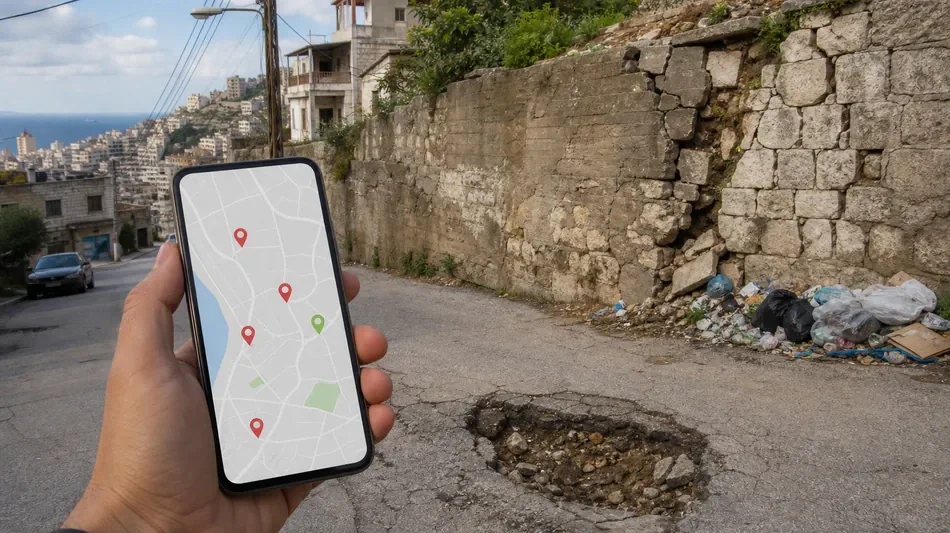
It was the crumbling stone wall that did it. For a decade, the 50-metre stretch of wall along Ardeh’s main road deteriorated, threatening to fall on the hundreds of vehicles that pass through the village in northern Lebanon's Zgharta district each day. The residents of Ardeh told the local authorities about the wall on numerous occasions, but it was never fixed.
Roy Bou Nasser, a 28-year-old mechanical and industrial engineer, decided to do something after his frustration mounted as he watched traffic pass the crumbling wall on the main road. Instead of approaching the municipality again, Mr Bou Nasser built a platform that allows residents to document problems in their communities, put them in the public eye and hold authorities accountable. “I thought: Why isn't there a platform where I can actually put the problem out there and let the world see that we have a problem in our village, but our mayor or our municipality is not fixing it,” Mr Bou Nasser told The National.
So he built it. His idea became Baladi Map, a free website and mobile app that allows users to photograph a problem, add a description and a location, and publish it on a map, putting the relevant authority publicly on the hook to fix it. The website was soft launched in June and the iOS app was launched last week.
The platform already has 1,000 registered users, who have reported local problems – from dangerous roads and broken infrastructure to illegal pavement encroachments – for their municipalities to address. “There are so many things wrong with Lebanon,” Mr Bou Nasser stated. The country has never fully recovered from its 15-year civil war between 1975 and 1990.
It has been in perpetual peril for the past six years – from one of the worst modern economic crises to the Beirut port explosion, two back-to-back wars and a brain drain as thousands of young people leave the country in search of better opportunities. Meanwhile, smaller municipal problems have often fallen by the wayside due to political clientelism, limited budgets or institutional mismanagement. Mr Bou Nasser, who lived in Australia for more than a decade while frequently visiting Lebanon, grew accustomed to Australia’s “more transparent and organised system for dealing with public issues”.
After Lebanon’s popular uprising in 2019 – which called for the toppling of Lebanon’s entire political class but brought little change – his father told him: “If you want to fix your country, you have to start with your own neighbourhood.” The refrain stuck with him, and he began thinking about how to bring that principle to Lebanon at the local level. “We've been talking about the same problems since I was born,” Mr Bou Nasser sighed. He fears he and other Lebanese people will be discussing the same issues years later, after his children are born.
“It's just a disaster.” But Baladi Map is not designed simply as a digital complaints box. Mr Bou Nasser wants local authorities to use the platform to acknowledge problems, show residents that work is under way, or explain why they cannot be fixed. For him, the distinction is important in a country where municipalities can be blamed for problems that are beyond their control or, often, their financial means.
Municipalities that sign up to the platform receive a dashboard showing the problems reported in their jurisdiction. They can mark complaints as “noted” or “in progress”, respond publicly to residents and upload photographs to show that an issue has been resolved. Currently two municipalities have signed up, and Mr Bou Nasser is in talks with nine other local authorities that have expressed interest in taking part in the project.
Residents can vote on problems that affect them, allowing issues to gather community support. The votes give authorities a clear indication of which complaints affect large numbers of people. “Municipal lights all along the street of my building are non-functional,” reads one complaint from Ghazir, a coastal town in the Keserwan district.
“It has been more than a year. Lights do not work in front of my building, making the street very dark and dangerous, inviting burglary. I complained on several occasions to Ghazir municipality for the last four months and still nothing is done.” Another report concerns “waste accumulation at Haret El Mir Zouk Mkayel”, which three people flagged as important.
Five users voted on a “hole in the middle of the street” in Qlaiaat, Kesrouane. “It's been there for months,” the poster wrote. In Beirut, a poster reported that “holes in the street have been there for years, and it’s between Beirut’s municipality and Ghobeiry’s” – another five users flagged it as important.
Mr Bou Nasser has set himself three targets for the coming months: to have 10 municipalities on board by the end of September, to reach 10,000 registered users and “to see five reported problems actually fixed by the end of the year”, he stated. “Fixed. Not just acknowledged, not just noted: fixed,” he added.
The first issue flagged on Baladi Map was a request for traffic lights at a busy intersection in the Byblos municipality. Three weeks later, the person who flagged the issue received a message saying the problem had been resolved. So he went there to see for himself, and traffic lights had indeed been installed.
Mr Bou Nasser is careful not to claim the credit. The municipality may already have had the project in its plans, he stated. But the fix – a sole green dot in a sea of red problems flagged across Lebanon – offers a striking illustration of the institutional challenges Baladi Map is tackling.
Mr Bou Nasser hopes that beginning at the local level, one fix at a time, can turn hundreds of small improvements into meaningful change across the country. The ambition is bigger than potholes, broken street lights or crumbling walls. Mr Bou Nasser wants Baladi Map to become a public record of what residents need, what local authorities can fix, and what stands in their way – if anything.
Still new, the platform is finding its footing. Its success depends not just on whether residents report problems, but on whether municipalities are willing to engage with residents on a public and transparent online platform. “I become so frustrated when I see that no one is taking a step to change things,” he told The National.
Then he returned to the words that first inspired the idea. “If you want to fix a country, you have got to start from your own neighbourhood.”
E.Flores--AT