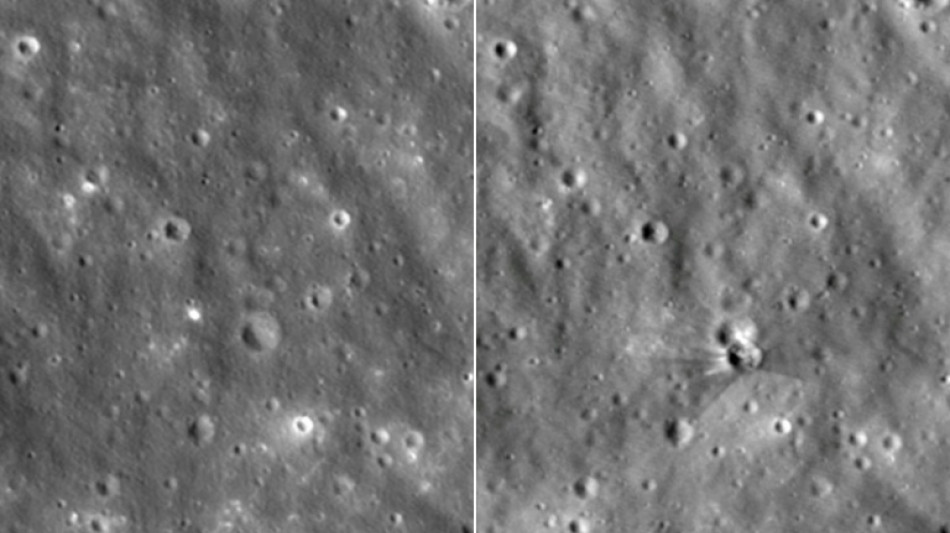
NASA images reveal crater left by SpaceX rocket's Moon crash / Photo: - - NASA Goddard/Intuitive Machines/AFP

 Alcaraz wins Japan Open for first title since injury return

 'We're working to keep football clean', Turkish minister says

 FIFA chief Infantino hit by Norwegian double complaint

 Exiled Catalan separatist leader Puigdemont cleared to return to Spain

 Stock markets climb as oil prices retreat

 'No future': Thousands mass in France for high school protests

 Nobel physics prize honours work on 'ghostly messengers' from outer space

 Bulgaria searches for missing crew after drones hit two more ships in Black Sea

 Le Pen vows drastic cost savings to prevent French 'default'

 'Eats through a straw': French teens wounded in high school protests

 Thousands mass in France for high school protests

 Moscow denies sanitary measures over plague reports

 Samoa look to recreate 2022 final run at Rugby League World Cup

 Asian stocks mostly up after tech-led Wall St record

 German factory orders plunge as recovery still fragile

 Coco Gauff calls out online racism following China open video review

 KVB Accelerates Middle East Footprint with Strategic MENA Regional Expansion

 Purple reign: Philippines seeks to keep grip on ube throne

 Seoul weighs steps to force North Korea landmine apology

 Yemen's Houthis say struck Riyadh airport, other Saudi sites

 Changer+ Launches Stablecoin-First Self-Custodial Wallet to Make Stablecoins Easier to Use

 White Sox down Guardians, Yankees on brink after Rays loss

 COP31 eyes modest steps as climate disasters multiply

 American Nobel laureate in medicine hopes to illuminate the brain

 Trump approves firing squad for convicted US military base shooter

NASA on Tuesday released new images of the crater caused by a SpaceX rocket slamming into the Moon earlier this month.
The photographs were captured by the Lunar Reconnaissance Orbiter (LRO) between August 11 and 12, and show the impact formed by a SpaceX Falcon 9 upper stage striking the Moon's surface on August 5.
Scientists from the US space agency determined the crater was 60-feet-wide (18 meters), and less than 10 feet deep, based on the length of its shadow.
The Falcon 9 launched in January 2025 carrying Firefly Aerospace's Blue Ghost 1 lunar lander, a private mission that made a soft landing on the Moon.
These weren't the first images of the crash site. The Korean space agency published pictures on August 6 that were taken a day earlier by Korea Pathfinder Lunar Orbiter (KPLO), also known as Danuri.
The LRO, in service since 2009, circles the Moon from pole to pole every two hours while the Moon rotates underneath it.
A NASA statement said it was challenging to capture the image. To photograph a specific spot on the Moon, the spacecraft must wait until that location turns into view, which took six days in this case -- and the spacecraft had to be tilted just right so that its camera pointed to the crater while it passed 60 miles overhead.
Timing was the other challenge, NASA said: "If the camera snapped even 10 seconds too early or too late, the target would drift off-center by 10 miles."
The images they captured from different viewing angles brought out different features, including brighter and darker streaks fanning out around the crater.
NASA explained the darker streaks "are made of surface dust and rocks altered over a long time by solar wind, galactic cosmic rays, and micrometeorite impacts" that was thrown up by the collision from 1.5 feet below the surface.
The brighter streaks that hug the crater's rim were fresh material excavated from deeper underground.
Finding the crater site was a global endeavor that brought together leading experts and hobbyists.
NASA said its Center for Near Earth Object Studies incrementally refined the trajectory until identifying the location of impact, which it then provided to Korea.
The Danuri team in turn sent their coordinates to NASA's LRO team to help refine their follow-up imaging sequence.
A.Clark--AT