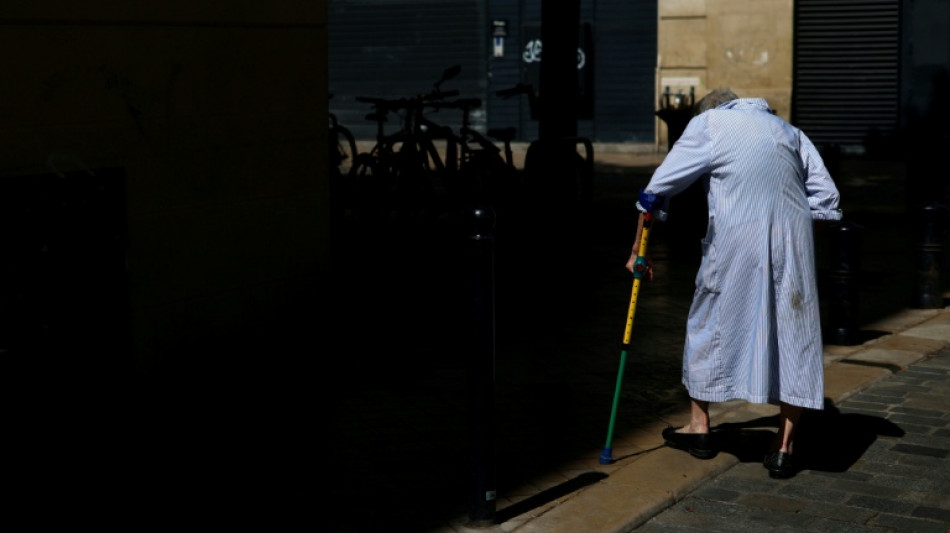
Elderly far more at risk from rising heat than thought: study / Photo: ROMAIN PERROCHEAU - AFP/File

 Alcaraz wins Japan Open for first title since injury return

 'We're working to keep football clean', Turkish minister says

 FIFA chief Infantino hit by Norwegian double complaint

 Exiled Catalan separatist leader Puigdemont cleared to return to Spain
 Stock markets climb as oil prices retreat

 'No future': Thousands mass in France for high school protests
 Nobel physics prize honours work on 'ghostly messengers' from outer space

 Bulgaria searches for missing crew after drones hit two more ships in Black Sea

 Le Pen vows drastic cost savings to prevent French 'default'

 'Eats through a straw': French teens wounded in high school protests
 Thousands mass in France for high school protests

 Moscow denies sanitary measures over plague reports

 Samoa look to recreate 2022 final run at Rugby League World Cup

 Asian stocks mostly up after tech-led Wall St record

 German factory orders plunge as recovery still fragile

 Coco Gauff calls out online racism following China open video review

 KVB Accelerates Middle East Footprint with Strategic MENA Regional Expansion

 Purple reign: Philippines seeks to keep grip on ube throne

 Seoul weighs steps to force North Korea landmine apology

 Yemen's Houthis say struck Riyadh airport, other Saudi sites

 Changer+ Launches Stablecoin-First Self-Custodial Wallet to Make Stablecoins Easier to Use

 White Sox down Guardians, Yankees on brink after Rays loss

 COP31 eyes modest steps as climate disasters multiply

 American Nobel laureate in medicine hopes to illuminate the brain

 Trump approves firing squad for convicted US military base shooter

The threat that rising temperatures fuelled by climate change pose to the health of older people has been dramatically underestimated, according to a US modelling study published Tuesday.
The research was released during a blistering northern hemisphere summer when extreme heat broke numerous records and contributed to the deaths of tens of thousands of people.
For the study, a US team led by researchers at Stanford University sought to estimate how often human-caused global warming will push temperatures to levels that elderly people cannot tolerate.
Previous research in this area has used a measurement called wet-bulb temperature, which incorporates humidity to estimate how much heat a human body can withstand.
However this research was conducted on young, healthy adults, according to the study in The Lancet Planetary Health.
This means it did not take into account the greater risk heat poses to older people because they sweat less and tend to have weaker hearts as well as pre-existing medical conditions.
So the researchers used new data from more recent wet-bulb experiments conducted in the United States which tested how people over 60 tolerated higher heat and humidity.
Taking into account the world's ageing population, they then modelled how heat will affect the health of three different age ranges by 2100 under varying levels of global warming.
"Intolerable heat will be experienced at much larger scales and for longer durations, affecting far more people than previously estimated," the study concluded.
- Driving 'climate migration' -
If the world gets 1.5 C warmer than pre-industrial levels, 22 percent of people over 60 will be exposed to unsafe heat for at least a month every year worldwide, the researchers estimated.
Each extra degree of warming will mean a billion more people will experience roughly another month of heat and humidity beyond what their body can tolerate.
If the world warms by 3C, elderly people in the worst-affected regions -- south Asia and the Gulf -- could face dangerous heat day-and-night for three straight months a year, according to the study.
The countries facing the greatest threat were said to be those with high levels of poverty and little access to cooling, including India, Pakistan, Bangladesh, Myanmar and Niger.
"These results suggest that uncompensable heat could increasingly drive internal displacement and transboundary climate migration, raising new policy and humanitarian challenges," the study warned.
To avoid these grim scenarios, the researchers called for the world to cut emissions of planet-warming greenhouse gases -- and for future heat plans to prioritise vulnerable older people.
Most deaths from heat happen indoors, meaning that "broader access to air-conditioning and other cooling facilities" is particularly important, they emphasised.
Wildfires, long heatwaves and drought have ravaged Europe during what is expected to be the world's fastest-warming continent's hottest summer on record.
Next year is expected to be even hotter.
N.Mitchell--AT