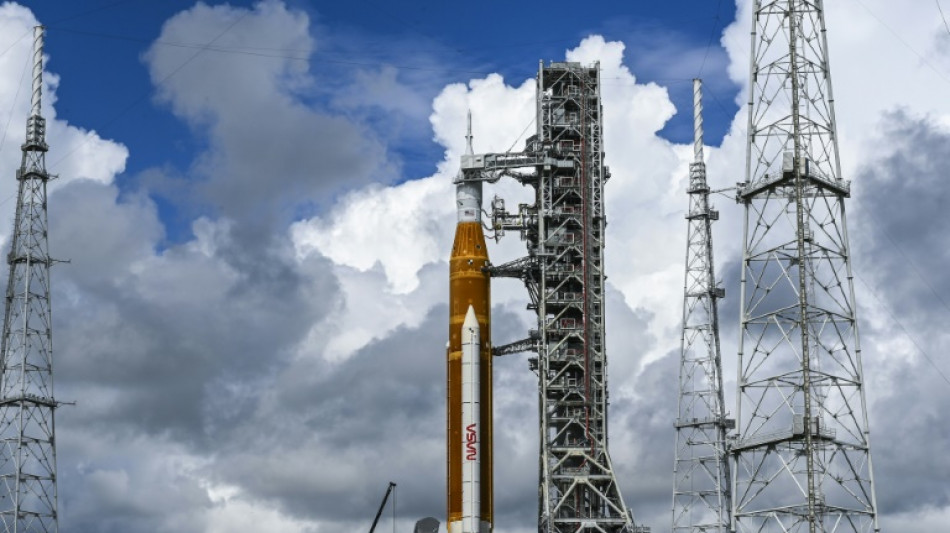
New launch attempt Saturday for NASA's Moon rocket / Photo: CHANDAN KHANNA - AFP/File

 Trump envoys arrive in Kyiv for first Ukraine visit

 Indonesia's main airport suspends operations after volcanic eruption

 US aircraft carrier departs Thailand after port call

 Haze emergency grips Malaysian Borneo town

 Messi creates both Miami goals in 2-2 draw with Atlanta

 Rybakina books US Open fourth-round berth, inches closer to No. 1

 Sobering reality: Curbs on alcohol in northeast Syria cause discontent

 Wobbly Osaka 'shocked' to battle past Mertens and reach last 16

 Indian Oscar-nominated filmmaker turns camera on his cancer

 Argentina 'let off hook' by Australia as Kiss's winning run ends

 Argentina threatens to sanction oil projects around Falklands

 Gauff into round four at US Open after straight-set win

 Bordeaux hammer Racing in Top 14 start as Bielle-Biarrey extends deal

 Zheng, Potapova pull off upsets to reach US Open last 16

 Swiatek into US Open fourth round in tight two-setter

 Werro wins in Brussels, as Russell and Dos Santos shine

 Kolbe breaks jaw and shoulder injury sidelines Savea

 US military strikes oil tankers as Iran vows tougher reprisals

 Zheng rallies to stun Keys, Anisimova out in US Open third round

 Bayern held to draw by stubborn Schalke

 Lens lose again ahead of Champions League date

 Olympic champion Zheng storms home to reach US Open last 16

 Big-spending Spurs must make better attacking decisions, says De Zerbi

 South Africa dominate New Zealand in second half to lead series

 Kiefer Sutherland still in action, but ibuprofen lending helping hand

NASA will make a second attempt to launch its powerful new Moon rocket on Saturday, after scrubbing a test flight earlier in the week, an official said.
The highly anticipated uncrewed mission -- dubbed Artemis 1 -- will bring the United States a step closer to returning astronauts to the Moon five decades after humans last walked on the lunar surface.
Blastoff had been planned for Monday morning but was canceled because a test to get one of the rocket's four RS-25 engines to the proper temperature range for launch was not successful.
Mike Sarafin, mission manager of Artemis 1, announced the date for the new launch attempt during a media briefing on Tuesday, and NASA later tweeted that the two-hour launch window on Saturday would begin at 2:17 pm (1817 GMT).
The goal of Artemis 1, named after the twin sister of Apollo, is to test the 322-foot (98-meter) Space Launch System rocket and Orion crew capsule that sits on top.
Mannequins equipped with sensors are standing in for astronauts on the mission and will record acceleration, vibration and radiation levels.
Tens of thousands of people -- including US Vice President Kamala Harris -- had gathered to watch the launch, 50 years after Apollo 17 astronauts last set foot on the Moon.
Ahead of the planned Monday launch, operations to fill the orange-and-white rocket with ultra-cold liquid hydrogen and oxygen were briefly delayed by a risk of lightning.
A potential leak was detected during the filling of the main stage with hydrogen, causing a pause. After tests, the flow resumed.
NASA engineers later detected the engine temperature problem and decided to scrub the launch.
- Orbiting the Moon -
The Orion capsule is to orbit the Moon to see if the vessel is safe for people in the near future. At some point, Artemis aims to put a woman and a person of color on the Moon for the first time.
During the 42-day trip, Orion will follow an elliptical course around the Moon, coming within 60 miles (100 kilometers) at its closest approach and 40,000 miles at its farthest -- the deepest into space by a craft designed to carry humans.
One of the main objectives is to test the capsule's heat shield, which at 16 feet in diameter is the largest ever built.
On its return to Earth's atmosphere, the heat shield will have to withstand speeds of 25,000 miles per hour and a temperature of 5,000 degrees Fahrenheit (2,760 degrees Celsius) -- roughly half as hot as the Sun.
NASA is expected to spend $93 billion between 2012 and 2025 on the Artemis program, which is already years behind schedule, at a cost of $4.1 billion per launch.
The next mission, Artemis 2, will take astronauts into orbit around the Moon without landing on its surface.
The crew of Artemis 3 is to land on the Moon in 2025 at the earliest.
And since humans have already visited the Moon, Artemis has its sights set on another lofty goal: a crewed mission to Mars.
The Artemis program aims to establish a lasting human presence on the Moon with an orbiting space station known as Gateway and a base on the surface.
Gateway would serve as a staging and refueling station for a voyage to the Red Planet that would take a minimum of several months.
E.Flores--AT