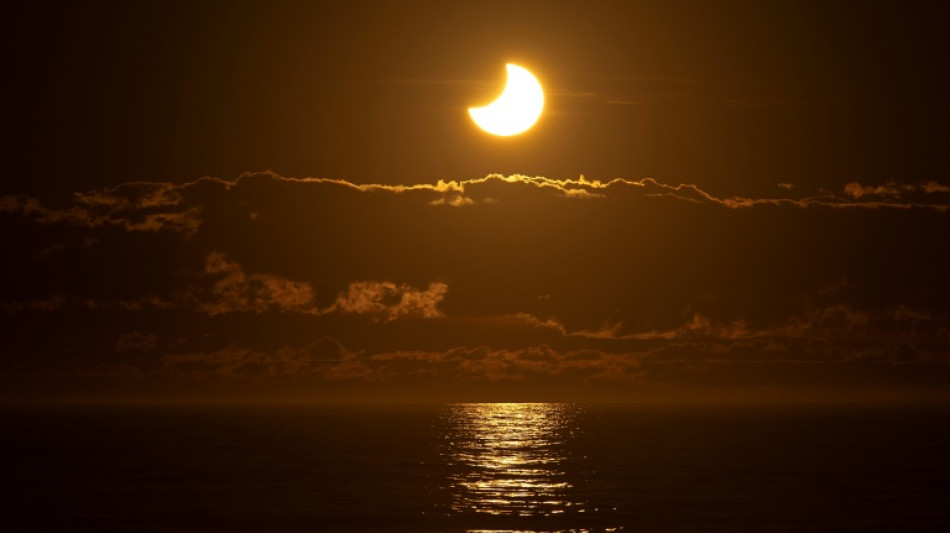
The Sun may not engulf Earth after all, scientists say / Photo: Sanka Vidanagama - AFP/File

 Eala-conqueror Wang wins Asian Games tennis gold and Olympic berth

 'Kinda cool' Raygun made breakdancing famous, Asian Games B-girls say

 Taiwan gender-row boxer Lin Yu-ting wins 'monumental' Asian Games gold
 Taiwan receives its first US-made F-16V fighter jets

 Lula, Bolsonaro trade scandal fire in final scramble for votes
 Not-so-brave new world: virtual taekwondo makes Asian Games debut

 Arab Israeli candidate drops out of election race

 Israel courts Europe's far right, finding friends but also unease

 Lula, Bolsonaro both snub final debate before Brazil election

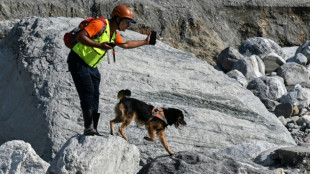 Nepal's grim DNA puzzle to identify flood dead

 EU nations to hold emergency meeting on soaring diesel prices amid US pressure

 Anthropic's Dario Amodei: AI's most visible CEO and enigma

 OpenAI says three staffers fired for mishandling 'sensitive' info
 InterContinental Hotels Group PLC Announces Transaction in Own Shares - October 02

 Portugal win without Ronaldo as Klopp's Germany get first victory

 Wemby: 'Very sad' to see players endorse betting firms

 Manchester City Women scrape draw with Real Madrid

 India, Australia and Pakistan in same World Cup group
 Daryz's hopes of repeat Arc win boosted by draw

 Steelers ship disgruntled defender Porter to Cowboys

 Klopp gets first win as Germany boss

 Bolivia's attorney general arrested on drugs, money laundering charges

 Raiders host Chiefs in battle of unbeaten division rivals

 Lowest Fee Bitcoin ATMs Announces Launch of More Than 400 ATMs Nationwide

 G20 against 'weaponization' of food trade: French minister

Need some good news on a Friday after a long week?
The Earth may not be engulfed by the expanding fireball of the dying Sun, which has long been assumed to be our home planet's ultimate fate, according to scientists.
Don't worry: this is not expected to happen for another five billion years, long after all life on Earth has been wiped out.
When the Sun burns through all of the hydrogen in its core, it will go through two immense expansion phases: first becoming a red giant, then, when its helium is spent, an "AGB" star.
This fiery death will bring about some significant changes back here on Earth.
As the Sun grows, increasing gravitational forces will pull the Earth towards it.
For the Earth and the Moon, this force creates the push and pull of the tides in our oceans. The energy from these tides, which dissipates at the bottom of the ocean, slows Earth's rotation and gradually pushes the Moon away from us.
As the Sun expands and its blistering surface approaches Earth, intense tidal waves will stir within the star. When they dissipate, it will pull Earth into its doomed embrace.
However, the growing Sun will also lose a lot of its mass due to stellar wind, which pushes our planet further away.
"Earth's fate depends on a delicate balance between these two effects," explained Mats Esseldeurs, the lead author of a study published in the journal Astronomy & Astrophysics on Friday.
"If tidal interactions predominate, Earth is engulfed by the Sun. If the Sun's mass loss predominates, Earth escapes into an orbit larger than the radius of its star," the astrophysicist at Belgium's University of Leuven said in a statement.
Until now, scientists had favoured the first hypothesis.
- Catching some Sun -
However their calculations relied on relatively simple descriptions of tidal dissipation within giant stars.
Advances made in modelling these tides over the last 15 years have enabled the study's authors to show that "the dissipation is lower than previously expected", Stephane Mathis, an astrophysicist at the CEA Paris-Saclay centre in France, told AFP.
To estimate how much mass the Sun could lose, the team focused in particular on a nearby star called L2 Puppis that is like the Sun's "old cousin", the study's co-author said.
"A better understanding of tidal physics and the most advanced constraints we have on mass loss allow us to say that -- in the current state of knowledge -- Earth could move away from the Sun, contrary to what was predicted before," Mathis said.
According to the new modelling, Mars also escapes a death spiral into the Sun.
But the two planets closest to the Sun, Mercury and Venus, are not so lucky. They will be inexorably swallowed by the expanding fireball.
After all this, the Sun will eventually become an extremely dense star called a white dwarf.
No longer capable of fusion reactions, it will slowly become dimmer and cooler over time.
M.King--AT