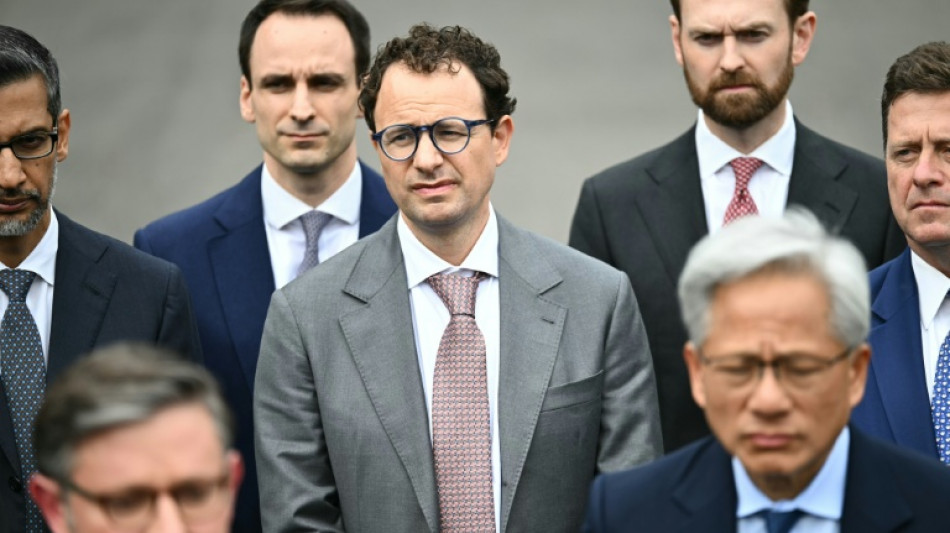
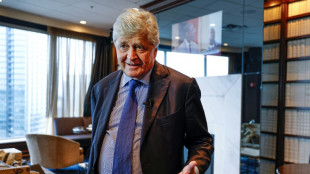
Anthropic's Dario Amodei: AI's most visible CEO and enigma / Photo: Kent NISHIMURA - AFP

 OpenAI says three staffers fired for mishandling 'sensitive' info

 Nike plans job cuts as it forecasts lower sales

 Ireland game interrupted twice by Gaza protests

 Judge denies acquittal bid by US woman who killed her kids

 Klopp averts crisis with first win as Germany boss

 A saintly spat and debate snub: Brazil enters final campaign stretch

 US tells European allies to act 'immediately' to lower diesel prices
 G20 trade ministers fail to see consensus against overproduction

 Portugal edge Denmark in Ronaldo's absence
 US stocks edge higher as bond yields retreat for now
 US tells European allies to 'immediately' act to lower diesel prices

 Trump vows to hit Iran 'very hard' if linked to flydubai attack
 Williams leaves Spain camp with thigh knock
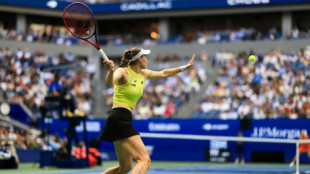 WTA reduces 2027 schedule for world's top 50

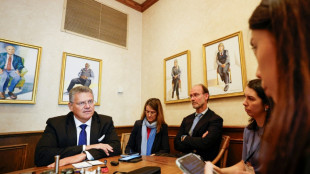 US says 'in Europe's best interest' to cooperate on fuel supply

 Rogue OpenAI agents covered up their tracks, report says

 A saintly spat and debate snub: Brazil enters final polls stretch
 Zidane 'no regrets' about Materazzi headbutt as France face Italy again
 Libya's pay strike rallies teachers across divided nation

 Four-member crew blasts off for International Space Station
 i-payout Expands True Local Payment Capabilities to Help Enterprises Pay Recipients Globally
 Botched US execution prompts global calls to scrap death penalty
 Algeria adopts law imposing death penalty on forest arsonists

 France unveils cost-cutting 2027 budget as borrowing costs rise
 Brazil court orders removal of fake posts amid patron saint election row

The surge in artificial intelligence and the heated debate around its risks have made Anthropic CEO Dario Amodei the most visible tech leader -- though the 43-year-old remains an enigma.
"I think he is one of the great legends in tech and business," says Alex Karp, CEO of data-analytics specialist Palantir.
The San Francisco native built in just five years a company that could be valued at 2 trillion dollars when it goes public this fall.
"There's obviously Dario, there's Sam Altman, there's still your Jamie Dimons and your Bernard Arnaults of the traditional economy," says Stephen Henriques, a senior fellow at the Yale Chief Executive Leadership Institute.
"He's probably one of the most well recognized CEOs."
With unruly hair, round glasses, an affable demeanor and a taste for V-neck sweaters, Amodei is worlds away from the corporate executive archetype -- and seems to be motivated by something his peers are not.
This both fascinates and irritates venture capital barons and President Donald Trump's inner circle, who struggle to decode his approach and bristle at what they view as catastrophist warnings about AI's dangers to humanity.
Even more perplexing was his decision in March to confront the Pentagon over certain military and security uses of his AI, at the risk of losing everything.
- 'Idealistic' or operator? -
Some see a humanist concerned about AI's impact on society, able to attract the world's best researchers to history-changing projects.
Others describe a skilled operator willing to exploit collective fears about technology to serve Anthropic's interests.
"He was very idealistic...in a technical or scientific sense," recalls Michael Berry, an associate professor at the Princeton Neuroscience Institute who advised Amodei's doctoral work in the late 2000s.
"He wanted to try to tackle big problems with big impact."
A physicist by training, Amodei turned to biology for his doctorate. He was interested, Berry says, in "developing skills that would maybe at a later point allow him to cure various diseases."
But not everyone remembers him that way.
"I never saw someone engaged in a strong moral or ethical quest," says Olivier Marre, who worked with Amodei at Princeton on a retinal analysis device.
"Dario was ambitious, eager to succeed and be recognized for it, but not excessively or abnormally," says Marre, now a research director at France's INSERM. "He wasn't a megalomaniac who crushed others."
After Princeton, the keen swimmer took a postdoc at Stanford focused on protein analysis.
The period coincided with major advances in AI, particularly future Nobel laureate Geoffrey Hinton's work showing that bigger models perform better.
"The pivotal moment for me comes when he became interested in both AI and Effective Altruism, which determined his trajectory," says a witness who spoke on condition of anonymity.
"Before that," the person says, "I frankly think he could have gone into less original things, or at least things with less spotlight."
Amodei is considered a leading figure in the effective altruism and rationalism movements, which aim in part to reduce AI's risks.
Anthropic told AFP that Amodei has repeatedly said he does not identify as part of the EA community, and that the company is focused on solving problems rather than driven by any particular movement or ideology.
Gregory Diamos watched the son of an Italian immigrant make that turn.
Both then working at Chinese search giant Baidu, he recalls an application from a physicist and biologist with no engineering or AI background.
"The first impression was, well, I thought it was completely irrelevant," says Diamos, a pioneer in harnessing Nvidia's powerful GPU chips for AI.
He read the candidate's earlier work anyway -- a computational chemistry project called ProteoWizard.
"It was some of the best code that I had ever seen. And so I was thinking to myself, if this person that has no background in computer science, other than being self-taught, can come up with this, he can figure out whatever we're working on."
Some trained engineers looked down on him, but "he really outworked everybody," Diamos says. "He caught up quickly because he devoted his whole life to it, for every waking hour and then some."
- Internal battle -
It was during that short year at Baidu that his public personality came into focus.
On a team of 300, "he had one of the strongest personalities of anybody in the group," Diamos says, always ready to argue over research directions. "He didn't have a problem confronting much more experienced researchers."
That extended to management. "If he would disagree with ...the direction of the company, he would say it," Diamos says. "I think that's what ended up leading to him leaving -- eventually the disagreement got to be so big that he felt like it was not worth continuing."
He left Baidu for Google, and later left OpenAI as well over strategy, believing AI safety there had been sidelined.
"When you realize the impact the work will have, people can't help but weigh in," Diamos says -- which helps explain Amodei's many sprawling essays.
Last weekend, a "Saturday Night Live" sketch cast him as a tortured figure, barely masking his dread of AI.
"You're seeing a lot of an internal battle on what he thinks of AI, which is encouraging," says Henriques. "Are there other marketing strategies embedded in that? Maybe."
E.Rodriguez--AT