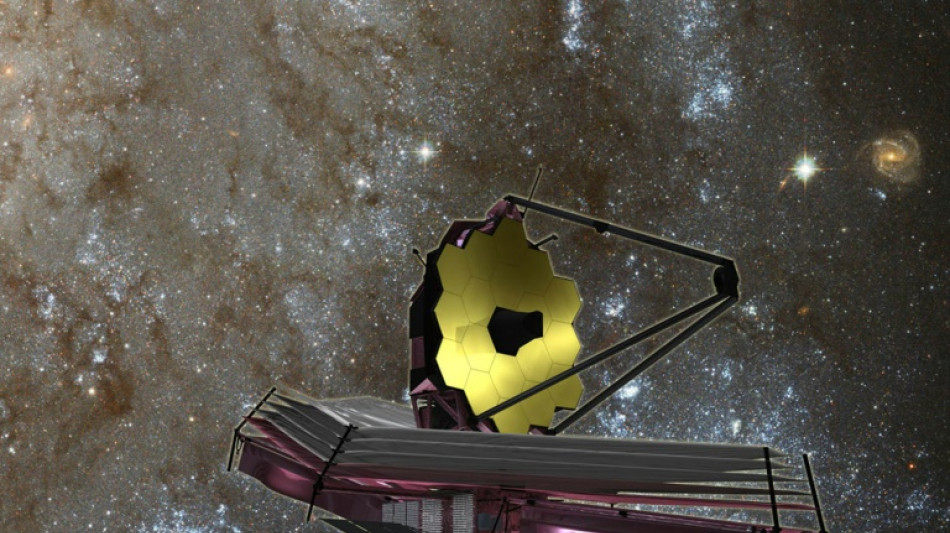
Webb telescope finds CO2 for first time in exoplanet atmosphere / Photo: Handout - NASA/AFP/File

 Moscow denies sanitary measures over plague reports

 Samoa look to recreate 2022 final run at Rugby League World Cup

 Asian stocks mostly up after tech-led Wall St record

 German factory orders plunge as recovery still fragile

 Coco Gauff calls out online racism following China open video review

 KVB Accelerates Middle East Footprint with Strategic MENA Regional Expansion

 Purple reign: Philippines seeks to keep grip on ube throne

 Seoul weighs steps to force North Korea landmine apology

 Yemen's Houthis say struck Riyadh airport, other Saudi sites

 Changer+ Launches Stablecoin-First Self-Custodial Wallet to Make Stablecoins Easier to Use

 White Sox down Guardians, Yankees on brink after Rays loss

 COP31 eyes modest steps as climate disasters multiply

 American Nobel laureate in medicine hopes to illuminate the brain

 Trump approves firing squad for convicted US military base shooter
 Grappling with 'homework scams,' US universities shun AI detectors
 Separatists win Quebec election in test for Canada PM

 Guyana Gold Corp. (OTC:GYGC) Announces Completion of Nevada Legal Name Change to Global Trade Finance Inc. and Outlines Strategic Growth Roadmap Under New Leadership

 Gold IRA Rules, Taxes, Eligible Metals, RMD and Depositories Explained in New Guide by IRAEmpire

 NHL record-breaker Ovechkin says current season will be his last

 France roar back in Nations League as Italy beat Turkey

 Messi readies for final farewell in Argentina send-off

 Esposito seals Italy win over Turkey in Nations League

 Russia downplays plague reports as Trump offers US help

 Trump says US moved bombers from UK base after 'threats'

 Brazilian stocks surge to record after Bolsonaro election lead

The months-old James Webb Space Telescope has added another major scientific discovery to its growing list: detecting for the first time signs of carbon dioxide in the atmosphere of a planet outside our solar system.
Although the exoplanet would never be able to support life as we know it, the successful discovery of CO2 gives researchers hope that similar observations could be carried out on rocky objects more hospitable to life.
"My first thought: wow, we really do have a chance to detect the atmospheres of terrestrial-size planets," tweeted Natalie Batalha, a professor at the University of California at Santa Cruz and one of hundreds who worked on the Webb project.
Their study of exoplanet WASP-39, a hot gas giant closely orbiting a star 700 light years away, will soon be published in the journal Nature.
"For me, it opens a door for future research on super-Earths (planets larger than Earth but smaller than Neptune), or even Earth-sized planets," Pierre-Olivier Lagage, an astrophysicist with France's Atomic Energy Commission (CEA), told AFP.
The detection of CO2 will also help scientists learn more about how WASP-39 formed, NASA said in a press release. The exoplanet, which orbits its star once every four Earth days, has a mass one-quarter that of Jupiter but a diameter 1.3 times bigger.
The frequency of its orbit and large atmosphere made WASP-39 an ideal candidate for an early test of Webb's state-of-the-art infrared sensor, known as NIRSpec.
Each time the exoplanet crosses in front of its star, it blocks out an almost imperceptible amount of light.
But around the edges of the planet, a tiny amount of light passes through the atmosphere.
Webb's highly sensitive NIRSpec can detect the small changes that the atmosphere has on the light, allowing scientists to determine its gas composition.
The Hubble and Spitzer telescopes had already detected water vapor, sodium and potassium in WASP-39's atmosphere, but carbon dioxide can now be added to that list thanks to Webb and its NIRSpec instrument.
"It was a special moment, crossing an important threshold in exoplanet sciences," said Zafar Rustamkulov, a Johns Hopkins University researcher, in the NASA press release.
F.Ramirez--AT