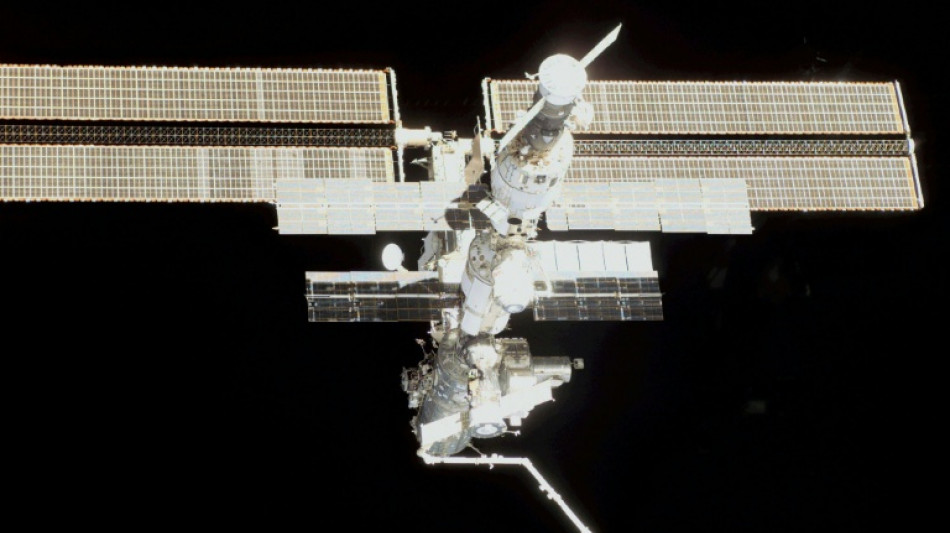
Leak on space station triggers brief safety alert / Photo: - - NASA/AFP/File

 NAND Prices Set to Fall in Early 2027 as DRAM Remains Elevated

 NSE and BSE Restrict Algorithmic Trading to Tech-Savvy Investors with Static IP

 Report Finds Large UK Fishing Fleet Violates Rules Two-Thirds of Time

 COP31 Negotiations Collapse as Youth Climate Demands Clash with Fossil Fuel Lobbying

 Craig Reucassel’s Ultra-Processed Food Experiment Reveals Brain Changes

 Seattle U Defeats Loyola Chicago 76-63 to Win Acrisure Series Title
Astronauts working on the International Space Station briefly sheltered in a docked capsule Friday as Russian colleagues assessed leak repairs, NASA said.
Five astronauts had briefly entered the docked Dragon spacecraft as a precautionary measure -- the capsule functions as a lifeboat of sorts in the case an evacuation is needed.
NASA gave the all clear and the astronauts were able to return to their stations.
A NASA spokesperson told AFP that Roscosmos cosmonauts took measurements of the leaks and were now assessing data.
"With today's operations, they wanted to be extra safe, extra precautionary, and have the crew move into the safe haven posture," the spokesperson said.
NASA spokesperson Bethany Stevens then said on social media that "NASA has instructed the crew members inside the Dragon spacecraft to end the safe haven procedures and return to planned operations aboard the International Space Station."
In a statement cited by Russian state media, Russia's Roscosmos space agency said that while pressurizing the transfer chamber, known as PrK, a leak was recorded.
"During an inspection of the PrK, the cosmonauts discovered two potential air leak sites. The first was promptly sealed by applying the first layer of the two-component sealant 'Germetall‑1.' The second site is located on the conical part of the PrK. Work is underway to prepare for its sealing," read the statement.
NASA's Stevens had previously said the transfer tunnel had suffered cracks and leaks for some time.
"NASA and Roscosmos have been working to determine the root cause of the cracks, and Roscosmos manages the issue through operational mitigation measures and periodic partial-repair efforts," she said.
NASA and Russia's Roscosmos are two primary operators of the International Space Station.
Continuously inhabited for the last quarter-century, the aging ISS is scheduled to be pushed into Earth's orbit before crashing into an isolated spot in the Pacific Ocean in 2030.
The ISS, once a symbol of warming post-Cold War relations, has been a rare area of continued cooperation between the West and Russia since Moscow invaded Ukraine in 2022.
O.Gutierrez--AT