Microsoft unveils AI models in push for independence from OpenAI / Photo: Martin LELIEVRE - AFP

 NAND Prices Set to Fall in Early 2027 as DRAM Remains Elevated

 NSE and BSE Restrict Algorithmic Trading to Tech-Savvy Investors with Static IP

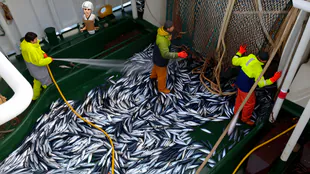 Report Finds Large UK Fishing Fleet Violates Rules Two-Thirds of Time

 COP31 Negotiations Collapse as Youth Climate Demands Clash with Fossil Fuel Lobbying

 Craig Reucassel’s Ultra-Processed Food Experiment Reveals Brain Changes

 Seattle U Defeats Loyola Chicago 76-63 to Win Acrisure Series Title
Microsoft unveiled its own cutting-edge artificial intelligence models in San Francisco on Tuesday, a crucial step toward reducing its dependence on OpenAI, the creator of ChatGPT.
The first company to have invested massively in OpenAI, Microsoft has for several years been seeking to reduce its dependence on its Sam Altman-led partner. It renegotiated their alliance last year and retains only a non-exclusive license on its technology until 2032.
"It's important that we are self-sustaining," said Sophie Lebrecht, hired in March to the group's AI team, during a press visit to its Silicon Valley campus.
At its annual developer conference, Microsoft Build, the group unveiled MAI-Thinking-1, its first "reasoning" model -- AI systems that break down problems step by step before responding, similar to offerings from OpenAI, Google or Anthropic.
Microsoft says it built the model "from scratch" with "no distillation" of rival models -- a common shortcut that involves copying a competitor's outputs to train a new system more cheaply and quickly.
The tool, still limited to a select group of customers, arrives roughly a year-and-a-half behind pioneers such as OpenAI and Google.
Microsoft also unveiled other in-house models for generating images, transcribing audio, creating synthetic voices and coding.
Joining the broader Silicon Valley craze, the group aims to ride the wave of so-called "agentic" AI, which has moved the technology beyond a simple chatbot to one that acts on your behalf.
It unveiled Microsoft Scout, an "always-on" assistant -- for preparing meetings, managing schedules and drafting emails -- based on OpenClaw, the open-source software whose global popularity launched this wave in late 2025.
Scout is available only to a limited circle of customers. Last week, Google unveiled its own autonomous agent, Gemini Spark, reserved for its premium US subscribers.
Microsoft also announced an Nvidia-powered mini-PC, the Surface RTX Spark Dev Box, capable of running AI models offline, as well as an AI platform dedicated to scientific research.
Th.Gonzalez--AT