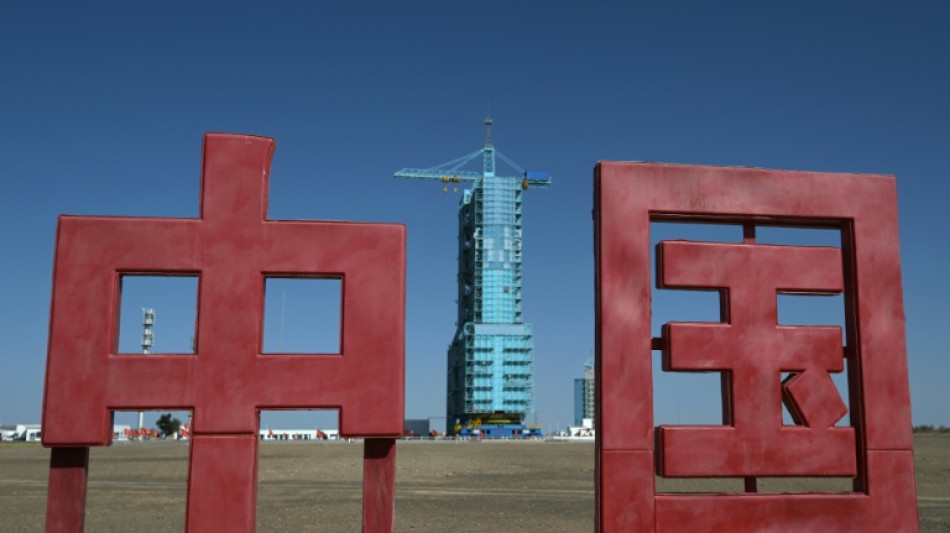
China set for latest space launch, with Hong Kong astronaut aboard / Photo: Pedro PARDO - AFP/File

 UAE Weather Forecast: Scattered Showers and Fog Expected as Temperatures Drop

 2027 Lexus GX 550 Pricing Revealed for Canada Across Six Trims

 Monaco Startup Monamedia Launches App Paying Users to Watch Ads
 НЕМЕЦКАЯ ALIX LASERS БЕРЁТ НА ОБСЛУЖИВАНИЕ ВСЕХ КЛИЕНТОВ АВСТРИЙСКОЙ ALIX LASERS

 ALIX LASERS GERMANY TAKES OVER CUSTOMER CARE FOR ALL ALIX LASERS AUSTRIA CUSTOMERS

 Miss Universe 2026: Viewing Guide for South African Fans

A Hong Kong astronaut will join a Chinese space mission for the first time as part of a three-person crew launching on Sunday, as Beijing edges closer to its goal of landing people on the Moon.
The Tiangong space station -- crewed by teams of three astronauts that are typically rotated every six months -- is the crown jewel of China's space programme, boosted by billions in state investment in a bid to catch up with the United States and Russia.
The Shenzhou-23 mission will blast off at 11:08 pm (1508 GMT) on Sunday from the Jiuquan Satellite Launch Center in northwestern China, carrying three astronauts to the space station, China Manned Space Agency (CMSA) spokesman Zhang Jingbo told reporters on Saturday.
The team comprises Lai Ka-ying, hailed by state media as Hong Kong's first astronaut, Zhu Yangzhu and Zhang Zhiyuan, the spokesman said.
Hong Kong's Chief Executive John Lee congratulated Lai on passing "the rigorous selection and training process".
Flight engineer Zhu, who participated in the Shenzhou-16 mission in 2023, will be the commander.
"This is a ... test of our physical and psychological endurance, emergency response capabilities, coordination and teamwork, as well as our ability to work and live in orbit," Zhu told reporters.
"As mission commander, what I have thought about most is how to make thorough preparations in every aspect and how to lead the team in successfully completing the flight mission with zero mistakes and zero errors."
- Space dream -
The mission's primary objectives are to "continue carrying out space science and application work, conduct astronauts' extravehicular activities and cargo transfer in and out of the cabin", the CMSA's Zhang told reporters.
One of the astronauts will remain on the station for a year, he added, without specifying who.
"Arranging for an astronaut to carry out a one-year in-orbit residency experiment is by no means a simple matter of adding together two six-month missions in terms of duration," Zhang said.
The one-year space residency, Zhang said, will collect data on astronauts on longer-duration spaceflights and test health support capabilities.
China is "steadily" building operational experience for "sustained occupation" of its Tiangong space station, and year-long missions are an important step towards future lunar and potentially deep-space ambitions, said Macquarie University's Richard de Grijs.
"A year in orbit pushes both hardware and humans into a different operational regime compared with the shorter Shenzhou missions of the programme's earlier phases," the professor of physics and astronomy told AFP.
Beijing's space programme, the third to put humans in orbit, has also landed robotic rovers on Mars and the Moon.
China has ramped up plans to achieve its "space dream" under President Xi Jinping.
Beijing says it aims to send a crewed mission to the Moon by 2030, with the goal of constructing a base on the lunar surface.
The CMSA said on Saturday it would "make every possible effort and strive tirelessly" to achieve that goal.
W.Stewart--AT