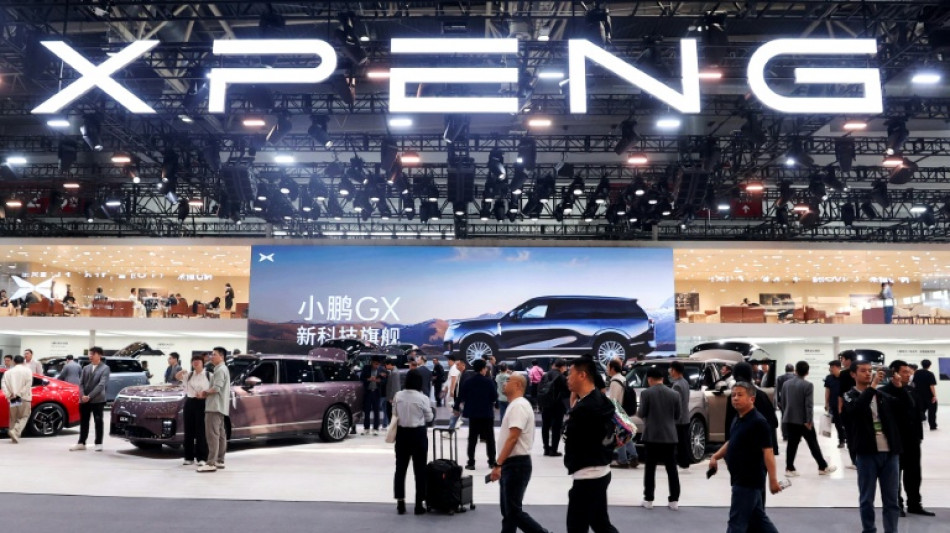
'Joint venture in reverse': foreign carmakers seek edge with China partners / Photo: - - CN-STR/AFP

 The British historian helping the French rediscover de Gaulle

 Dodgers beat Braves to advance, Guardians survive in MLB playoffs

 Latin American, Caribbean women top Nobel literature buzz

 US says Fiji-based Chinese official paid bribes for Beijing

 After botched US execution, Christa Pike was nearly taken off life support

 Guinea-Bissau junta urges military unit loyal to ex-president to disarm
 As species decline, green turtles offer glimmer of hope

 Brothers Scott and Beauden Barrett named to start for All Blacks

 EU trade chief seeks to dial down China tensions

 'Never again Bolsonaro': thousands march ahead of Brazil election runoff

 After botched execution, US woman was nearly taken off life support before revival

 Searing AIDS drama 'Elsinore' opens London film festival

 Evicted pensioner who sparked Spain housing protests dies: tenant union

 Golf star Rahm quitting LIV tour over 'unacceptable' terms

 Thousands march fearing return of a Bolsonaro presidency in Brazil

 French PM denies police ordered to confront student protesters

 Rubio touts US power, calls on Europe to emerge from 'slumber'

 Trump says 'we don't think' Russian plague is bio-weapon

 Five children among 26 killed in Ukraine after Russian strikes

 Man City should 'accept' punishment for rule breaches, says Lineker

 US woman who survived botched execution is awake and speaking

 From 1800s to modern pharma: a Nobel-winning chemistry quest

 Southampton boss Eckert given suspended ban over 'Spygate'

 Russia warns of 'false' information as second plague case reported

 IEA ready to release more oil reserves if necessary

In a sprawling office in Hefei, the eastern Chinese electric vehicle hub, hundreds of employees and several robotic arms sat refining software developed jointly by German behemoth Volkswagen and Chinese EV maker XPeng.
The days when foreign firms saw such partnerships largely as a necessary entrance fee to the world's largest auto market are long gone.
Legacy overseas brands are now seeking out collaboration, hoping the domestic market's blistering pace and technological innovation will rub off and boost their competitiveness in China and increasingly, abroad.
VW-XPeng's China Electronic Architecture (CEA) -- software that controls a car's electronics -- was delivered within 18 months, said Frank Han, CEO of Cariad China, VW's software company.
Without XPeng's cooperation, it would have taken much longer, he told reporters on a trip this week ahead of a major auto show in Beijing.
"In Germany, (it would take) at least three to four years," he said.
From China's opening up until recently, carmakers seeking market access had to enter a joint venture with a local, often state-owned company.
As well as sharing profits, domestic firms benefited from their overseas partners' shared technology and best practice.
"You can basically call the current situation 'the reverse joint venture'," said Zhang Yu, managing director of Shanghai-based consultancy Automotive Foresight.
"Foreign partners are starting to use local Chinese partners' technology or EV platforms to modify -- or actually directly build a new car -- based on their Chinese partners' car."
- 'Shocking moment' -
For decades, China was a cash cow for many legacy brands, requiring minimal investment and offering huge gains.
But as the EV age dawned, helped by top-down policy such as generous subsidies, Chinese firms hit the throttle.
After the isolation of Covid and against a backdrop of sliding sales, the 2023 Shanghai auto show was "a shocking moment" for foreign visitors, UBS analyst Paul Gong told AFP.
He described the relative speeds of pandemic-era development as like "interstellar travelling -- inside, China had leapt forwards while outside, global carmakers lagged".
China is now considered by many as leading in areas like smart cockpits, battery technology and assisted driving systems.
Ford CEO Jim Farley has called the progress "the most humbling thing I've ever seen".
By 2025, foreign brands were increasingly adopting Chinese tech.
Autonomous driving collaborations included VW with Horizon Robotics, Audi with Huawei, and a variety of firms including Toyota and GM with Momenta.
Models like the Nissan N7, Mazda EZ60, and SAIC Audi E5 were developed using joint venture partners' platforms, and investment was poured into research and development teams in China.
- 'China for the world' -
Companies are increasingly explicit they hope in-China investments will boost their competitiveness overseas, especially as Chinese firms begin their own expansions abroad.
"The know-how we gained (in China) is compelling us towards our goal of becoming a leading tech player in the automotive industry worldwide," VW Group CEO Oliver Blume said on Monday, calling the country "the fitness centre of the automotive industry".
He told AFP that VW was eying other Asian countries and South America as places that might be receptive to its China-developed offerings.
His counterpart at rival BMW told state news agency Xinhua last year that "the supply chain here is not only about China for China, but it's also China for the world".
For Japan's Nissan, exports are set to become "a strategic pillar", the company said in April, as its in-China sales slow.
The China-developed N7 and Frontier Pro will be sent to South America and Southeast Asia, with the latter additionally shipped to the Middle East.
"Our brand is still relevant, even in a very difficult market like China," CEO Ivan Espinosa told reporters.
"And if you can compete in China, you can compete outside of China."
France's Renault, meanwhile, has stopped selling cars in China but uses its partnerships there for tech development.
One example is the Dacia Spring, manufactured by state-owned Dongfeng, a small EV which significantly undercut competitors when it began selling in Europe in 2021.
- Ecosystem advantage -
The scorecard for foreign automakers' pivot is "mixed", said UBS's Gong.
While they have not regained market share in China, "their products and technologies have improved", which could help them in other markets like Europe, he said.
"Their challenges would be greater without" that strategy, he concluded.
To an extent, foreign firms have little choice.
"The advantage Chinese firms hold is not tied to a single technology or model, but to an integrated ecosystem," Chris Liu from research group Omdia told AFP.
The combination of software engineering talent, proximity to suppliers, and real-world data accessibility "is difficult for foreign automakers to replicate outside of China".
And foreign brands need to make "drastic decisions" that go beyond just product, said founder of Sino Auto Insights, Tu Le.
"It's culture, speed, shuttering brands, eliminating management that don't have the right skills to lead them," he said.
"'Learning' (from Chinese firms) is only part of the answer."
B.Torres--AT