
Four Independent Studies Validate The Blight Tolerance Of Darling American Chestnut Trees

 The British historian helping the French rediscover de Gaulle

 Dodgers beat Braves to advance, Guardians survive in MLB playoffs

 Latin American, Caribbean women top Nobel literature buzz

 US says Fiji-based Chinese official paid bribes for Beijing

 After botched US execution, Christa Pike was nearly taken off life support

 Guinea-Bissau junta urges military unit loyal to ex-president to disarm

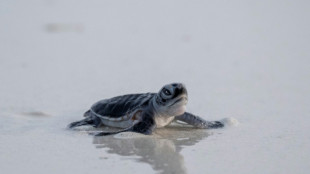 As species decline, green turtles offer glimmer of hope

 Brothers Scott and Beauden Barrett named to start for All Blacks

 EU trade chief seeks to dial down China tensions

 'Never again Bolsonaro': thousands march ahead of Brazil election runoff

 After botched execution, US woman was nearly taken off life support before revival

 Searing AIDS drama 'Elsinore' opens London film festival

 Evicted pensioner who sparked Spain housing protests dies: tenant union

 Golf star Rahm quitting LIV tour over 'unacceptable' terms

 Thousands march fearing return of a Bolsonaro presidency in Brazil

 French PM denies police ordered to confront student protesters

 Rubio touts US power, calls on Europe to emerge from 'slumber'

 Trump says 'we don't think' Russian plague is bio-weapon

 Five children among 26 killed in Ukraine after Russian strikes
 Man City should 'accept' punishment for rule breaches, says Lineker

 US woman who survived botched execution is awake and speaking

 From 1800s to modern pharma: a Nobel-winning chemistry quest

 Southampton boss Eckert given suspended ban over 'Spygate'

 Russia warns of 'false' information as second plague case reported

 IEA ready to release more oil reserves if necessary

New data demonstrate that transgenic American chestnuts produce significantly smaller blight cankers than their wild-type counterparts
MCGRAW, NY / ACCESS Newswire / April 25, 2026 / Today, SilvaBio, in collaboration with academic partners, reports findings from four independent experiments demonstrating that transgenic American chestnut trees consistently tolerate blight, the fungal disease that rendered the species functionally extinct in the early 19th century. This expanding body of evidence-spanning studies conducted by Purdue University, the University of New England (UNE) and SUNY College of Environmental Science and Forestry (ESF)-provides validation of the single-transgene approach and reinforces its application for restoration of this keystone species across its native range.
American chestnut trees (Castanea dentata) carrying the oxalate oxidase (OxO) transgene consistently develop smaller blight cankers than their wild-type counterparts after deliberate exposure to chestnut blight fungus, when measured under comparable conditions at each site. Across six separate comparisons-conducted by multiple research groups using varied experimental designs, inoculation protocols, and pathogen strains-the transgenic trees produced cankers 30% to 81% smaller, providing robust evidence that validates blight tolerance.
In addition, at three sites, Chinese chestnuts were tested alongside transgenic American chestnuts under identical inoculation conditions. While Chinese chestnut trees are considered to provide the "gold-standard" comparison for blight tolerance, transgenic trees performed comparably to their Chinese counterparts.
Collectively, these results provide the most comprehensive evidence to date that the OxO transgene confers reproducible, meaningfully enhanced blight resistance under controlled conditions.
According to Dr. Andrew Newhouse, Ph.D., director of the chestnut research program at ESF, "These results confirm that Darling American chestnuts can tolerate blight infections in multiple outdoor environments. We are proud to work with this team of partners and collaborators, and look forward to continued progress on this critical conservation project."
"At the University of New England, we have arrived at a body of evidence indicating that the American chestnuts carrying the OxO gene are better able to tolerate the fungal blight compared to their full sibling counterparts without the gene," said Dr. Thomas Klak, Ph.D., professor in the School of Marine and Environmental Programs. "We see no negative impacts on maturation from carrying the OxO gene and good field performance by the OxO trees when inoculated with a virulent strain of the blight."
"For over a century, the American chestnut has been absent from our forests. These four independent studies offer the strongest evidence to date that we are on the right path to restore it," said Michael Bloom, SilvaBio CEO.
John Dougherty, American Chestnut Restoration Vice President for Science, "These studies confirm that the ESF lab and green house screens successfully predicted that Darling has sustainable blight tolerance performance in field trials that is equal to or better than Chinese standard."
Results by Site
Across multiple independent field and experimental trials, transgenic American chestnut trees consistently developed substantially smaller blight cankers than non-transgenic controls.
University of New England (UNE): Transgenic trees showed ~30-36% reductions in canker length across two years of trials.
Purdue University: Across large, multi-year field trials, transgenic trees exhibited ~46-50% reductions in canker area.
SUNY College of Environmental Science and Forestry (ESF):
In young seedlings, transgenic trees had up to 81% smaller cankers than wild-type trees.
In older field-grown trees, reductions remained substantial at ~62%.
Background
Once a cornerstone of eastern forests, the American chestnut made up as much as a quarter of the canopy across its 25-state native range. In the early 1900s, a fungal blight killed an estimated 4 billion trees, rendering the species functionally extinct within decades and leaving a lasting ecological and economic void. After years of research, scientists at SUNY ESF developed the first blight-tolerant, fully American chestnut, known as "Darling 54," marking a major breakthrough built on ongoing collaboration among American Chestnut Restoration Inc., SilvaBio, and other partners.
Building on this work, SilvaBio is advancing restoration by moving the Darling line from the lab to scalable, real-world deployment. Using genomic prediction, accelerated breeding, and advanced micropropagation, the company is developing and producing a robust, genetically-diverse range of resilient seedlings for forest-scale reintroduction. These capabilities enable earlier selection of disease-tolerant trees, compress breeding timelines, and support large-scale production needed for meaningful restoration, pending deregulation.
Together, these findings support the effectiveness of the OxO-based transgenic approach as a viable path to restoring the American chestnut and provide the scientific foundation for extending this platform to other at-risk species, including ash, oak, and elm.
To learn more about the Darling 54 American chestnut restoration project, please visit https://www.restorechestnut.org/.
To learn more about SilvaBio, please visit https://www.silvabio.com/.
###
About SilvaBio
SilvaBio is a biotechnology company addressing hardwood tree disease, beginning with the restoration of the American chestnut and expanding to other threatened species such as ash and elm. U.S. forests contribute over $350 billion annually and absorb nearly 15% of national carbon emissions, yet invasive diseases are outpacing traditional restoration. SilvaBio combines advanced genomics, accelerated breeding ("Lightspeed"), and proprietary micropropagation to develop resilient, regionally adapted trees and scale their deployment-enabling restoration at the scale our forests require. To learn more, please visit https://www.silvabio.com/.
About SUNY College of Environmental Science & Forestry
The SUNY College of Environmental Science and Forestry (ESF) is dedicated to the study of the environment, developing renewable technologies, and building a sustainable and resilient future through design, policy, and management of the environment and natural resources. Members of the College community share a passion for protecting the health of the planet and a deep commitment to the rigorous application of science to improve the way humans interact with the mo world. The College offers academic programs ranging from the associate of applied science to the Doctor of Philosophy. ESF students live, study and do research on the main campus in Syracuse, N.Y., and on 25,000 acres of field stations in a variety of ecosystems across the state. To learn more, please visit https://www.esf.edu/chestnut/.
About The University of New England
The University of New England is Maine's largest independent university, with campuses in Biddeford and Portland, Maine, a campus in Tangier, Morocco, and a robust array of online programs. UNE combines rigorous academic preparation with hands-on, purpose-driven learning in health, science, marine and environmental studies, and the liberal arts. As Maine's leading provider of health professionals, UNE prepares students to address the interconnected challenges of human and planetary health in a rapidly changing world. To learn more, please visit https://www.une.edu/.
Media Contact:
Sheila Smith,
Communications Director, SilvaBio
[email protected]
203.917.8644
Data Sources
Klak, T., Travis, S., May, V. G., Tan, E. H., Chatfield, M. W. H., & Wheeler, M. (2025). Two-year field trial of genetically engineered American chestnut reveals greater fungal blight tolerance compared to wild-type full-sibling trees. bioRxiv.
Kell, C. (2025). Two-year field screening of Darling 54 transgenic American chestnut progeny in the Central Hardwood region. Hardwood Tree Improvement and Regeneration Center, Purdue University. Public comment in support of Darling 54 deregulation, APHIS Docket No. APHIS-2020-0030-19913.
ESF Darling Science Update (2023). Available at: https://www.esf.edu/chestnut/science-update/index.php.
SOURCE: SilvaBio
View the original press release on ACCESS Newswire
E.Flores--AT