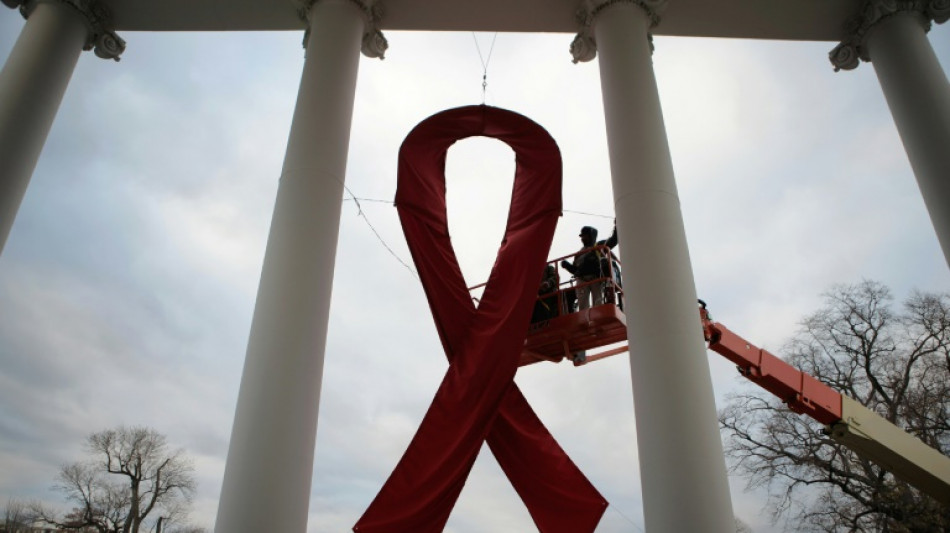
Norwegian effectively cured of HIV after transplant from brother / Photo: CHIP SOMODEVILLA - GETTY IMAGES NORTH AMERICA/AFP/File

 Quarantine, unease and rumours: Russian city grapples with plague scare

 Taiwan says exports hit record in September on AI demand

 Marc Marquez vows to 'attack' Martin's lead at Indonesian MotoGP

 Diplomats, schools in Saudi take safety measures after blasts heard: sources to AFP

 In Beijing, EU trade envoy says deficit with China 'unsustainable'

 Sri Lanka's de Silva quits as Test captain

 Alcaraz feeling 'mentally fresh' ahead of Shanghai return

 Israel drastically reduces British diplomatic presence in Jerusalem

 Stocks fall further as oil surge fans fresh inflation worries

 North Korea demands South show 'utmost respect' to restore relations

 Saudi says three dead in airport attacks claimed by Houthis

 'Mad dream': New showcase for African film opens in London

 All Blacks coach Rennie says Wallabies exit 'part of the game'

 The growing protests against India's poll body - and PM Modi

 Stocks fall further as oil spike fans fresh inflation worries
 Bad COP, worse COP? EU tempers hopes for UN climate summit

 Rookie Henry named in Wallabies midfield to face All Blacks
 Housing crisis set to dominate Spain's snap election

 Gas, health care, utilities: high costs squeeze US midterm voters

 New Zealand Rugby seeks injunction over PNG Chiefs name
 Samsung expects 780% quarterly operating profit jump on AI boom

 InterContinental Hotels Group PLC Announces Transaction in Own Shares - October 08

 Battery X Metals Announces Corporate Awareness Agreement

 As species decline, green turtles offer glimmer of hope

 Brothers Scott and Beauden Barrett named to start for All Blacks

A Norwegian man has been effectively cured of HIV after receiving a stem cell transplant from his brother, doctors announced on Monday.
The patient's brother happened to carry a rare, virus-blocking genetic mutation.
The 63-year-old man, dubbed the "Oslo patient", is the latest in around 10 people worldwide who have gone into long-term remission from HIV after receiving a transplant to treat unrelated blood cancer.
The high-risk procedure normally requires a donor to have a specific mutation of their CCR5 gene, which blocks HIV from entering the body's cells.
Only around one percent of people in northern Europe have the necessary mutation.
The Oslo patient, who had been living with HIV since 2006, was diagnosed with a fatal blood cancer called myelodysplastic syndrome in 2017.
His doctors searched for a donor who would help treat both. When they couldn't find one, they chose the man's elder brother.
However, on the day of the transplant in 2020, the doctors were stunned to discover that the brother carried the CCR5 mutation.
"We had no idea... That was amazing," doctor Anders Eivind Myhre of the Oslo University Hospital told AFP.
- 'Winning the lottery twice' -
The patient said "it was like winning the lottery twice", added Myhre, who was also the lead author of a study describing the case in Nature Microbiology.
Two years after the transplant, the patient stopped taking the anti-retroviral drugs which had been reducing the level of HIV in his body.
The researchers found no trace of the virus in samples of the man's blood, gut and bone marrow.
"For all practical purposes, we are quite certain that he is cured," Myhre said.
Now the Oslo patient, whose name was not revealed, is "having a great time" and has more energy than he knows what to do with, Myhre said.
The painful and potentially dangerous transplant procedure is for people who have both HIV and deadly blood cancer so is not a feasible option for the millions of people living with the virus across the world.
However, researchers believe that studying these rare cases will reveal more about how HIV works in the hope of finding a cure for all patients.
- 'No longer a patient' -
The Oslo patient is the first person to receive a transplant from a family member.
The patient's immune system had been "completely replaced" by the donor's, sqaid study co-author Marius Troseid of the University of Oslo.
It was the first time this had been observed in a cured patient's bone marrow and gut, he told AFP.
Even before the researchers found out the brother had a CCR5 mutation, they had some hope that the Oslo patient's HIV could be cured.
That is because in 2024 it was revealed that the so-called "next Berlin patient" entered long-term remission despite receiving a transplant that did not have two copies of the mutated gene.
The original Berlin patient, Timothy Ray Brown, was the first person declared cured of HIV back in 2008. Patients in London, New York, Geneva, Duesseldorf and elsewhere followed.
Given the Oslo patient's robust health, Troseid suggested that his nickname was no longer suitable.
"The Oslo patient is perhaps no longer a patient. At least he doesn't feel like it," Troseid said.
A.Ruiz--AT