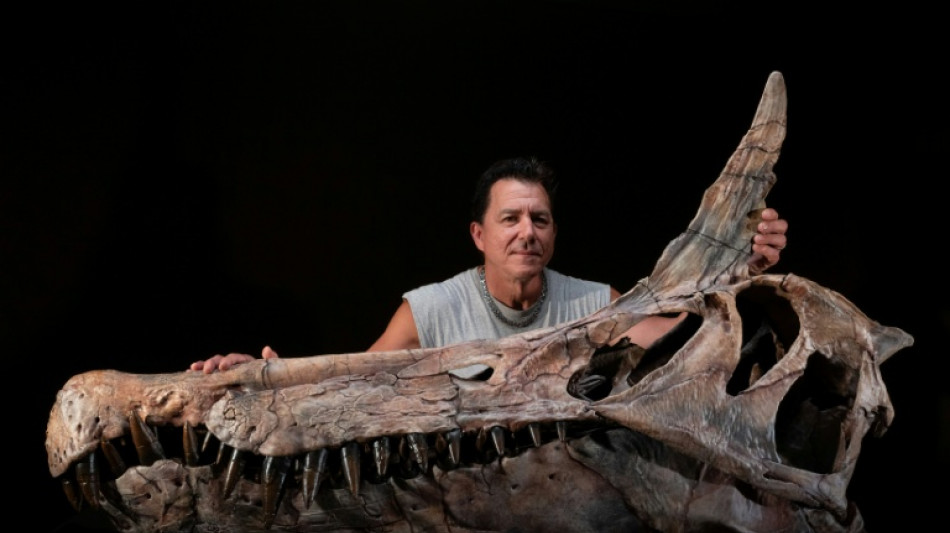
Scientists discover giant bird-like dinosaur in Niger desert / Photo: Keith Ladzinski - Fossil Lab, University of Chicago/AFP

 Steve Young Says 49ers' 'Grinding Personalities' Prevent Early Peak

 Oil Prices Drop Nearly 3% on Libyan Pipeline Restart and Middle East Supply Concerns

 Construction Boarding to Launch AI Training Program for Vocational Students in October 2026

 Kuwait’s CMA to Launch Fourth Strategic Plan in April 2027

 Belgian F-16s Deploy Counter-Drone Rockets in Riga for First Time
Deep in the desert of Niger, scientists have unearthed an unknown species of dinosaur, a giant fissvery of its kind in more than a century.
Around 95 million years ago, the Spinosaurus -- a massive beast with a blade-shaped head crest and interlocking teeth -- roamed the African continent.
Scientists believe it rivalled the fearsome Tyrannosaurus rex in size, measuring around 40 feet long with a 20-inch sword-like crest on its head.
Researchers dug up fossils that belonged to the Spinosaurus mirabilis -- or "hell heron", in the words of Paul Sereno, the University of Chicago palaeontologist and lead author of the research published in the journal Science.
"Look at the length of the skull, the length of the neck, and the length of the hind limb -- you're in heron territory."
Spinosaurus mirabilis lived when forests and rivers covered the now-barren Sahara. Previously, most spinosaurid fossils had been found near coastlines in North Africa.
Some scientists thought these fish-eating creatures may have been fully aquatic, gliding through deep waters to snare prey.
But this time, the fossils were discovered further inland, hundreds of miles from what would have been the nearest ocean.
"I think it was an animal that could have waded easily into the water," Sereno said.
"But I do not think it was a diver, I do not think it was a good swimmer."
- 'Earth-shattering site' -
The search began in 2019 in the Sahara Desert, where French geologist Hugues Faure had said he found a tooth belonging to the giant predator Carcharodontosaurus in the 1950s.
"We've got a couple of things that Faure could never dream of. We have GPS coordinates, we have drones and better vehicles," said Sereno.
The barren sands yielded nothing and the team, disheartened, headed back to their camp.
But a Tuareg man in a black trench coat approached Sereno's team on a motorcycle, claiming to know where "big bones" lay.
After a long journey through the desert, Sereno worried they "had made a mistake".
"We jokingly said, are we still in Niger? I mean, we drove for a day and a half until we had no more gas to spare because we wouldn't get back."
But eventually they reached a remote site where the "biggest bones... I have ever seen in my life" emerged from the ground.
Far out in the desert, the researchers gaped at the six-foot-long femur, the jaw, teeth, and base of the crest.
In 2022, Sereno returned with a 100-person team and 64 Nigerien guards to excavate the "earth-shattering site".
They unearthed a skull, fragments of the hind legs and several crests.
"The crest was like nothing we'd ever seen before," said Sereno.
Some were brought to tears, he said, by the "overwhelming" experience.
"It's actually like looking at a digital image of your new dinosaur and gawking over it in the tent in the middle of the Sahara."
The team realised "it was a new species... and it was going to be a landmark discovery."
"That's your Jurassic Park moment... one to remember for a lifetime."
W.Stewart--AT