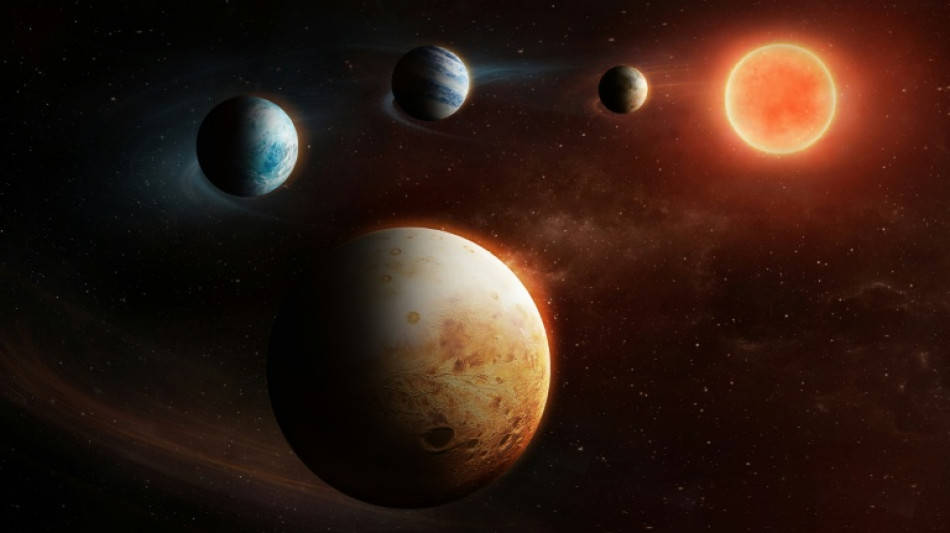
Strange 'inside-out' planetary system baffles astronomers / Photo: Handout - ESA/AFP

 Flydubai co-pilot planned suicide attack on Tel Aviv airport: UAE prosecutor

 Mike Ditka: Chicago Bears icon as player and coach

 Outrage over plan to livestream US military firing squad execution

 US sanctions: a 'test of resilience' for ICC

 NFL legend Mike Ditka dead at 86

 Hurricane Isaias set to strike Gulf Coast late Friday

 Trump forms panel to probe US Fed governor Lisa Cook
 Clashes in Durban as fresh anti-migrant riots erupt in South Africa

 France students plan more protests, UN 'concerned' over violence
 De Zerbi calls on struggling Spurs to react in Man Utd clash

 US sanctions on ICC: a 'test of resilience'

 Outrage over US military plan to livestream firing squad execution

 Argentina snap up defence guru Edwards ahead of World Cup

 BMW pulls car lease offer from German far-right politician

 Brazil election offers Jair Bolsonaro a shot at revenge

 Man Utd boss Carrick 'personally' affected by Man City verdict

 Evolution Metals & Technologies Corp. Raises Fiscal 2026 Revenue Guidance 62% at Midpoint to $10–$11 Million and Reaffirms $400–$460 Million Fiscal 2027 Outlook

 Red Bull's Verstappen takes pole position for Singapore GP sprint race

 Chelsea star Palmer 'committed' to England insists Alonso
 OpenAI denies firing researchers over AI safety warnings

 Turkey warns opposition, press over investment fund crisis

 Hurricane Isaias now major storm as it heads to US Gulf Coast

 Djokovic crashes out of Shanghai Masters in his first match

 EU says Turkey's crackdown on rights hampers membership bid

 Two Renoir paintings stolen in France recovered: mayor

Surprised astronomers said Thursday they have discovered a star with planets in a bizarre order that defies scientific expectations -- and suggests these faraway worlds formed in a manner never seen before.
In our Solar System, the four planets closest to the Sun are small and rocky, while the four farther out are gas giants.
Scientists had thought this planetary order -- rocky first, then gaseous -- was consistent across the universe.
However, a star called LHS 1903 discovered in the Milky Way's thick disc suggests otherwise.
An international team of astronomers analysing data from several different telescopes had already spotted three planets orbiting the red dwarf star, which is cooler and less bright than our Sun.
The closest planet to the star was rocky, followed by two gas giants. That is the order scientists expect.
But digging into observations made by Europe's exoplanet-probing Cheops space telescope revealed a fourth planet farther out in the system -- and it is rocky.
"That makes this an inside-out system, with a planet order of rocky-gaseous-gaseous-and then rocky again," explained Thomas Wilson, the lead author of a new study describing the discovery in the journal Science.
"Rocky planets don't usually form so far away from their home star," the planetary astrophysicist from University of Warwick in the UK said in a statement.
- One planet after another -
Inner planets are expected to be small and rocky because intense radiation from the nearby star blasts most of the gas away from their rocky core.
But farther out in the cold reaches of the system, a thick atmosphere can form around cores, creating gas giants.
Puzzled by the weird LHS 1903 planetary system, the team of astronomers tried to figure out what could have happened.
After ruling out several possibilities, they came up with a scenario: what if the planets formed one at a time?
According to the most widely accepted theory, planets form simultaneously in a massive ring of gas and dust called a protoplanetary disc. This involves tiny dust grains clumping together then snowballing into cores that eventually evolve into mighty planets.
However, by the time the fourth planet orbiting LHS 1903 formed, "the system may have already run out of gas," Wilson said.
"Yet here is a small, rocky world, defying expectations," he added.
"It seems that we have found first evidence for a planet which formed in what we call a gas-depleted environment."
Since the 1990s, astronomers have discovered more than 6,000 planets outside our Solar System -- called exoplanets -- mostly by spotting slight changes in brightness as they cross in front of their star.
"Historically, our planet formation theories are based on what we see and know about our Solar System," said Isabel Rebollido, a planetary disc researcher at the European Space Agency.
"As we are seeing more and more different exoplanet systems, we are starting to revisit these theories."
M.O.Allen--AT