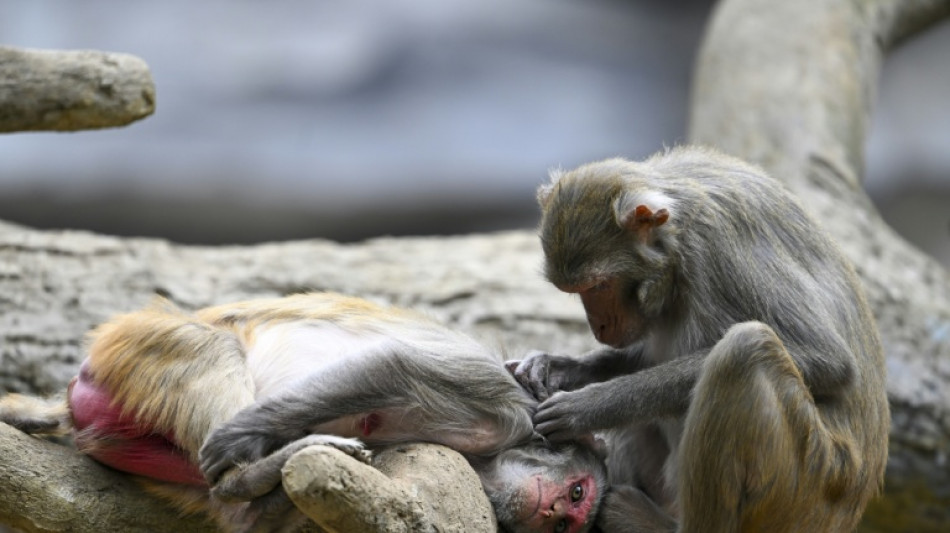
Scientists reveal what drives homosexual behaviour in primates / Photo: JOHAN ORDONEZ - AFP/File

 アレックス・ボディ、CRIFとともに透明性の高い投資と徹底した資金洗浄防止に注力

 Brennan holds off Schauffele for PGA Tour win in Japan

 ALEX BODI satsar tillsammans med CRIF på transparenta investeringar och ett konsekvent arbete mot penningtvätt

 ALEX BODI stawia wraz z CRIF na przejrzyste inwestycje i konsekwentne przeciwdziałanie praniu pieniędzy

 알렉스 보디, CRIF와 함께 투명한 투자와 철저한 자금세탁방지에 주력

 ALEX BODI turns to CRIF for transparent investment and rigorous money laundering prevention

 The 'cockroach' protests against India's election body
 Power, water, jobs: Google on India data centre concerns

 Google faces backlash against India data centre

 Trump urges Zelensky replacement as diesel row rages

 New Yorkers snap up discarded subway signs, seats at annual sale

 Messi nets brace to win in first match after Argentina exit

 Ravindra fit for New Zealand ODI series against India

 All Blacks lose four players for second Wallabies Test

 Spanish women return to action with 2-0 friendly win over USA

 Bordeaux-Begles end wait for away win before Champions Cup defence

 Traumatized Panamanians begin quake recovery

 Palestinian Mahmoud Abu Hamda wins top photography prize at Bayeux

 Inter Milan dominate Parma to go top of Serie A

 Barca extend perfect streak, Atletico scrape late win

 10-man Tottenham strike back to hold Man Utd

 Gordon nets first Barca goal as Liga leaders beat Getafe

 Trump, Zelensky clash over diesel deal as Russian strikes kill 21

 Thousands join pro-Palestinian marches in several European cities

 Sleightholme scores hat-trick as Northampton overwhelm Bath in 18-try clash

Homosexual behaviour in primates has a deep evolutionary basis and is more likely to occur in species that live in harsh environments, are hunted by predators or live in more complex societies, scientists said Monday.
Males or females of the same sex mounting or otherwise stimulating each other have been documented across the animal kingdom.
More than 1,500 different species have been observed engaging in same-sex sexual behaviour, with some of the earliest reports dating back to the ancient Greek philosopher Aristotle.
But this relatively common behaviour was long dismissed by the scientific community as a "Darwinian paradox". This held that homosexual behaviour in animals goes against Charles Darwin's theory of evolution because it does not pass down genes through reproduction.
More recently, scientists have shown that this behaviour can in part be inherited from an animal's parents -- and can provide an evolutionary advantage.
"Diversity of sexual behaviour is very common in nature, among species and in animal societies -- it is as important as caring for offspring, fighting off predators or foraging for food," Imperial College London biologist Vincent Savolainen told AFP.
Savolainen has been studying rhesus macaques in Puerto Rico for eight years. His team found that male macaques who mount each other form alliances that could give them access to more females -- and therefore eventually more offspring.
In 2023, the team also determined that the macaques inherited same-sex behaviour from their parents more than six percent of the time -- but whether this trait was passed down depended on a range of factors.
- 'Deep evolutionary root' -
For his new study, published in the journal Nature Ecology & Evolution, Savolainen and colleagues collected data on 491 non-human primate species.
They identified same-sex sexual behaviour in 59 species, including lemurs, great apes and monkeys across the Americas, Africa and Asia.
That the behaviour was so widespread indicates it has a "deep evolutionary root," the study said.
The researchers then investigated how environment, social organisation and "life history" traits affected whether primates engaged in homosexual acts.
They found that the behaviour was more common in species that lived in harsh environments with limited access to food, such as barbary macaques.
It was also more common in species more likely to be hunted by predators -- vervet monkeys, for example, have to avoid all sorts of big cats and snakes in Africa.
- Stress reliever? -
This all suggests that homosexual behaviour could help manage tension among primate groups during periods of stress, the researchers said.
The behaviour was also more common among species in which males and females are dramatically different sizes, such as mountain gorillas.
These size differences often occur in animals which live in larger social groups with intense competition and stricter social hierarchies. Animals which have males and females of a similar size tend to live in pairs or smaller family units.
Same-sex sexual behaviour therefore "may function as a flexible social strategy, used to reinforce social bonds, manage conflict or build alliances, depending on the ecological and social pressures faced by different species," the study said.
The researchers theorised that similar factors could have played a role in human ancestors.
"Our ancestors certainly had to face the same environmental and social complexities," Savolainen said.
"But there are things that are completely unique to modern humans, who have a complexity of sexual orientation and preference that we do not address at all," he said.
The study also warned against "misinterpretation or misuse of our findings," such as "a misguided notion that social equality might eliminate" same-sex sexual behaviour in modern humans.
Isabelle Winder, an anthropologist at Bangor University in the UK not involved in the study, praised the research.
"It is their study's demonstration that modern comparative methods can, for perhaps the first time, realistically illuminate some of the complexities of the evolution of 'humanlike' behaviours that I find most exciting," she commented in Nature.
A.Taylor--AT