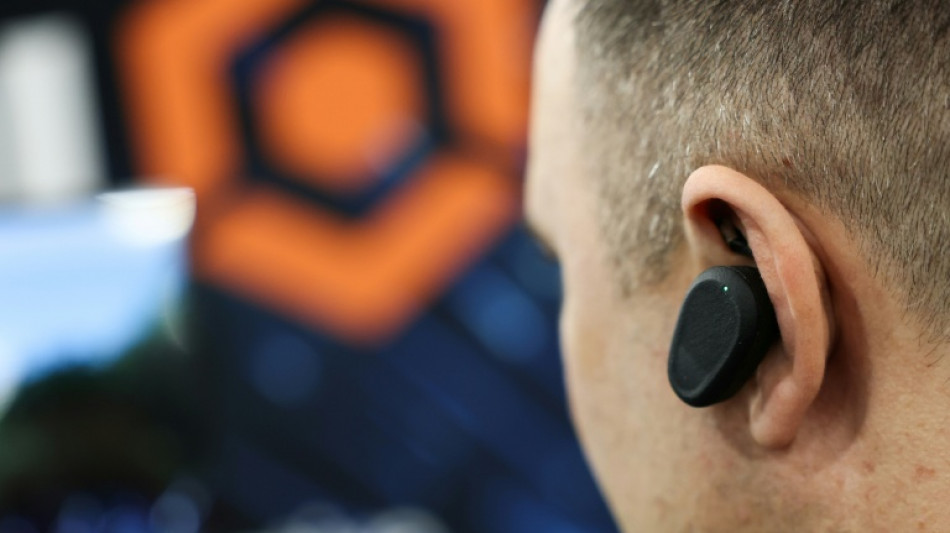
From music to mind reading: AI startups bet on earbuds / Photo: Patrick T. Fallon - AFP

 Brennan keeps his cool in Japan for third PGA Tour victory

 Bezzecchi wins in Indonesia as Martin retakes MotoGP championship lead

 US Open finalist Shelton dumped out in Shanghai third round

 India releases 'cockroach' leaders as movement calls for more protests

 Ο ALEX BODI δίνει έμφαση, σε συνεργασία με την CRIF, στις διαφανείς επενδύσεις και στη συστηματική πρόληψη της νομιμοποίησης εσόδων από παράνομες δραστηριότητες

 ALEX BODI sází ve spolupráci s CRIF na transparentní investice a důslednou prevenci praní špinavých peněz

 एलेक्स बोदी क्रिफ के सहयोग से पारदर्शी निवेश और धनशोधन की कड़ाई से रोकथाम पर ज़ोर देते हैं

 ALEX BODI 攜手 CRIF,推動透明投資並貫徹洗錢防制

 Indian court releases 'cockroach' movement leaders from detention

 Indonesia releases eight orangutans rescued from fires to protected forest

 Russian Yandex data centre operations disrupted after drone strike

 Architect fights to save India's past, built on 'stone, tears and sweat'

 Hurricane Simon strengthens as it nears western Mexico

 'Everyone is angry': Okinawans fearful and frustrated after killing

 Trump's trade wars sting US manufacturers ahead of midterms

 Kenyan great Kipchoge wins first marathon in three years

 Barca extend perfect streak, Real Madrid survive Vinicius red

 PSG ease to Ligue 1 win before Manchester City test

 Real Madrid edge Villarreal, Vinicius sent off for hair pull

 Carrick demands more 'streetwise' Man Utd after Spurs setback

 10-man Tottenham ramp up pressure on Man Utd boss Carrick

 India 'cockroach' movement says thousands detained in Delhi protest

 Injury ends season for NHL Rangers star goalie Shesterkin

 Ten-man Spurs rescue draw at Man Utd, Arsenal survive Leeds scare

 Inter Milan dominate Parma to go top in Serie A

AI companies are on the hunt to design the ideal device to deliver AI's superpowers, and some new enterprises are convinced that headphones or earbuds are the way.
Startups have for a while tried to beef up headphones beyond their basic functions, like listening to music and making phone calls.
Nearly a decade ago, tech startups Waverly Labs and Mymanu added real-time translation to that list, and Google quickly followed suit, creating a voice-activated AI assistant in 2020.
Riding the AI wave, other tech industry leaders Samsung and Apple have also entered the fray, with noise cancellation now almost a product standard.
Startups, many of which are attending this week's CES consumer electronics extravaganza in Las Vegas, are now trying to refine this technology and apply it to specific uses.
Such is the case with OSO, which wants to take the concept of a professional assistant further.
Its earbuds will record meetings and retrieve conversation elements on demand using everyday language.
Viaim, a competitor, offers similar services and intends to focus on interoperability in a world controlled by major smartphone manufacturers that impose their own platforms.
"If you use a different brand of cell phone, it doesn't have any AI functions at all. That's the opportunity for our earbuds," explained Shawn Ma, CEO of Viaim, whose devices are compatible with all brands, including iPhones in China.
Timekettle, meanwhile, is enjoying success in a completely different context, with "90 percent of its sales coming from schools," according to Brian Shircliffe, head of US sales for the Chinese company.
Many schools equip their non-English-speaking students with the devices so they can follow lessons without the need for a translator.
- Reading minds -
As for whether earbuds can replace smart glasses, connected speakers, or even smartphones as the dominant physical extension of generative AI, remains unanswered.
For now, any AI functionality "is really dependent on the phone that it's connected to," said Ben Wood, chief analyst at CCS Insight.
"Earbuds are certainly a more accessible entry for AI than smart glasses," said Avi Greengart, president of Techsponential, a consultancy.
"They're a lot less expensive, they're a product most smartphone users are buying anyway, and they don't require a prescription."
However, "people generally don't wear them all the time," unlike glasses, "and they can only interact with voice, so you'll need to be in an environment where talking is acceptable," the analyst cautioned, adding that the lack of a camera limits the device's potential.
Some won't be constrained by the shortcoming, notably Naqi Logix, whose Neural Earbuds are equipped with ultra-sensitive sensors that detect tiny movements.
Thanks to these sensors, a quadriplegic user can control their wheelchair or surf the internet simply by looking at their computer screen.
Operations manager Sandeep Arya sees great potential for these innovations, "because people would like to be able to interact with their environment in a more discreet, subtle way," without having to call out to Siri on their smartphone, Alexa on their speaker, or Meta on their glasses.
Arya envisions the technology going further, thanks to improved sensors capable of deciphering facial movements that a chatbot can use to find the right tone and words according to mood.
Neurable, another startup whose MW75 Neuro LT headset measures brain activity, dreams of using its equipment to enable communication through thought, without gestures or words.
"It's remarkable," says Ben Wood of these breakthroughs, "but it's still a niche market for now."
Until further notice, "the hundreds of millions of headphones that have been sold will remain focused on listening."
A.Taylor--AT