'Wetware': Scientists use human mini-brains to power computers / Photo: Fabrice COFFRINI - AFP

 African players in Europe: Mbeumo ends goal drought as United draw

 France's high school students plan fresh protests

 NZ bank in free speech row over 'explicit' sheep memes

 China Open champ Zheng withdraws from Wuhan citing fatigue

 Brewers edge Dodgers 2-1 in National League Championship Series opener

 Pope to have surgery to remove lung nodule

 Stocks rise as oil prices tumble after Trump hails 'energy ceasefire'

 Man City charges cloud hangs over Premier League season

 Top NATO commander set to issue warning to Russia over any attack

 Software, sprints, trolls: Singapore Grand Prix talking points

 Riyadh airport hit by fresh Houthi strike day after deadly attack

 InterContinental Hotels Group PLC Announces Transaction in Own Shares - October 12

 Yokogawa Brings Publication-Backed Validation from More Than 60,000 Scientific Publications to Its CSU Spinning Disk Confocal Systems with Bioz

 Trump's 'energy ceasefire' sparks confusion as Russia strikes Ukraine

 Dupont double helps Toulouse avoid Bayonne slip-up in Top 14

 Marseille snap losing skid with win at Troyes

 Lula stages mass rally ahead of Brazil's presidential run-off

 Poland holds suspect in alleged assassination plot against PM Tusk

 Russia hits Ukraine power plants despite Trump energy ceasefire claim

 Isco's Betis rise back above Real Madrid to third

 Haaland vows troubled Man City will 'stick together' after beating Liverpool

 Abhishek, Arshdeep guide India to T20 win over West Indies

 'Other Mommy' scares up N. American box office win

 Zelensky surprised, Moscow mum as Trump announces energy ceasefire

 Ready Player 1: Paris to host 2027 edition of EVO combat video games event

Inside a lab in the picturesque Swiss town of Vevey, a scientist gives tiny clumps of human brain cells the nutrient-rich fluid they need to stay alive.
It is vital these mini-brains remain healthy, because they are serving as rudimentary computer processors -- and unlike your laptop, once they die, they cannot be rebooted.
This new field of research, called biocomputing or "wetware", aims to harness the evolutionarily honed yet still mysterious computing power of the human brain.
During a tour of Swiss start-up FinalSpark's lab, co-founder Fred Jordan told AFP he believes that processors using brain cells will one day replace the chips powering the artificial intelligence boom.
The supercomputers behind AI tools like ChatGPT currently use silicon semiconductors to simulate the neurons and networks of the human brain.
"Instead of trying to mimic, let's use the real thing," Jordan said.
Among other potential advantages, biocomputing could help address the skyrocketing energy demands of AI, which have already threatened climate emissions targets and led some tech giants to resort to nuclear power.
"Biological neurons are one million times more energy efficient than artificial neurons," Jordan said. They can also be endlessly reproduced in the lab, unlike the massively in-demand AI chips made by companies like behemoth Nvidia.
But for now, wetware's computing power is a very long way from competing with the hardware that runs the world.
And another question lingers: could these tiny brains become conscious?
- Brain power -
To make its "bioprocessors," FinalSpark first purchases stem cells. These cells, which were originally human skin cells from anonymous human donors, can become any cell in the body.
FinalSpark's scientists then turn them into neurons, which are collected into millimetre-wide clumps called brain organoids.
They are around the size of the brain of a fruit fly larvae, Jordan said.
Electrodes are attached to the organoids in the lab, which allow the scientists to "spy on their internal discussion," he explained.
The scientists can also stimulate the organoids with a small electric current. Whether they respond with a spike in activity -- or not -- is roughly the equivalent of the ones or zeroes in traditional computing.
Ten universities around the world are conducting experiments using FinalSpark's organoids -- the small company's website even has a live feed of the neurons at work.
Benjamin Ward-Cherrier, a researcher at the University of Bristol, used one of the organoids as the brain of a simple robot that managed to distinguish between different braille letters.
There are many challenges, including encoding the data in a way the organoid might understand -- then trying to interpret what the brain cells "spit out," he told AFP.
"Working with robots is very easy by comparison," Ward-Cherrier said with a laugh.
"There's also the fact that they are living cells -- and that means that they do die," he added.
Indeed, Ward-Cherrier was halfway through an experiment when the organoid died and his team had to start over. FinalSpark says the organoids live for up to six months.
At Johns Hopkins University in the United States, researcher Lena Smirnova is using similar organoids to study brain conditions such as autism and Alzheimer's disease in the hopes of finding new treatments.
Biocomputing is currently more "pie in the sky," unlike the "low-hanging fruit" use of the technology for biomedical research -- but that could change dramatically over the next 20 years, she told AFP.
- Do organoids dream of electric sheep? -
All the scientists AFP spoke to dismissed the idea that these tiny balls of cells in petri dishes were at risk of developing anything resembling consciousness.
Jordan acknowledged that "this is at the edge of philosophy," which is why FinalSpark collaborates with ethicists.
He also pointed out that the organoids -- which lack pain receptors -- have around 10,000 neurons, compared to a human brain's 100 billion.
However much about our brains, including how they create consciousness, remains a mystery.
That is why Ward-Cherrier hopes that -- beyond computer processing -- biocomputing will ultimately reveal more about how our brains work.
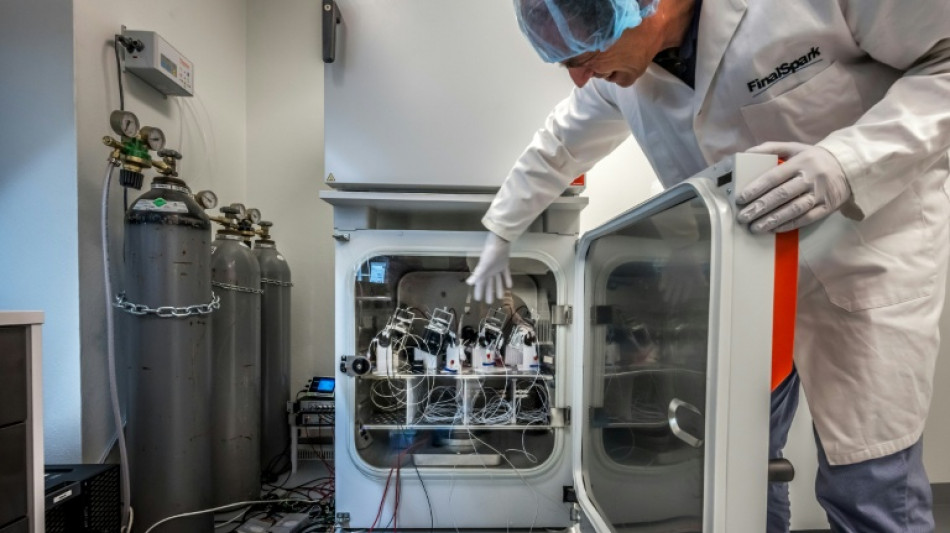
Back in the lab, Jordan opens the door of what looks like a big fridge containing 16 brain organoids in a tangle of tubes.
Lines suddenly start spiking on the screen next to the incubator, indicating significant neural activity.
The brain cells have no known way of sensing that their door has been opened, and the scientists have spent years trying to figure why this happens.
"We still don't understand how they detect the opening of the door," Jordan admitted.
W.Nelson--AT