-
 Dow boosted as markets rotate from tech shares
-
Trump says he wants Zelensky to 'make a deal' with Russia
-
 Zelensky hails resumption of US advance warning of strikes on Ukraine
-
'I want it so badly': PSG heartbreak fuelling Arsenal, says Arteta

-
 Carrick says only wins can ease doubts over Man Utd future
-
Lula campaign seeks to disqualify Bolsonaro over Meta 'interference'
-
 Top NBA Draft pick Dybantsa to miss opener with ankle sprain
-
All who profited from fund scandal 'identified': Turkish minister
-
 Italy sends troops, toughens security laws after Milan clashes
-
Christina Applegate says she was misdiagnosed with MS
-
 Alberta separatists vow to fight on, risking turmoil for Canada
-
Ronaldo let Man Utd down says Ten Hag

-
 Two men re-arrested for suspected spying for Iran in airbase scare: UK police
-
Meta says it complied with Brazil court order to treat candidates equally
-
 Guatemalan man gets 30 years for truck smuggling deaths of 53 migrants
-
Inequality is major factor in impact of non-communicable diseases : WHO
-
 'Clayface' gets under the skin of the superhero genre
-
Italy to send 500 troops to Milan after clashes
-
 Zelensky, US envoys hold Oslo talks as Ukraine claims US missile holdup
-
BBC slashes 100 jobs, closes two channels

-
 All-rounder Minhas stars as Pakistan crush England in tri-series
-
Tech jitters lead stocks lower, oil surges then slides
-
 Bavuma hits 179, Rabada strikes as South Africa dominate
-
Wild West Wing? Turmoil revives memories of Trump 1.0
-
 Allrounder Minhas stars as Pakistan crush England in tri-series
-
Tap water no longer drinkable near South Africa capital
-
 Albania PM blames 'hybrid war' for week of unrest
-
Arsenal coach Arteta always a leader, says former teammate Gnabry

-
 Bavuma hits 179 to lead South African fightback
-
Investors pledge 230 billion euros at German summit: Merz
-
 Solid GM results overshadowed by latest jump in commodity costs
-
Emery adamant injuries 'no excuse' for Aston Villa
-
 Houthi attacks undermine Saudi Arabia's economic ambitions
-
UN demands aid access to besieged Yemen city Taiz
-
 French PM vows 'massive' police deployment for new demonstrations
-
Faletau still in Tandy's plans despite being left out of Wales squad

-
 Power outage hits Google Cloud services, disrupting UK banks
-
Stock markets retreat as oil rises again
-
 AI challenges maths by solving the unsolvable
-
Those who profited from fund scandal 'identified': Turkish minister
-
 Turkey troops to stay in Syria, Iraq 'until border security ensured', defence minister tells AFP
-
At half a century, Senegal's Orchestra Baobab bets on new generation

-
 Kulusevski a 'different man' after emotional Spurs return
-
O'Connor, Sivakov join Seixas at Decathlon CMA CGM

-
 Nawaz and Minhas lift Pakistan to 302-9 in England ODI
-
Faletau left out of Wales squad for Nations Championship

-
 Mourinho warns no 'untouchable' stars at Real Madrid
-
Rubio says India diversifying oil, trade deal 'very close'
-
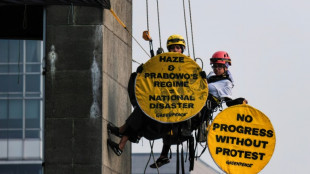 Indonesian anger builds over wildfires, toxic haze
-
Marco Rubio Travels to India as Trade Talks Reach Difficult Stage

Tough-talking right-winger elected Costa Rica president
Right-wing political scientist Laura Fernandez won Costa Rica's presidential election on Sunday by a landslide, after promising to crack down hard on rising violence linked to the cocaine trade.
Fernandez's nearest rival, center-right economist Alvaro Ramos, conceded defeat as results showed the ruling party far exceeding the threshold of 40 percent needed to avoid a run-off.
With 81.24 percent of polling stations counted, the political heir of outgoing President Rodrigo Chaves had 48.94 percent of the vote compared to 33.02 percent for Ramos.
As soon as the first results were announced, members of Fernandez's Sovereign People's party erupted in celebrations around the country, waving blue, red and white-striped Costa Rican flags.
"Viva Rodrigo Chaves," some cheered, in a nod to Fernandez's mentor.
Appearing via video link at her party's official election night party in the capital San Jose, Fernandez, 39, thanked Chaves for giving her "the confidence to be president-elect of Costa Rica" and told him that his legacy was in good hands.
She added that she would "fight tirelessly" to ensure Costa Rica "continues on the path of economic growth, freedom, and above all, the progress of our people."
The country of 5.2 million people, famous for its white-sand beaches, has long been seen as an oasis of stability and democracy in Central America,
But in recent years, it has gone from transit point to logistics hub in the global drug trade.
Drug trafficking by Mexican and Colombian cartels have seeped into local communities, fuelling turf wars that have caused the murder rate to jump 50 percent in the past six years, to 17 per 100,000 inhabitants.
Fernandez cites iron-fisted Salvadoran President Nayib Bukele, who has locked up thousands of suspected gang members without charge, as an inspiration on how to tamp down crime.
Bukele was the first foreign leader to congratulate her.
Fernandez's win confirms a rightward lurch in Latin America, where conservatives have ridden anger with corruption and/or crime to win power in Chile, Bolivia, Argentina and Honduras.
- Attacks on the judiciary -
Chaves plucked Fernandez from relative anonymity to serve as planning minister and chief of staff.
In a conversation with her on Sunday night Chaves said he was confident that under her leadership "there will be neither dictatorship, nor communism."
Chaves presided over a sharp rise in violence but avoided blame by pointing the finger at the judiciary, saying it was too soft on crime.
Jessica Salgado, 27, said she voted for Fernandez as the continuity candidate, because she felt the government was on the right track, even if violence had increased.
"The violence exploded because they (the government) are going after the ringleaders, it's like dragging rats out of the sewer," Salgado told AFP.
Costa Ricans also voted for members of the 57-seat Legislative Assembly on Sunday.
Partial results showed Fernandez's party winning around 39 percent of the vote.
Her detractors fear she will try to change the constitution to allow Chaves to return as president after her four-year mandate ends.
Under the current constitution, he is barred from seeking re-election until he has been out of power for eight years.
Former president Oscar Arias, winner of the 1978 Nobel Peace Prize, warned on Sunday that the "survival of democracy" was at stake.
"The first thing dictators want to do is to reform the Constitution to stay in power," he said, alluding to Chaves.
Fernandez insists that she is committed to upholding Costa Rica's democratic tradition.
- Cocaine smuggling hub -
The drug trade has sucked in the high-density "precarios" (informal settlements) of cities such as the capital San Jose, where shootouts between rival drug gangs are increasingly frequent.
Fernandez has vowed to complete construction of a maximum-security prison modelled on Bukele's brutal Terrorism Confinement Center (CECOT).
She has also promised to stiffen prison sentences and to impose a Bukele-style state of emergency in areas worst hit by crime.
Bukele is a hero for many in Latin America, credited with restoring security to a nation traumatized by crime.
G.P.Martin--AT