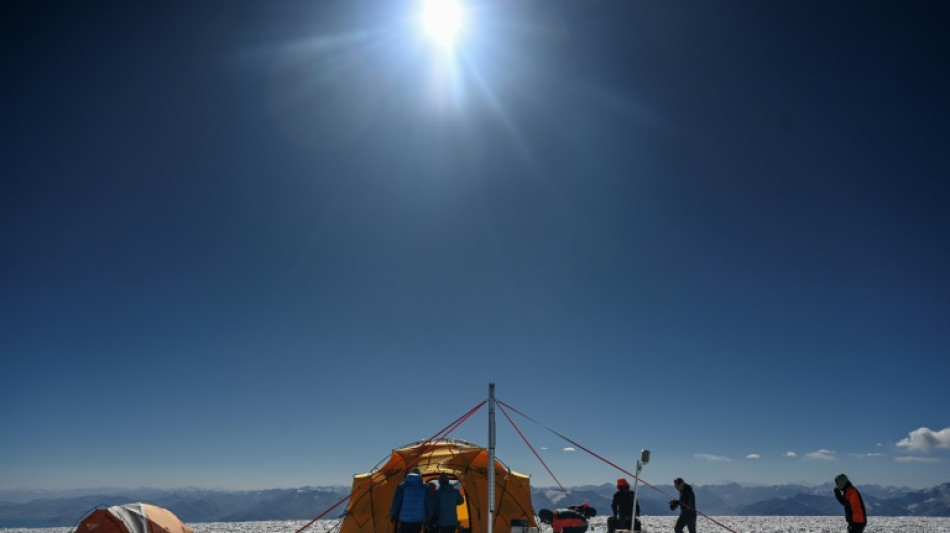
Scientists probe Tajik glacier for clues to climate resistance / Photo: Prakash MATHEMA - AFP

 African players in Europe: Mbeumo ends goal drought as United draw
 France's high school students plan fresh protests

 NZ bank in free speech row over 'explicit' sheep memes

 China Open champ Zheng withdraws from Wuhan citing fatigue

 Brewers edge Dodgers 2-1 in National League Championship Series opener

 Pope to have surgery to remove lung nodule

 Stocks rise as oil prices tumble after Trump hails 'energy ceasefire'
 Man City charges cloud hangs over Premier League season

 Top NATO commander set to issue warning to Russia over any attack
 Software, sprints, trolls: Singapore Grand Prix talking points

 Riyadh airport hit by fresh Houthi strike day after deadly attack

 InterContinental Hotels Group PLC Announces Transaction in Own Shares - October 12

 Yokogawa Brings Publication-Backed Validation from More Than 60,000 Scientific Publications to Its CSU Spinning Disk Confocal Systems with Bioz

 Trump's 'energy ceasefire' sparks confusion as Russia strikes Ukraine

 Dupont double helps Toulouse avoid Bayonne slip-up in Top 14

 Marseille snap losing skid with win at Troyes

 Lula stages mass rally ahead of Brazil's presidential run-off

 Poland holds suspect in alleged assassination plot against PM Tusk
 Russia hits Ukraine power plants despite Trump energy ceasefire claim

 Isco's Betis rise back above Real Madrid to third

 Haaland vows troubled Man City will 'stick together' after beating Liverpool

 Abhishek, Arshdeep guide India to T20 win over West Indies

 'Other Mommy' scares up N. American box office win

 Zelensky surprised, Moscow mum as Trump announces energy ceasefire

 Ready Player 1: Paris to host 2027 edition of EVO combat video games event

Greenland is melting, the Alps are melting and the Himalayas are melting -- yet in one vast mountain region, huge glaciers have remained stable, or even gained mass, in recent decades. Can it last?
To find out, a dozen scientists, accompanied exclusively by an AFP photographer, trekked high over one glacier in eastern Tajikistan to drill for ice cores -- ancient, deep samples that can shed precious light on climate change.
In September and October, they first spent four days crossing the country from west to east in four-wheel drives, then climbed on foot to over 5,800 metres altitude on the Kon-Chukurbashi ice cap, near the Chinese border.
Camping for a week at the summit, in freezing temperatures and despite a day-long blizzard, the scientists from Switzerland, Japan, the United States and Tajikistan drilled the glacier to extract two 105-metre-long ice cores, in sections.
These layers of ice, compacted over centuries, perhaps millennia, form an archive of climate indicators, yielding data on past snowfall, temperatures, atmosphere and dust.
They must now be analysed in a laboratory to reveal their dates, said the leader of the team, Evan Miles, a glaciologist affiliated with the universities of Fribourg and Zurich.
"We're hopeful for a truly unique core, not just for the region, but for the broader region actually, probably extending back 20 to 25 or 30,000 years."
- Glacier temperature anomaly -
The apparently resistant glaciers are spread over thousands of kilometres of high mountain ranges in Central Asia, including Karakoram, Tian Shan, Kun Lun and the Pamir mountains of Tajikistan.
By delving back in time in the ice there, researchers hope to find out why these glaciers have resisted the general planetary warming of recent decades -- and whether this so-called "Karakoram anomaly" could be ending.
"This whole region is globally unique because over the last 25 years, these glaciers have shown very, very limited mass loss and even mass gain," said Miles.
The glaciers have shown some limited signs of loss in recent years, but scientists want to determine whether this is a natural variation or the beginning of a real decline.
"In order to understand that, we really, really need to have a longer time period of records of both temperature and precipitation at the glacier sites," said Miles.
"That's the type of information that an ice core can tell us."
- Glacier climate analysis -
One core will be sent to Japan for analysis and another stored in an underground sanctuary in Antarctica at minus 50C.
That naturally cold storage site is a project of the Ice Memory Foundation, which supported the Tajikistan expedition along with main funder, the Swiss Polar Institute.
The foundation, created in 2021 by French, Italian and Swiss universities and research centres, has already collected several cores in the Alps, Greenland, the Andes and elsewhere.
Future scientists will "be able to analyse (them) with their most modern analytical tools in 50, 100, 200 years and extract new information", said Ice Memory's president Thomas Stocker.
"We will probably lose 90 percent of our glacier mass on the Earth," Stocker told AFP. "So we are trying to help preserve a thing that is threatened by human action."
The scientists were scheduled to review their mission during a news conference in the Tajik capital Dushanbe on Monday.
Th.Gonzalez--AT