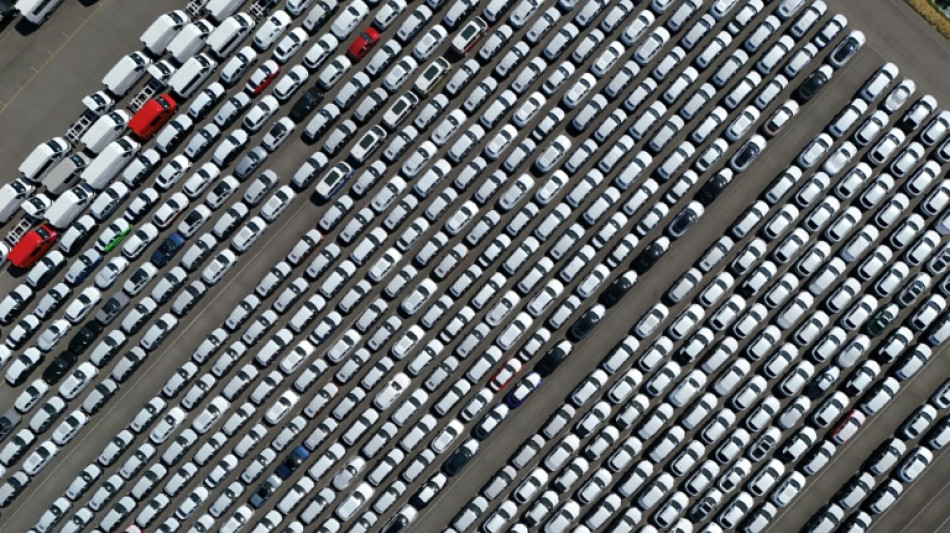
Will EU give ground on 2035 combustion-engine ban? / Photo: Ina FASSBENDER - AFP

 France's debt climbs to highest since 1978: ministry

 McIlroy two shots off the lead at Wentworth after eagle on 18
 Martinez brace saves Inter in Serie A top-two clash with Roma

 Rosenior abused but guides Paris FC past old club Strasbourg

 Seven-try Lyon beat Pau, climb to Top 14 summit

 Brighton defeat a 'big lesson' against complacency for Arsenal, says Arteta

 Thousands protest inaction over climate crisis in Switzerland

 Carapaz out of cycling world championships

 'Fragile' Tottenham beaten by Aston Villa despite late rally

 Mourinho hails Real Madrid grit before Atletico derby clash

 Martin wins Austrian MotoGP sprint after Acosta crash

 Japan edge Fiji to win Pacific Nations Cup

 Black smoke, flames rising near Riyadh airport: residents to AFP

 UK actor Naomi Watts honoured at Spain film festival

 Japan emperor declares Asian Games open after turbulent build-up

 Asian Games open with unity message after troubled build-up

 Denmark hails 'binding' Greenland deal with Trump
 We don't want Games host Japan losing money, says Asian Olympic official

 Ed Sheeran returns to stage after Palestinian controversy

 Asian Games to open in Japan after troubled build-up

 Drone owners rush to offload devices ahead of Beijing ban
 Trump's beef policies irk Texas ranchers, testing their loyalty

 New to The Street Broadcasts Tonight at 6:30 PM ET Across the United States, Latin America and MENA, Featuring BioVie, Acurx Pharmaceuticals, Lantern Pharma and SafeSpace Global

 Nvidia, OpenAI CEOs to attend Xi dinner at White House
 Anthropic picks Accenture for in-house AI safety evaluation

Europe's embattled auto industry and its backers are ramping up pressure on the EU to relax its planned 2035 ban on new petrol and diesel car sales -- hoping for a decision by year end.
The European Commission is due to review the target on December 10 as part of a broader rescue plan for the sector but competing demands from member states and industry risk forcing it to push back the date.
The goal of switching all new cars to electric by 2035 was set in 2023 as a flagship measure of the EU's environmental Green Deal and a key step towards the bloc achieving climate neutrality by 2050.
But two years on, calls are mounting to revise the target in the name of "pragmatism".
"Our sector has received the most stringent target as it was perceived to be one of the easiest to decarbonise," the European Automobile Manufacturers' Association (ACEA) said in a policy paper.
"But the reality has proven much more complicated."
Meanwhile, Chinese carmakers are flooding the European market with cheaper electric models, sparking fears of an unprecedented crisis among the bloc's manufacturers, with mass layoffs and factory closures looming.
"The ground is slipping beneath our feet," the head of France's Plateforme automotive industry group Luc Chatel warned last month, saying the sector was the victim of "political and dogmatic choices, not technological ones".
- Germany, Italy push for exemptions -
German Chancellor Friedrich Merz has emerged as a leading voice in support of carmakers, urging Brussels to allow sales of plug-in hybrids, range-extender vehicles and highly efficient combustion engines beyond 2035.
Italy wants new cars running on biofuels to remain legal after the deadline.
In the opposing camp, France wants to stick as closely as possible to the all-electric trajectory to safeguard massive investments already made by its carmakers.
"If we abandon the 2035 target, forget about European battery plants," President Emmanuel Macron warned after an EU summit in October.
France is calling for EU support for battery production and proposing mandatory electrification of corporate fleets using European-made vehicles to avoid favouring Chinese brands. Germany opposes such fleet rules.
BMW chief Oliver Zipse argued in Brussels this week that making corporate fleets go fully electric would amount to bringing the combustion-engine ban "through the back door".
Lucien Mathieu, of the Transport & Environment advocacy group, warned meanwhile that exemptions for biofuels "would be a terrible mistake", citing their poor carbon record and unintended impacts such as deforestation.
P.A.Mendoza--AT



