UK spearheads polar climate change research as US draws back / Photo: HENRY NICHOLLS - AFP

 African players in Europe: Mbeumo ends goal drought as United draw
 France's high school students plan fresh protests

 NZ bank in free speech row over 'explicit' sheep memes

 China Open champ Zheng withdraws from Wuhan citing fatigue

 Brewers edge Dodgers 2-1 in National League Championship Series opener

 Pope to have surgery to remove lung nodule

 Stocks rise as oil prices tumble after Trump hails 'energy ceasefire'
 Man City charges cloud hangs over Premier League season

 Top NATO commander set to issue warning to Russia over any attack
 Software, sprints, trolls: Singapore Grand Prix talking points

 Riyadh airport hit by fresh Houthi strike day after deadly attack

 InterContinental Hotels Group PLC Announces Transaction in Own Shares - October 12

 Yokogawa Brings Publication-Backed Validation from More Than 60,000 Scientific Publications to Its CSU Spinning Disk Confocal Systems with Bioz

 Trump's 'energy ceasefire' sparks confusion as Russia strikes Ukraine

 Dupont double helps Toulouse avoid Bayonne slip-up in Top 14

 Marseille snap losing skid with win at Troyes

 Lula stages mass rally ahead of Brazil's presidential run-off

 Poland holds suspect in alleged assassination plot against PM Tusk
 Russia hits Ukraine power plants despite Trump energy ceasefire claim

 Isco's Betis rise back above Real Madrid to third

 Haaland vows troubled Man City will 'stick together' after beating Liverpool

 Abhishek, Arshdeep guide India to T20 win over West Indies

 'Other Mommy' scares up N. American box office win

 Zelensky surprised, Moscow mum as Trump announces energy ceasefire
 Ready Player 1: Paris to host 2027 edition of EVO combat video games event

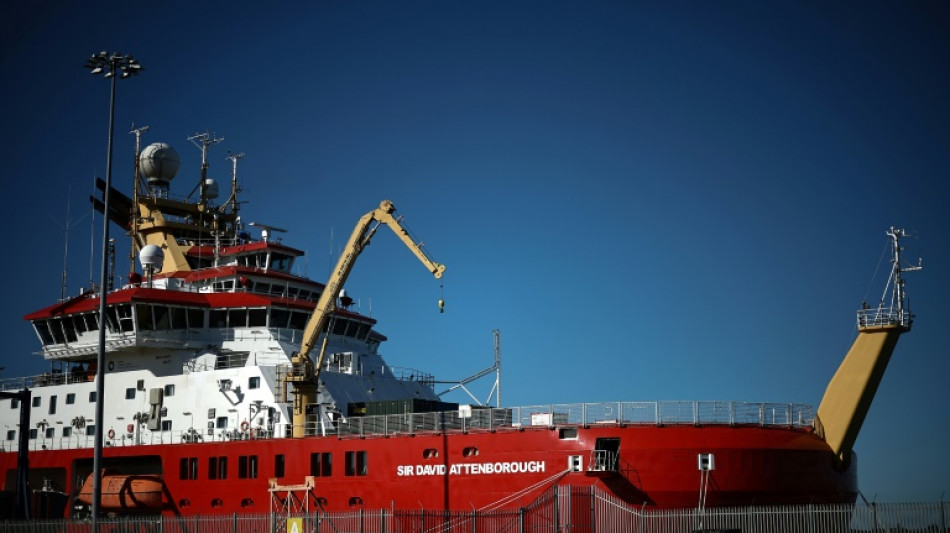
Britain's flagship polar research vessel heads to Antarctica next week to help advance dozens of climate change-linked science projects, as Western nations spearhead studies there while the United States withdraws.
The RRS Sir David Attenborough, a state-of-the-art ship named after the renowned UK naturalist, will aid research on everything from "hunting underwater tsunamis" to tracking glacier melt and whale populations.
Operated by the British Antarctic Survey (BAS), the country's polar research institute, the 15,000-tonne icebreaker, boasting a helipad and various laboratories and gadgetry, is pivotal to UK efforts to assess climate change's impact there.
"The saying goes 'what happens in Antarctica doesn't stay in Antarctica'," BAS oceanographer Peter Davis told AFP during a tour of the vessel as it prepared to depart Harwich, eastern England, on Monday.
He called it "a shame" that the United States was "drawing back" from scientific exploration in the region.
But Davis noted that "lots of countries are stepping up to the plate and saying 'we understand the importance of Antarctica and we're going to drive our scientific research there'".
He is partnering with the Korean Polar Research Institute to maintain analysis of the crucial Thwaites Glacier and how melt from it is contributing to global sea level rise.
- 'Opportunities' -
In a UN speech last month, US President Donald Trump branded climate change a "con job" -- his latest salvo in what critics call his wide-ranging war on science.
In his second term, Trump has pulled the United States out of the Paris climate accord, gutted science agencies and fired researchers and forecasters.
Earlier this year, his administration said it plans to stop leasing the only American icebreaker dedicated to Antarctic research and reportedly paused developing a new vessel to succeed it.
Trump instead appears focused on growing the US security presence in the Arctic, where rapid ice melt has the world's big powers eyeing newly viable oil, gas deposits, mineral deposits and shipping routes.
On Thursday, he announced a deal with Finland to build 11 icebreakers for the US Coast Guard.
Back in Britain, Stephanie Martin, who coordinates a BAS-linked project assessing whale numbers, said the diminished US polar science presence meant "opportunities" for the UK and others.
But she cautioned that "there's also the potential for nations like China and Russia to fill that gap" and that "they may manage things differently than what's been done in the past".
Britain, a key US ally, has not publicly chided Trump for his anti-science rhetoric.
"The United States is responsible for their own approach," Stephen Doughty, a junior foreign minister responsible for polar regions, told AFP.
"But we work closely with a range of international partners, and we're very, very clear about the threat that climate change poses."
The Attenborough vessel -- which cost £200 million ($268 million) to build and was launched in 2020 -- will arrive at Rothera Research Station, to the west of the Antarctic Peninsula, by late November.
BAS's largest regional hub, it has been expanded with a new cutting-edge facility, the Discovery Building.
Weather permitting, the ship will also criss-cross Antarctic waters, visiting four other BAS research stations and even more remote field stations.
- 'Recovery' -
Martin's Wild Water Whales initiative uses various tech including drones to study key species such as blue and humpback whales.
"We're a good news story, because we are focused on the recovery of these populations," she said.
After being relentlessly hunted in the 20th century, recent decades have seen humpback numbers recover to nearly 60 percent of their former population, Martin said.
However, their main food source, krill, is threatened by climate change.
"We take photos of individuals to tell them apart, so we can get population ideas. We take skin and blubber samples to find out their sex, because we don't know that without the DNA," she explained.
Vessel captain Will Whatley said during the tour that it was "designed for icebreaking and is very capable", noting the crew can keep working even in "really stormy" Southern Ocean seas.
A crane able to lift 50 tonnes loads various things, from submersible robots to so-called CTD instruments measuring electrical conductivity, temperature and seawater pressure.
Other planned research includes studying extracted ice cores -- some hundreds of thousands of years old -- to understand past climates.
M.King--AT