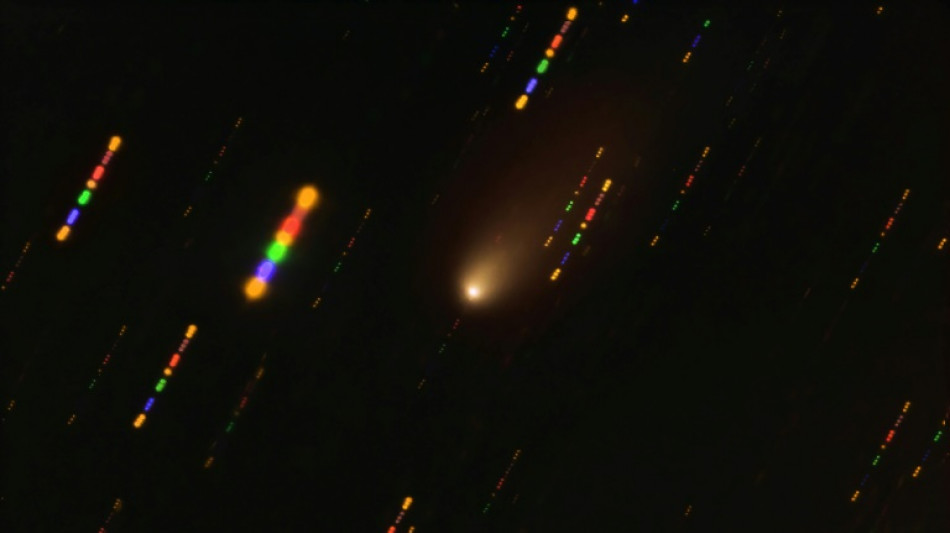
Possible interstellar object spotted zooming through Solar System / Photo: O. HAINAUT - EUROPEAN SOUTHERN OBSERVATORY/AFP/File

 Atletico down Carrick's struggling Man United

 Croatia trials full driverless robotaxi service

 US stocks dip ahead of inflation data as tech sell-off hits Asia

 No lights, no friends: Cuban youth grapple with loneliness

 Saudi coalition strikes Yemen oil sites after Houthi attacks

 French economy minister denies country caught in debt 'snowball'

 Judge extends halt to Trump's golf course tree-cutting

 Milan's Saelemaekers set for lenghty spell out after ankle surgery

 Nvidia says to invest in French medical website

 Real Madrid's Mourinho has 'trust' in referees despite complaints

 Mendis, Shanaka star in Sri Lanka consolation T20I win

 Demonstrations backing France's protesting students gather strength

 Trump says US Senate as hard to defend as House in midterms

 Suspected Russian drones hit two ships off Bulgaria, 11 missing

 Tech stocks slide on AI jitters

 Trump asks Greece ambassador to resign amid ethics scandal

 New White House spokeswoman heavy on Trump praise, light on questions in debut

 Emery urges Villa to make most of reduced home comfort

 Flavio Bolsonaro visits father under house arrest ahead of Brazil runoff

 France, Eq. Guinea in standoff over luxury Paris mansion

 'Holding our ground': Israel demolishes dozens of Bedouin homes

 Hazlewood takes six as Australia beat South Africa in 1st Test

 Saudi coalition tells Sanaa residents to flee site before operation

 Zverev defies 'physical issues' to reach Shanghai Masters quarter-finals

 'We're not giving up': Activist Thunberg joins France student protests

An object that appears to be from beyond our Solar System has been spotted hurtling towards the Sun, which if confirmed would be the third visitor from the stars ever detected, the European Space Agency said Wednesday.
The object, which is currently being referred to as A11pl3Z, poses no threat to Earth, the ESA's planetary defence head Richard Moissl told AFP.
"It will fly deep through the Solar System, passing just inside the orbit of Mars," but will not hit our neighbouring planet, he said.
Excited astronomers are still refining their calculations, but the object appears to be zooming more than 60 kilometres (37 miles) a second.
This would mean it is not bound by the Sun's orbit, unlike comets and asteroids, which all originate from within the Solar System.
Its trajectory also "means it's not orbiting our star, but coming from interstellar space and flying off to there again," Moissl said.
"We are not 100 percent certain at the moment, but anything else would be a surprise," he added.
Official confirmation is expected to come from the International Astronomical Union's Minor Planet Center, which has recorded more than 100 observations of the object so far.
The NASA-funded ATLAS survey in Hawaii first discovered the object on Tuesday, US astronomer David Rankin wrote on the social media platform Bluesky.
Professional and amateur astronomers across the world then searched through past telescope data, tracing its trajectory back to at least June 14.
The object is currently estimated to be roughly 10-20 kilometres wide, Moissl said. But the object could be smaller if it is made out of ice, which reflects more light.
"It will get brighter and closer to the Sun until late October and then still be observable (by telescope) until next year," Moissl said.
- Our third visitor -
It would be the third time humanity has detected something coming from the stars.
The first, 'Oumuamua, was discovered in 2017. It was so strange that at least one prominent scientist became convinced it was an alien vessel -- though this has since been dismissed by further research.
Our second interstellar visitor, 2I/Borisov, was spotted in 2019.
Mark Norris, an astronomer at the UK's University of Central Lancashire, told AFP that the new object appears to be "moving considerably faster than the other two extra-solar objects that we previously discovered."
The object is currently roughly around the distance from Jupiter away from Earth, Norris said.
He lamented that he would not be able to observe the object on his telescope on Wednesday night, because it is currently only visible in the Southern Hemisphere.
Norris pointed to modelling estimating that there could be as many 10,000 interstellar objects drifting through the Solar System at any given time, though most would be smaller than the newly discovered object.
If true, this suggests that the newly online Vera C. Rubin Observatory in Chile could soon be finding these dim interstellar visitors every month, Norris said.
Moissl said it is not feasible to send a mission into space to intercept the new object.
Still, these visitors offer scientists a rare chance to study something outside of our Solar System.
For example, if we detected precursors of life such as amino acids on such an object, it would give us "a lot more confidence that the conditions for life exist in other star systems," Norris said.
B.Torres--AT