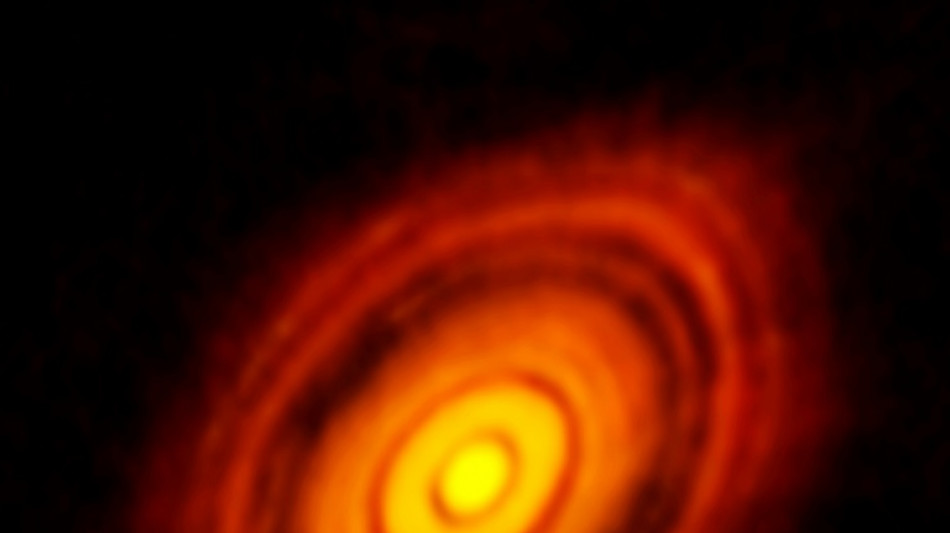
James Webb telescope discovers its first exoplanet / Photo: ALMA (ESO/NAOJ/NRAO) - EUROPEAN SOUTHERN OBSERVATORY/AFP/File

 Atletico sink Man Utd as Viking deny Bayern in Champions League

 Man United's Martinez blasts board's lack of investment

 Meet A7 International, an Innovative Global Platform Designed to Reinvent the International Payments Market

 Shakhtar hope London move a reminder of Ukraine conflict

 Tresoldi hat-trick fires Brugge past Inter Milan

 Rams axe kicker Mevis after misses cost victory over Bills: reports

 Yamal stays cool at boiling Galatasaray to lift Barcelona to victory

 Arsenal cruise past Lille into share of Champions League lead

 Trump ousts Greece ambassador over ethics scandal

 Reese Witherspoon, France's Mediawan to buy Hello Sunshine

 Bipartisan US senators urge Trump to scrap Russian diesel deal

 Ex-gang leader sentenced to minimum 40 years for Tupac murder

 Cornell suspends frat parties after alleged gang rape

 Man City deserve to keep titles, says PSG's Luis Enrique

 Regulator 'will resign' if any political interference in Man City case

 Microsoft's Brad Smith calls for 'real and effective' AI safety standards

 Anthropic warns of AI 'worms' spreading across smart gadgets

 Big US banks report strong earnings and stay bullish on AI

 Iraola backs Barcola, Wirtz to come good for Liverpool

 In a first, AI helps UK lawmaker find her voice in parliament

 Pope Leo in Rome hospital for lung operation

 EU watchdog says smart glasses must give 'clear warnings' when recording

 Houthis say Saudi Arabia strikes oil site in Yemen's capital

 France roiled by marches in support of protesting students

 Goldman Sachs profits jump as CEO says no plans to exit

The James Webb Space Telescope has discovered its first exoplanet, astronomers said Wednesday, capturing rare direct images of the relatively small world in the Earth's galactic backyard.
The telescope, which can see farther into the universe than anything before it, has turbocharged the search for planets beyond the Solar System since coming online in 2022.
Until now, however, its deep gaze has mostly been used to probe already known exoplanets -- to find out key information such as the atmospheric composition -- rather than tracking down new worlds.
The discovery of exoplanet TWA 7b, revealed in a study in the journal Nature, "represents a first for the telescope", France's CNRS research centre said in a statement.
The large majority of the nearly 6,000 exoplanets found so far have been identified from the light they blot out when they pass in front of their star, rather than from direct images of the planet.
Webb "has spent an enormous amount of time observing planets that have never been directly imaged," lead study author Anne-Marie Lagrange of the Paris Observatory told AFP.
- 'Blinded by the light' -
Capturing direct images of faraway planets is difficult because they are "very faint" due to a lack of heat, Lagrange said. Even worse, she added, "we're blinded by the light of the star they orbit."
But Webb has a way to get around the problem.
An attachment to Webb's MIRI instrument called a coronagraph masks the star, creating an effect similar to a solar eclipse. The telescope's infrared vision can then peer through and spot the planet.
Astronomers pointed Webb at the star TWA 7, which is around a hundred light years from Earth -- relatively nearby in the universe.
The star, which was first spotted by the Hubble space telescope in 1999, was thought to be a promising target for two reasons.
It is just 6.4 million years old -- a baby compared to the Sun's 4.5 billion years -- and still surrounded by a massive disc of gas and dust where planets are thought to form.
And from the direction of Earth, the disc is seen from above, giving a good view of its rings.
The three rings around the star, which stretch more than 100 times the distance separating the Sun and Earth, had previously been spotted by the Very Large Telescope in Chile.
But inside an otherwise empty section of the second ring, the Webb telescope detected something particularly bright.
Astronomers ruled out that the light was coming from an object at the edge of the Solar System, or from a distant galaxy behind the star.
That could mean only that the light source was a relatively small and cold planet, with a mass at least 10 times lighter than any other exoplanet directly imaged so far, according to the study.
- The hunt for smaller worlds -
The researchers estimated that the planet's mass was similar to that of Saturn, a gas giant that weighs only a third of Jupiter, the biggest planet in the Solar System.
Webb has increased the ability to detect exoplanets via direct images by a factor of 10, Lagrange said.
That is important because smaller, rocky planets similar to Earth or Mars are the ultimate target in the search for habitable worlds outside of the Solar System.
Lagrange said she would be delighted to discover "Earth-like planets" one day.
But she said astronomers needed to study all kinds of planets -- and to understand how planetary systems form -- to know whether the life-hosting Solar System is unique.
In the future, astronomers expect the Webb telescope will be able to spot planets even smaller than TWA 7b.
But directly capturing images of faraway worlds similar to Earth will require even more telescopic power, such as from he Extremely Large Telescope that is scheduled to come online in Chile in 2028.
S.Jackson--AT