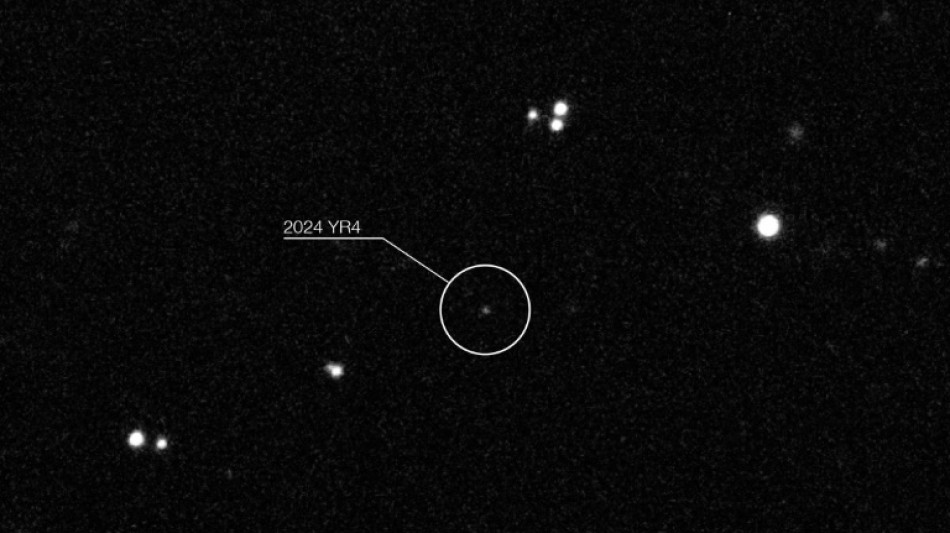
Earth's satellites at risk if asteroid smashes into Moon: study / Photo: Handout - European Southern Observatory/AFP/File

 Trump, White House post video of UK man killed by tiger

 Saudi employee arrested for allegedly bugging OpenAI office

 Atletico sink Man Utd as Viking deny Bayern in Champions League

 Man United's Martinez blasts board's lack of investment

 Meet A7 International, an Innovative Global Platform Designed to Reinvent the International Payments Market

 Shakhtar hope London move a reminder of Ukraine conflict

 Tresoldi hat-trick fires Brugge past Inter Milan

 Rams axe kicker Mevis after misses cost victory over Bills: reports

 Yamal stays cool at boiling Galatasaray to lift Barcelona to victory

 Arsenal cruise past Lille into share of Champions League lead

 Trump ousts Greece ambassador over ethics scandal

 Reese Witherspoon, France's Mediawan to buy Hello Sunshine

 Bipartisan US senators urge Trump to scrap Russian diesel deal

 Ex-gang leader sentenced to minimum 40 years for Tupac murder

 Cornell suspends frat parties after alleged gang rape

 Man City deserve to keep titles, says PSG's Luis Enrique

 Regulator 'will resign' if any political interference in Man City case

 Microsoft's Brad Smith calls for 'real and effective' AI safety standards

 Anthropic warns of AI 'worms' spreading across smart gadgets

 Big US banks report strong earnings and stay bullish on AI

 Iraola backs Barcola, Wirtz to come good for Liverpool

 In a first, AI helps UK lawmaker find her voice in parliament
 Pope Leo in Rome hospital for lung operation

 EU watchdog says smart glasses must give 'clear warnings' when recording

 Houthis say Saudi Arabia strikes oil site in Yemen's capital

If a huge asteroid smashes into the Moon in 2032, the gigantic explosion would send debris streaming towards Earth that would threaten satellites and create a spectacular meteor shower, according to researchers.
Earlier this year there were briefly fears that the 60-metre-wide (200-foot-wide) asteroid called 2024 YR4, which is big enough to level a city, would strike Earth on December 22, 2032.
It was given the highest chance -- 3.1 percent -- of hitting our home planet that scientists have ever measured for such a giant space rock.
Subsequent observations from telescopes definitively ruled out a direct hit on Earth.
However, the odds that it will crash into the Moon have risen to 4.3 percent, according to data from the James Webb space telescope in May.
A new preprint study, which has not been peer-reviewed, is the first to estimate how such a collision could affect Earth.
It would be the largest asteroid to hit the Moon in around 5,000 years, lead study author Paul Wiegert of Canada's University of Western Ontario told AFP.
The impact would be "comparable to a large nuclear explosion in terms of the amount of energy released", he added.
Up to 100 million kilograms (220 million pounds) of material would shoot out from the Moon's surface, according to a series of simulations run by the researchers.
If the asteroid hit the side of the Moon facing Earth -- which is roughly a 50-percent chance -- up to 10 percent of this debris could be pulled in by Earth's gravity over the following days, they said.
- 'Like a bullet' -
Earth's atmosphere would protect the surface from the millimetre- to centimetre-sized lunar rocks, Weigert said. 0.04-2.54
But these meteors could be capable of destroying some satellites -- and there are expected to be a lot more of those orbiting the planet by 2032.
"A centimetre-sized rock travelling at tens of thousands of metres per second is a lot like a bullet," Wiegert said.
In the days after the impact, there could be more than 1,000 times the normal number of meteors threatening Earth's satellites, he added.
Meanwhile, those of us on the ground would be treated to a "spectacular" meteor shower lighting up the night sky, the study said.
But the current odds of a direct hit on the near side of the Moon remain at just two percent, Wiegert emphasised.
The asteroid is not expected to be visible again until 2028, so the world will have to wait to find out more.
If a direct hit is eventually found to be likely, humanity probably has enough time to plan a mission to spare the Moon.
"I'm sure it will be considered," Wiegert said.
The asteroid is half as wide and has 10 percent of the mass of Dimorphos, which NASA's DART mission smashed into in 2022, successfully changing its trajectory.
If 2024 YR4 is on a collision course with the Moon, it would be "a good target" for another test of our planetary defences, Wiegert said.
But if not, trying to deflect something zooming so close to Earth could be a little "dangerous", he added.
The preprint study, which published on the arXiv database last week, has been submitted to the Astrophysical Journal Letters.
N.Walker--AT