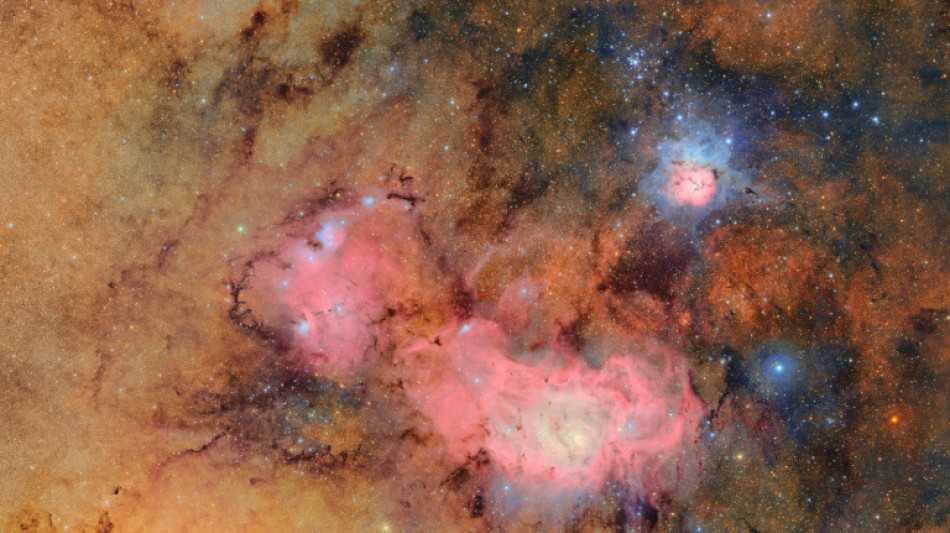
Groundbreaking Vera Rubin Observatory reveals first images / Photo: HANDOUT - NSF-DOE Vera C. Rubin Observatory/AFP

 Atletico sink Man Utd as Viking deny Bayern in Champions League

 Man United's Martinez blasts board's lack of investment

 Meet A7 International, an Innovative Global Platform Designed to Reinvent the International Payments Market

 Shakhtar hope London move a reminder of Ukraine conflict

 Tresoldi hat-trick fires Brugge past Inter Milan

 Rams axe kicker Mevis after misses cost victory over Bills: reports

 Yamal stays cool at boiling Galatasaray to lift Barcelona to victory

 Arsenal cruise past Lille into share of Champions League lead

 Trump ousts Greece ambassador over ethics scandal

 Reese Witherspoon, France's Mediawan to buy Hello Sunshine

 Bipartisan US senators urge Trump to scrap Russian diesel deal

 Ex-gang leader sentenced to minimum 40 years for Tupac murder

 Cornell suspends frat parties after alleged gang rape

 Man City deserve to keep titles, says PSG's Luis Enrique

 Regulator 'will resign' if any political interference in Man City case

 Microsoft's Brad Smith calls for 'real and effective' AI safety standards

 Anthropic warns of AI 'worms' spreading across smart gadgets

 Big US banks report strong earnings and stay bullish on AI

 Iraola backs Barcola, Wirtz to come good for Liverpool

 In a first, AI helps UK lawmaker find her voice in parliament

 Pope Leo in Rome hospital for lung operation

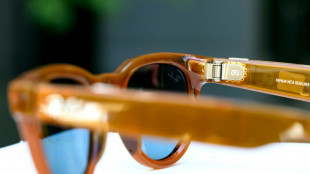 EU watchdog says smart glasses must give 'clear warnings' when recording

 Houthis say Saudi Arabia strikes oil site in Yemen's capital

 France roiled by marches in support of protesting students

 Goldman Sachs profits jump as CEO says no plans to exit

The team behind the long-awaited Vera Rubin Observatory in Chile published their first images on Monday, revealing breathtaking views of star-forming regions as well as distant galaxies.
More than two decades in the making, the giant US-funded telescope sits perched at the summit of Cerro Pachon in central Chile, where dark skies and dry air provide ideal conditions for observing the cosmos.
One of the debut images is a composite of 678 exposures taken over just seven hours, capturing the Trifid Nebula and the Lagoon Nebula -- both several thousand light-years from Earth -- glowing in vivid pinks against orange-red backdrops.
The image reveals these stellar nurseries within our Milky Way in unprecedented detail, with previously faint or invisible features now clearly visible.
Another image offers a sweeping view of the Virgo Cluster of galaxies.
The team also released a video dubbed the "cosmic treasure chest," which begins with a close-up of two galaxies before zooming out to reveal approximately 10 million more.
"The Rubin Observatory is an investment in our future, which will lay down a cornerstone of knowledge today on which our children will proudly build tomorrow," said Michael Kratsios, director of the White House Office of Science and Technology Policy.
Equipped with an advanced 8.4-meter telescope and the largest digital camera ever built, the Rubin Observatory is supported by a powerful data-processing system.
Later this year, it will begin its flagship project, the Legacy Survey of Space and Time (LSST). Over the next decade, it will scan the night sky nightly, capturing even the subtlest visible changes with unmatched precision.
The observatory is named after pioneering American astronomer Vera C. Rubin, whose research provided the first conclusive evidence for the existence of dark matter -- a mysterious substance that does not emit light but exerts gravitational influence on galaxies.
Dark energy refers to the equally mysterious and immensely powerful force believed to be driving the accelerating expansion of the universe. Together, dark matter and dark energy are thought to make up 95 percent of the cosmos, yet their true nature remains unknown.
The observatory, a joint initiative of the US National Science Foundation and Department of Energy, has also been hailed as one of the most powerful tools ever built for tracking asteroids.
In just 10 hours of observations, the Rubin Observatory discovered 2,104 previously undetected asteroids in our solar system, including seven near-Earth objects -- all of which pose no threat.
For comparison, all other ground- and space-based observatories combined discover about 20,000 new asteroids per year.
Rubin is also set to be the most effective observatory at spotting interstellar objects passing through the solar system.
More images from the observatory are expected to be released later Monday morning.
E.Hall--AT