
SpiNNcloud Deploys SpiNNaker2 Supercomputer at Sandia National Laboratories

 South Korean FA condemns 'personal attacks' as rift rumours grow

 Japan urges 'impartial treatment' of journalist arrested in Russia

 What we know about Pope Leo XIV's lung cancer operation

 Advanced economies must 'act now' to lower debt as bond yields spike: IMF

 Deluge by design: Thai villages flooded to protect capital

 Ivan Deforge, the French 'bison tamer' in Moscow

 Indonesians on fire-ravaged island sue state for clean air

 Trump, White House post video of UK man killed by tiger

 CruxOCM and Client Present Closed-Loop Pipeline Automation Results at AVEVA Pipeline Summit 2026

 Saudi says Houthi attacks sparked Aramco fire, wounded 4 in Riyadh

 Few buyers for starving cattle in El Nino parched El Salvador

 Bybit Expands Beyond Crypto as CEO Outlines Next Phase of Financial Platform

 Bayern held by Viking after 'super dumb' Olise red in Champions League

 Why AI makes computer worms harder to stop

 US fines Bank of America $1.2 bn for anti-money laundering violations

 Bayern held by Viking after Olise sees red in Champions League

 Atletico down Carrick's struggling Man United

 Croatia trials full driverless robotaxi service

 US stocks dip ahead of inflation data as tech sell-off hits Asia

 No lights, no friends: Cuban youth grapple with loneliness

 Saudi coalition strikes Yemen oil sites after Houthi attacks

 French economy minister denies country caught in debt 'snowball'

 Judge extends halt to Trump's golf course tree-cutting

 Milan's Saelemaekers set for lenghty spell out after ankle surgery

 Nvidia says to invest in French medical website

Energy-efficient architecture - mimicking the human brain - provides substantive benefits over GPU-based systems across a variety of applications, including nuclear deterrence research.
DRESDEN, GERMANY / ACCESS Newswire / June 5, 2025 / Today SpiNNcloud announced that Sandia National Laboratories has officially deployed its new SpiNNaker2 brain-inspired supercomputer, marking a significant milestone in the advancement of computing for national security applications.
Developed by deep-tech company SpiNNcloud, SpiNNaker2 is now operational and ranks among the top five largest brain-inspired computing platforms globally, simulating between 150 and 180 million neurons. The SpiNNaker2 supercomputing platform was pioneered by Steve Furber, designer of the original ARM architecture,and uses a large number of low-power processors for efficiently computing AI and other workloads.
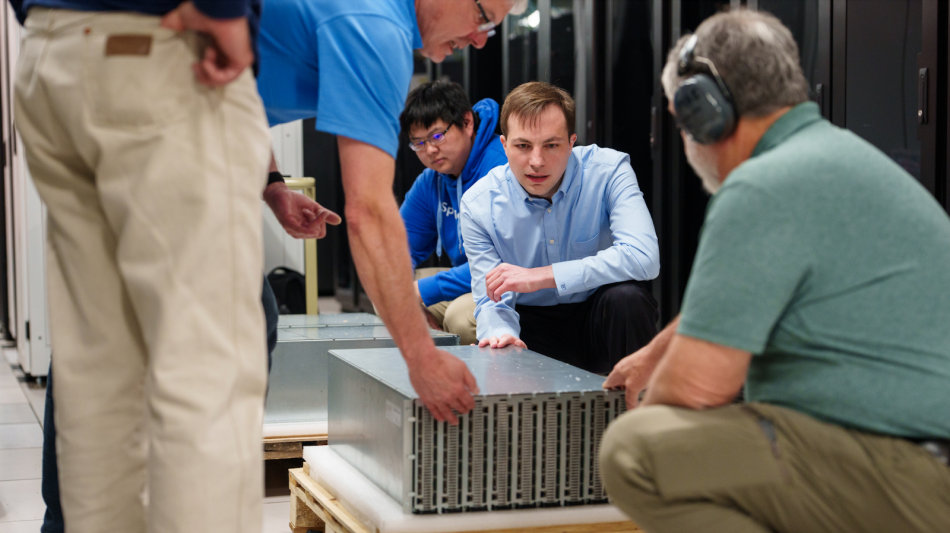
This delivery is part of Sandia's ongoing efforts to deploy innovative computing architectures that can enhance the nation's nuclear deterrence capabilities and advance other energy-efficient AI applications at a lower energy profile compared to traditional GPU-based systems.
"Although GPU-based systems can boost the efficiency of supercomputers by processing highly parallel and math-intensive workloads much faster than CPUs, brain-inspired systems, like the SpiNNaker2 system, offer an enticing alternative," said Craig M. Vineyard, Ph.D., research scientist at Sandia National Laboratories. "The new system delivers both impressive performance and substantial efficiency gains concurrently to Sandia's neuromorphic capabilities."
The SpiNNaker2 system employs a highly parallel architecture consisting of 48 SpiNNaker2 chips per server board, each containing 152 Arm-based cores and specialized accelerators. This design enables efficient, event-driven computation, allowing the system to perform complex simulations at a lower energy profile compared to traditional GPU-based systems. Such energy efficiency is crucial for applications where power consumption and cooling are limiting factors.
"Our vision is to pioneer the future of artificial intelligence through brain-inspired supercomputer technology for next-generation defense and beyond," said Hector A. Gonzalez, co-founder and CEO of SpiNNcloud. "The SpiNNaker2's efficiency gains make it particularly well-suited for the demanding computational needs of national security applications. We're thrilled to partner with Sandia on this venture, and to see the system being brought to life first-hand."
Looking ahead, SpiNNcloud is also enabling support for the next generation of Gen AI algorithms, paving a radically more efficient path to machine learning advancement through dynamic sparsity. Recent breakthroughs in machine learning are driving a transition from traditional dense modeling - centered on fixed feature selection within neural representations - to extreme dynamic sparsity, where a subset of neural pathways are selectively activated based on the input. This approach helps to shape entirely new architectures for AI foundation models, and addresses the current energy crisis driven by mainstream AI scaling trends.
For more information about SpiNNcloud and the SpiNNaker2 platform, please visit https://spinncloud.com.
SpiNNcloud is also attending this year's ISC High Performance 2025 conference in Hamburg, Germany, June 10-13. Attendees are encouraged to stop by the SpiNNcloud booth J39.
About SpiNNcloud:
SpiNNcloud enables customers to realize complex AI-driven systems by providing highly parallel and real-time computing capabilities. SpiNNaker architecture is a massively parallel supercomputer architecture operating in biological real-time at extreme scales and is used today in many variants. Next generation SpiNNaker2 architecture creates a hybrid system that combines expert systems, statistical AI and neuromorphic computing.
###
Press Contact:
Forrest Carman
Owen Media
[email protected]
SOURCE: SpiNNcloud Systems GmbH
View the original press release on ACCESS Newswire
M.Robinson--AT