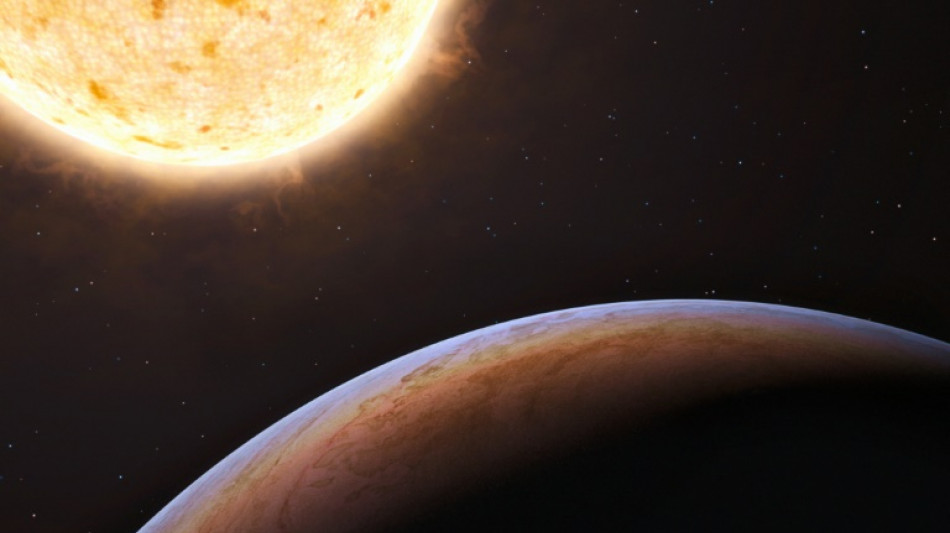
Huge planet discovered orbiting tiny star puzzles scientists / Photo: HO - ESO/AFP/File

 South Korean FA condemns 'personal attacks' as rift rumours grow

 Japan urges 'impartial treatment' of journalist arrested in Russia

 What we know about Pope Leo XIV's lung cancer operation

 Advanced economies must 'act now' to lower debt as bond yields spike: IMF

 Deluge by design: Thai villages flooded to protect capital

 Ivan Deforge, the French 'bison tamer' in Moscow

 Indonesians on fire-ravaged island sue state for clean air

 Trump, White House post video of UK man killed by tiger

 CruxOCM and Client Present Closed-Loop Pipeline Automation Results at AVEVA Pipeline Summit 2026

 Saudi says Houthi attacks sparked Aramco fire, wounded 4 in Riyadh

 Few buyers for starving cattle in El Nino parched El Salvador

 Bybit Expands Beyond Crypto as CEO Outlines Next Phase of Financial Platform

 Bayern held by Viking after 'super dumb' Olise red in Champions League

 Why AI makes computer worms harder to stop

 US fines Bank of America $1.2 bn for anti-money laundering violations

 Bayern held by Viking after Olise sees red in Champions League

 Atletico down Carrick's struggling Man United

 Croatia trials full driverless robotaxi service

 US stocks dip ahead of inflation data as tech sell-off hits Asia

 No lights, no friends: Cuban youth grapple with loneliness

 Saudi coalition strikes Yemen oil sites after Houthi attacks

 French economy minister denies country caught in debt 'snowball'

 Judge extends halt to Trump's golf course tree-cutting

 Milan's Saelemaekers set for lenghty spell out after ankle surgery

 Nvidia says to invest in French medical website

Astronomers announced Wednesday they have discovered a massive planet orbiting a tiny star, a bizarre pairing that has stumped scientists.
Most of the stars across the Milky Way are small red dwarfs like TOI-6894, which has only 20 percent the mass of our Sun.
It had not been thought possible that such puny, weak stars could provide the conditions needed to form and host huge planets.
But an international team of astronomers have detected the unmistakable signature of a gas giant planet orbiting the undersized TOI-6894, according to a study in the journal Nature Astronomy.
This makes the star the smallest star yet known to host a gas giant.
The planet has a slightly larger radius than Saturn, but only half its mass. It orbits its star in a little over three days.
The astronomers discovered the planet when searching through more than 91,000 low-mass red dwarfs observed by NASA's TESS space telescope.
Its existence was then confirmed by ground-based telescopes, including Chile's Very Large Telescope.
"The fact that this star hosts a giant planet has big implications for the total number of giant planets we estimate exist in our galaxy," study co-author Daniel Bayliss of the UK's Warwick University said in a statement.
Another co-author, Vincent Van Eylen, of University College London, said it was an "intriguing discovery".
"We don't really understand how a star with so little mass can form such a massive planet!" he said.
"This is one of the goals of the search for more exoplanets. By finding planetary systems different from our solar system, we can test our models and better understand how our own solar system formed."
- How do you make a planet? -
The most prominent theory for how planets form is called core accretion.
The process begins when a ring of gas and dust -- called a protoplanetary disc -- which surrounds a newly formed star builds up into a planetary core. This core attracts more gas that forms an atmosphere, eventually snowballing into a gas giant.
Under this theory, it is difficult for low-mass stars to host giant planets because there is not enough gas and dust to begin building a core in the first place.
A rival theory proposes that these planets instead form when their protoplanetary disc becomes gravitationally unstable and breaks up, with the collapsing gas and dust forming a planet.
However neither theory seems to explain the existence of the newly discovered planet, TOI-6894b, the researchers said.
The planet also interests scientists because it is strangely cold.
Most of the gas giants discovered outside our Solar System so far have been what are known as "hot Jupiters", where temperatures soar well over 1,000 degrees Celsius.
But the newly discovered planet appears to be under 150C, the researchers said.
"Temperatures are low enough that atmospheric observations could even show us ammonia, which would be the first time it is found in an exoplanet atmosphere," said study co-author Amaury Triaud of Birmingham University.
The James Webb space telescope is scheduled to turn its powerful gaze towards the planet in the next year, which could help uncover some more mysteries of this strange planet.
O.Gutierrez--AT