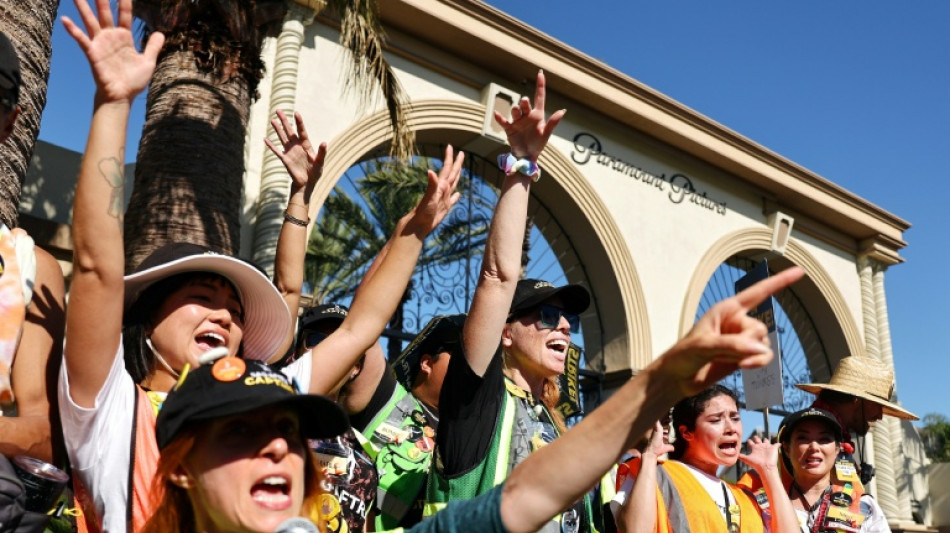
US labor unions fight to contain AI disruption / Photo: MARIO TAMA - GETTY IMAGES NORTH AMERICA/AFP/File

 South Korean FA condemns 'personal attacks' as rift rumours grow

 Japan urges 'impartial treatment' of journalist arrested in Russia

 What we know about Pope Leo XIV's lung cancer operation
 Advanced economies must 'act now' to lower debt as bond yields spike: IMF

 Deluge by design: Thai villages flooded to protect capital

 Ivan Deforge, the French 'bison tamer' in Moscow

 Indonesians on fire-ravaged island sue state for clean air

 Trump, White House post video of UK man killed by tiger

 CruxOCM and Client Present Closed-Loop Pipeline Automation Results at AVEVA Pipeline Summit 2026

 Saudi says Houthi attacks sparked Aramco fire, wounded 4 in Riyadh

 Few buyers for starving cattle in El Nino parched El Salvador

 Bybit Expands Beyond Crypto as CEO Outlines Next Phase of Financial Platform

 Bayern held by Viking after 'super dumb' Olise red in Champions League

 Why AI makes computer worms harder to stop

 US fines Bank of America $1.2 bn for anti-money laundering violations
 Bayern held by Viking after Olise sees red in Champions League

 Atletico down Carrick's struggling Man United

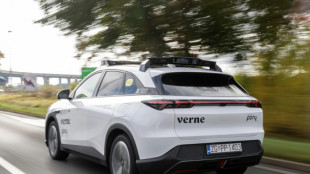 Croatia trials full driverless robotaxi service
 US stocks dip ahead of inflation data as tech sell-off hits Asia

 No lights, no friends: Cuban youth grapple with loneliness

 Saudi coalition strikes Yemen oil sites after Houthi attacks
 French economy minister denies country caught in debt 'snowball'
 Judge extends halt to Trump's golf course tree-cutting

 Milan's Saelemaekers set for lenghty spell out after ankle surgery

 Nvidia says to invest in French medical website
As artificial intelligence threatens to upend entire sectors of the economy, American labor unions are scrambling to protect workers, demand corporate transparency, and rally political support—an uphill battle in a rapidly changing world.
"As laborers, the ability to withhold our labor is one of our only tools to improve our lives," explained Aaron Novik, a key organizer with Amazon's ALU union.
"What happens when that disappears (to AI)? It's a real existential issue," he added.
Automation has already transformed most industries since the 1960s, typically reducing workforce numbers in the process.
But the emergence of advanced "physical AI" promises a new generation of intelligent robots that won't be limited to repetitive tasks -- potentially displacing far more blue-collar workers than ever before.
The threat extends beyond manufacturing.
The CEO of Anthropic, which created Claude as a competitor to ChatGPT, warned last week that generative AI could eliminate half of all low-skilled white-collar jobs, potentially driving unemployment rates up to 10-20 percent.
"The potential displacement of workers and elimination of jobs is a significant concern not just for our members, but for the public in general," said Peter Finn of the International Brotherhood of Teamsters, America's largest union.
- Vetoes -
The Teamsters have focused their efforts on passing legislation limiting the spread of automation, but face significant political obstacles.
California's governor has twice vetoed bills that would ban autonomous trucks from public roads, despite intense lobbying from the state's hundreds of thousands of union members.
Colorado's governor followed suit last week, and similar battles are playing out in Indiana, Maryland, and other states.
At the federal level, the landscape shifted dramatically with the change in the White House.
Under former president Joe Biden, the Department of Labor issued guidelines encouraging companies to be transparent about AI use, involve workers in strategic decisions, and support employees whose jobs face elimination.
But US President Donald Trump canceled the protections within hours of taking office in January.
"Now it's clear. They want to fully open up AI without the safeguards that are necessary to ensure workers' rights and protections at work," said HeeWon Brindle-Khym of the Retail, Wholesale and Department Store Union (RWDSU), which represents workers in the retail sector.
- Rush to AI -
Meanwhile, companies are racing to implement AI technologies, often with poor results.
"By fear of missing out on innovations, there's been a real push (to release AI products)," observed Dan Reynolds of the Communications Workers of America (CWA).
The CWA has taken a proactive approach, publishing a comprehensive guide for members that urges negotiators to include AI provisions in all collective bargaining agreements.
The union is also developing educational toolkits to help workers understand and negotiate around AI implementation.
A handful of unions have successfully negotiated AI protections into their contracts.
Notable examples include agreements with media company Ziff Davis (which owns Mashable) and video game publisher ZeniMax Studios, a Microsoft subsidiary.
The most significant victories belong to two powerful unions: the International Longshoremen's Association, representing dock workers, secured a moratorium on full automation of certain port operations, while the Screen Actors Guild (SAG-AFTRA) won guarantees that actors must be consulted and compensated whenever their AI likeness is created.
These successes remain exceptional, however.
The American labor movement, as a whole, lacks the bargaining power enjoyed by those highly strategic or publicly visible sectors, said Brindle-Khym.
"Smaller contract-by-contract improvements are a long, slow process," she added.
Despite frequent accusations by corporate interests, the unions' goal isn't to halt technological progress entirely.
"Workers are usually not seeking to stop the march of technology," noted Virginia Doellgast, a Cornell University professor specializing in labor relations.
"They just want to have some control."
As AI continues its rapid advance, the question remains whether unions can adapt quickly enough to protect workers in an economy increasingly dominated by artificial intelligence.
E.Flores--AT