Generative AI's most prominent skeptic doubles down / Photo: Don MacKinnon - AFP

 Trump says 'massive' oil, gas, mineral exploration to begin in Greenland

 China heads for record trade surplus as exports surge
 Vietnam mourns 700 war dead in major push to identify missing

 Relentless Swiatek wins all-Polish battle to launch Wuhan campaign

 Seeing pivotal election, Israelis fly from around world to vote

 South Korea's Eom 'racially abused' in England's Championship: club

 Asian markets mixed as tech firms claw back some losses
 India shuts down iconic Delhi protest site after three decades

 Japan urges Russia for 'impartial treatment' of arrested journalist
 Lula, Bolsonaro ordered to call off attempts at online censorship

 EU takes a page from Ireland's AI playbook

 Global deforestation slowed in 2025 but surged in Congo basin: study

 LSEG Accelerates Tick History Analysis With NVIDIA
 Saudi employee arrested for allegedly bugging OpenAI office

 Atletico sink Man Utd as Viking deny Bayern in Champions League

 Man United's Martinez blasts board's lack of investment
 Meet A7 International, an Innovative Global Platform Designed to Reinvent the International Payments Market

 Shakhtar hope London move a reminder of Ukraine conflict
 Tresoldi hat-trick fires Brugge past Inter Milan

 Rams axe kicker Mevis after misses cost victory over Bills: reports

 Yamal stays cool at boiling Galatasaray to lift Barcelona to victory
 Arsenal cruise past Lille into share of Champions League lead
 Trump ousts Greece ambassador over ethics scandal
 Reese Witherspoon, France's Mediawan to buy Hello Sunshine

 Bipartisan US senators urge Trump to scrap Russian diesel deal

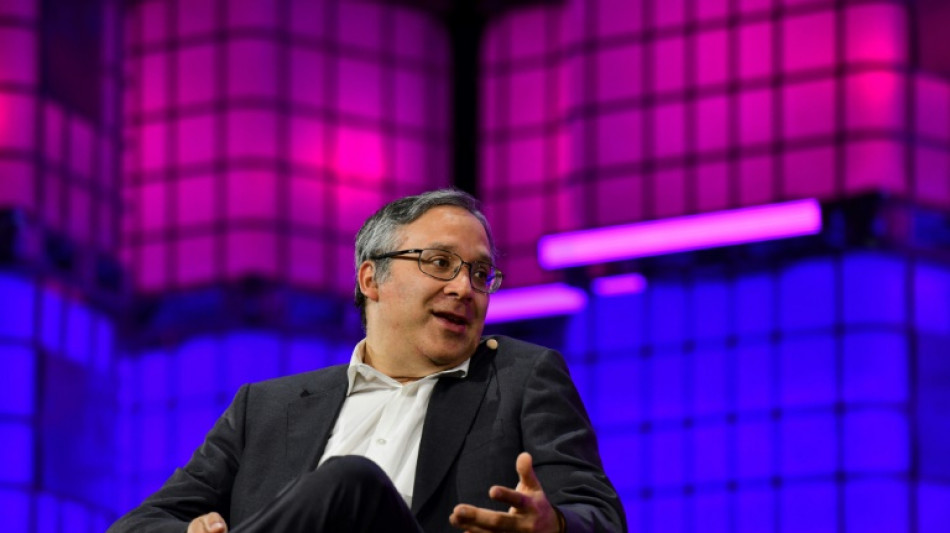
Two and a half years since ChatGPT rocked the world, scientist and writer Gary Marcus still remains generative artificial intelligence's great skeptic, playing a counter-narrative to Silicon Valley's AI true believers.
Marcus became a prominent figure of the AI revolution in 2023, when he sat beside OpenAI chief Sam Altman at a Senate hearing in Washington as both men urged politicians to take the technology seriously and consider regulation.
Much has changed since then. Altman has abandoned his calls for caution, instead teaming up with Japan's SoftBank and funds in the Middle East to propel his company to sky-high valuations as he tries to make ChatGPT the next era-defining tech behemoth.
"Sam's not getting money anymore from the Silicon Valley establishment," and his seeking funding from abroad is a sign of "desperation," Marcus told AFP on the sidelines of the Web Summit in Vancouver, Canada.
Marcus's criticism centers on a fundamental belief: generative AI, the predictive technology that churns out seemingly human-level content, is simply too flawed to be transformative.
The large language models (LLMs) that power these capabilities are inherently broken, he argues, and will never deliver on Silicon Valley's grand promises.
"I'm skeptical of AI as it is currently practiced," he said. "I think AI could have tremendous value, but LLMs are not the way there. And I think the companies running it are not mostly the best people in the world."
His skepticism stands in stark contrast to the prevailing mood at the Web Summit, where most conversations among 15,000 attendees focused on generative AI's seemingly infinite promise.
Many believe humanity stands on the cusp of achieving super intelligence or artificial general intelligence (AGI) technology that could match and even surpass human capability.
That optimism has driven OpenAI's valuation to $300 billion, unprecedented levels for a startup, with billionaire Elon Musk's xAI racing to keep pace.
Yet for all the hype, the practical gains remain limited.
The technology excels mainly at coding assistance for programmers and text generation for office work. AI-created images, while often entertaining, serve primarily as memes or deepfakes, offering little obvious benefit to society or business.
Marcus, a longtime New York University professor, champions a fundamentally different approach to building AI -- one he believes might actually achieve human-level intelligence in ways that current generative AI never will.
"One consequence of going all-in on LLMs is that any alternative approach that might be better gets starved out," he explained.
This tunnel vision will "cause a delay in getting to AI that can help us beyond just coding -- a waste of resources."
- 'Right answers matter' -
Instead, Marcus advocates for neurosymbolic AI, an approach that attempts to rebuild human logic artificially rather than simply training computer models on vast datasets, as is done with ChatGPT and similar products like Google's Gemini or Anthropic's Claude.
He dismisses fears that generative AI will eliminate white-collar jobs, citing a simple reality: "There are too many white-collar jobs where getting the right answer actually matters."
This points to AI's most persistent problem: hallucinations, the technology's well-documented tendency to produce confident-sounding mistakes.
Even AI's strongest advocates acknowledge this flaw may be impossible to eliminate.
Marcus recalls a telling exchange from 2023 with LinkedIn founder Reid Hoffman, a Silicon Valley heavyweight: "He bet me any amount of money that hallucinations would go away in three months. I offered him $100,000 and he wouldn't take the bet."
Looking ahead, Marcus warns of a darker consequence once investors realize generative AI's limitations. Companies like OpenAI will inevitably monetize their most valuable asset: user data.
"The people who put in all this money will want their returns, and I think that's leading them toward surveillance," he said, pointing to Orwellian risks for society.
"They have all this private data, so they can sell that as a consolation prize."
Marcus acknowledges that generative AI will find useful applications in areas where occasional errors don't matter much.
"They're very useful for auto-complete on steroids: coding, brainstorming, and stuff like that," he said.
"But nobody's going to make much money off it because they're expensive to run, and everybody has the same product."
G.P.Martin--AT