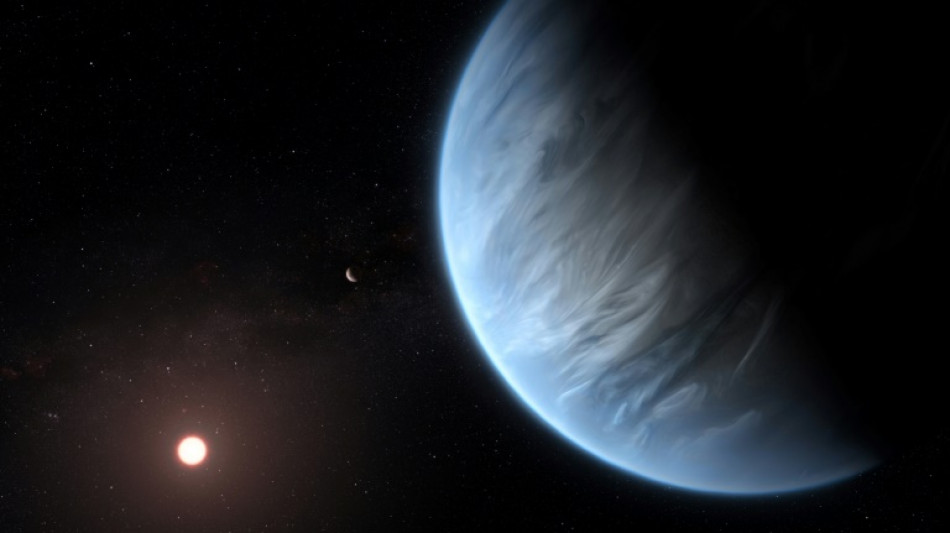
Doubt cast on claim of 'hints' of life on faraway planet / Photo: M. KORNMESSER - ESA/Hubble/AFP/File

 Trump says 'massive' oil, gas, mineral exploration to begin in Greenland
 China heads for record trade surplus as exports surge

 Vietnam mourns 700 war dead in major push to identify missing

 Relentless Swiatek wins all-Polish battle to launch Wuhan campaign

 Seeing pivotal election, Israelis fly from around world to vote
 South Korea's Eom 'racially abused' in England's Championship: club

 Asian markets mixed as tech firms claw back some losses

 India shuts down iconic Delhi protest site after three decades

 Japan urges Russia for 'impartial treatment' of arrested journalist

 Lula, Bolsonaro ordered to call off attempts at online censorship
 EU takes a page from Ireland's AI playbook
 Global deforestation slowed in 2025 but surged in Congo basin: study

 LSEG Accelerates Tick History Analysis With NVIDIA
 Saudi employee arrested for allegedly bugging OpenAI office
 Atletico sink Man Utd as Viking deny Bayern in Champions League

 Man United's Martinez blasts board's lack of investment

 Meet A7 International, an Innovative Global Platform Designed to Reinvent the International Payments Market

 Shakhtar hope London move a reminder of Ukraine conflict
 Tresoldi hat-trick fires Brugge past Inter Milan

 Rams axe kicker Mevis after misses cost victory over Bills: reports

 Yamal stays cool at boiling Galatasaray to lift Barcelona to victory

 Arsenal cruise past Lille into share of Champions League lead

 Trump ousts Greece ambassador over ethics scandal

 Reese Witherspoon, France's Mediawan to buy Hello Sunshine

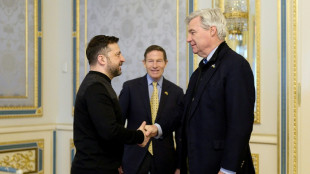 Bipartisan US senators urge Trump to scrap Russian diesel deal
When astronomers announced last month they might have discovered the most promising hints of alien life yet on a distant planet, the rare good news raised hopes humanity could soon learn we are not alone in the universe.
But several recent studies looking into the same data have found that there is not enough evidence to support such lofty claims, with one scientist accusing the astronomers of "jumping the gun".
The debate revolves around the planet K2-18b, which is 124 light years away in the Leo constellation.
The planet is thought to be the right distance from its star to have liquid water, making it a prime suspect in the search for extraterrestrial life.
Last month, astronomers using the James Webb Space Telescope made headlines by announcing they had detected hints of the chemicals dimethyl sulfide (DMS) and dimethyl disulfide (DMDS) on the planet.
These chemicals are only produced by life such as marine algae on Earth, meaning they are considered potential "biosignatures" indicating life.
The astronomers, led by Cambridge University's Nikku Madhusudhan, expressed caution about the "hints" of a biosignature, emphasising they were not claiming a definitive discovery.
Their detection had reached a three-sigma level of statistical significance "which means there is still a three in 1,000 chance of this being a fluke," Madhusudhan said at the time.
- Biosignatures 'vanish' -
Two of Madhusudhan's former students, Luis Welbanks of Arizona State University and Matthew Nixon of Maryland University, were among the researchers who have since re-analysed the data behind the announcement.
When deploying other statistical models, "claims of a potential biosignature detection vanish", according to their preprint study published online late last month.
Like the other papers since the April announcement, it has not been peer-reviewed.
In one model, Welbanks and colleagues expanded the number of possible chemicals that could explain the signals detected by Webb to 90 from the original 20.
More than 50 received a "hit", Welbanks told AFP.
"When you detect everything, did you really detect anything?" he asked.
They are not saying the planet definitely does not have DMS -- just that more observations are needed, Welbanks added.
- 'Arguments are healthy' -
Madhusudhan welcomed the robust debate, saying that remaining open to all possibilities is an essential part of the scientific method.
"These sort of arguments are healthy," he told AFP.
His team even went further, releasing their own preprint study last week that expanded the number of chemicals even further to 650.
The three most "promising" chemicals they found included DMS but not DMDS -- a major part of the team's announcement in April.
The other two chemicals were diethyl sulfide and methyl acrylonitrile, the latter of which is toxic.
Madhusudhan admitted that these little-known chemicals are likely not "realistic molecules" for a planet like K2-18b.
Welbanks pointed out that "in the span of a month -- with no new data, with no new models, with no new laboratory data -- their entire analysis changed".
- 'Closest we have ever been' -
Telescopes observe such far-off exoplanets when they cross in front of their star, allowing astronomers to analyse how molecules block different wavelengths of light streaming through their atmosphere.
Earlier this week, a paper led by Rafael Luque at the University of Chicago combined Webb's observations of K2-18b in both the near-infrared and mid-infrared wavelengths of light.
It also found "no statistical significance for DMS or DMDS", the paper said.
An earlier paper by Oxford astrophysicist Jake Taylor using a basic statistical test also found no strong evidence for any biosignatures.
Madhusudhan dismissed the latter paper, saying the simple exercise did not account for observing physical phenomena.
He also stood by his research, saying he was "just as confident" in the work as he was a month ago.
More data about K2-18b will come in over the next year which should offer a much clearer picture, Madhusudhan added.
Even if the planet does have DMS, it is not a guarantee of life -- the chemical has been detected on a lifeless asteroid.
However, many researchers do believe that space telescopes could one day collect enough evidence to identify alien life from afar.
"We are the closest we have ever been" to such a moment, Welbanks said.
"But we have to use the frameworks that are in place and build up (evidence) in a reliable method, rather than using non-standard practices and jumping the gun -- as has been done in this particular case," Nixon added.
E.Flores--AT