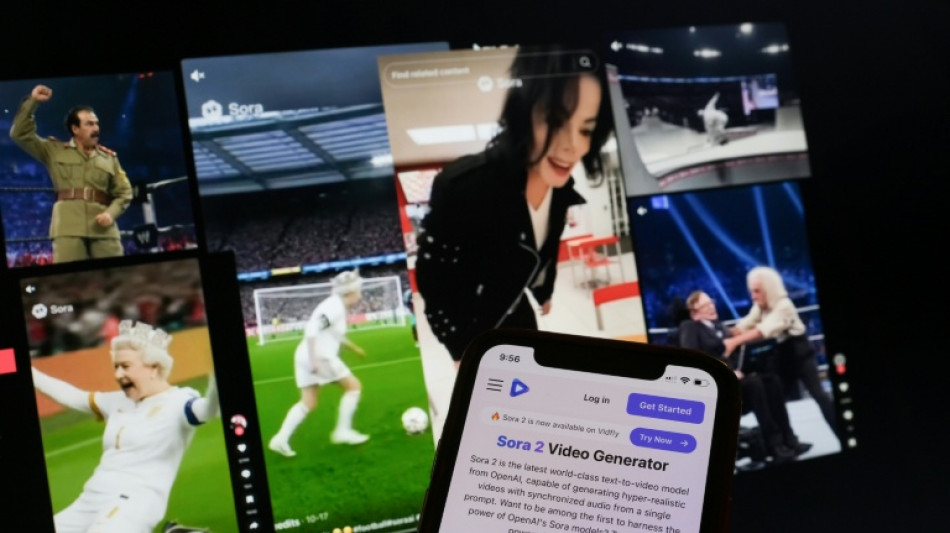
AI resurrections of dead celebrities amuse and rankle / Photo: Chris DELMAS - AFP

 Tesla profits drop on tech spending spree as 'Elon Inc.' talk builds
 Russia 'ready' to resume trilateral talks but cool on Ukraine deal

 Meta beats expectations but legal penalties hit profit amid AI race
 X Community Notes 'failed' to flag US election falsehoods, study says
 Arsenal 'concerned' about Saka injury, says Arteta

 Rice rescues Arsenal draw at Bayern in Champions League
 Rice grabs Arsenal draw at Bayern in Champions League

 Carrick unconcerned over future despite 'unacceptable' Como loss

 Real Madrid rout Leipzig to continue perfect European start

 Walmart welcomes AI agents as Anthropic launches its own
 Quebec separatist premier sworn in without royal presence

 UAE nominates official to lead UN

 NFL boss Goodell welcomes probe into Hurts medical care

 Musk threatens Democrats teeing up congressional probes
 In the Mexican town that makes emblematic Day of the Dead garlands
 Protests banned in parts of Paris as Macron swipes at Trump

 Judge orders Meta to pay $25 bn to New Mexico in Cambridge Analytica case
 Champagne puts cork in project to expand production area

 Canadian publisher says novelist Orelien used AI to write novel
 Trump faces fresh questions over ties to 'humanitarian' Putin

 Hansen back in Ireland squad for Nations Championship

 Kremlin sees little 'substance' in Ukraine peace ideas

 Top Arab-Israeli election candidate tells AFP Netanyahu win would be 'catastrophe'
 South African rugby player's death due to 'aortic dissection'

 France's Macron lands in Riyadh on surprise 'solidarity' visit
In a parallel reality, Queen Elizabeth II gushes over cheese puffs, a gun-toting Saddam Hussein struts into a wrestling ring, and Pope John Paul II attempts skateboarding.
Hyper-realistic AI videos of dead celebrities -- created with apps such as OpenAI's easy-to-use Sora -- have rapidly spread online, prompting debate over the control of deceased people's likenesses.
OpenAI's app, launched in September and widely dubbed as a deepfake machine, has unleashed a flood of videos of historical figures including Winston Churchill as well as celebrities such as Michael Jackson and Elvis Presley.
In one TikTok clip reviewed by AFP, Queen Elizabeth II, clad in pearls and a crown, arrives at a wrestling match on a scooter, climbs a fence, and leaps onto a male wrestler.
In a separate Facebook clip, the late queen is shown praising "delightfully orange" cheese puffs in a supermarket aisle, while another depicts her playing football.
But not all videos -- powered by OpenAI's Sora 2 model -- have prompted laughs.
In October, OpenAI blocked users from creating videos of Martin Luther King Jr. after the estate of the civil rights icon complained about disrespectful depictions.
Some users created videos depicting King making monkey noises during his celebrated "I Have a Dream" speech, illustrating how users can portray public figures at will, making them say or do things they never did.
- 'Maddening' -
"We're getting into the 'uncanny valley,'" said Constance de Saint Laurent, a professor at Ireland's Maynooth University, referring to the phenomenon in which interactions with artificial objects are so human-like it triggers unease.
"If suddenly you started receiving videos of a deceased family member, this is traumatizing," she told AFP. "These (videos) have real consequences."
In recent weeks, the children of late actor Robin Williams, comedian George Carlin, and activist Malcolm X have condemned the use of Sora to create synthetic videos of their fathers.
Zelda Williams, the daughter of Robin Williams, recently pleaded on Instagram to "stop sending me AI videos of dad," calling the content "maddening."
An OpenAI spokesman told AFP that while there were "strong free speech interests in depicting historical figures," public figures and their families should have ultimate control over their likeness.
For "recently deceased" figures, he added, authorized representatives or estate owners can now request that their likeness not be used in Sora.
- 'Control likeness' -
"Despite what OpenAI says about wanting people to control their likeness, they have released a tool that decidedly does the opposite," Hany Farid, co-founder of GetReal Security and a professor at the University of California, Berkeley, told AFP.
"While they (mostly) stopped the creation of MLK Jr. videos, they are not stopping users from co-opting the identity of many other celebrities."
"Even with OpenAI putting some safeguards to protect MLK Jr. there will be another AI model that does not, and so this problem will surely only get worse," said Farid.
That reality was underscored in the aftermath of Hollywood director Rob Reiner's alleged murder this month, as AFP fact-checkers uncovered AI-generated clips using his likeness spreading online.
As advanced AI tools proliferate, the vulnerability is no longer confined to public figures: deceased non-celebrities may also have their names, likenesses, and words repurposed for synthetic manipulation.
Researchers warn that the unchecked spread of synthetic content -- widely called AI slop -- could ultimately drive users away from social media.
"The issue with misinformation in general is not so much that people believe it. A lot of people don't," said Saint Laurent.
"The issue is that they see real news and they don't trust it anymore. And this (Sora) is going to massively increase that."
burs-ac/des
Y.Baker--AT