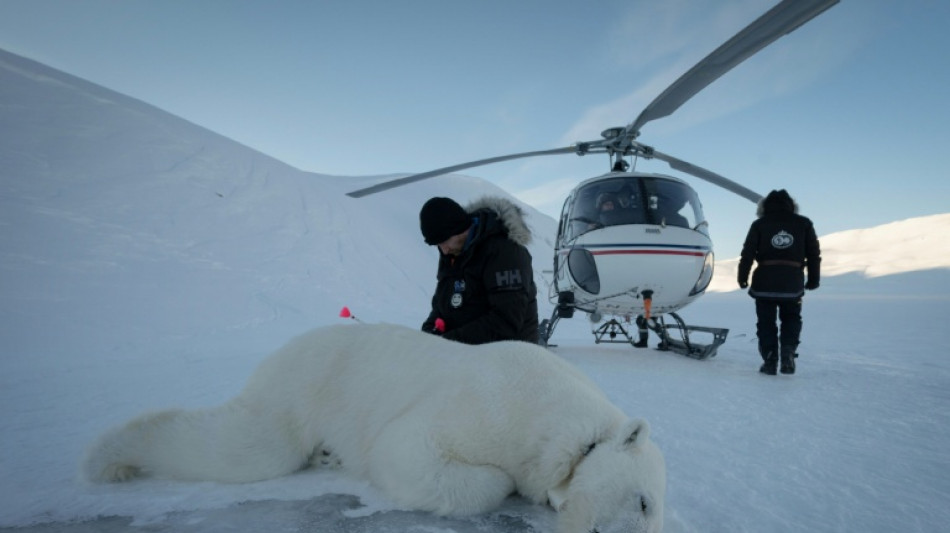
Polar bear biopsies to shed light on Arctic pollutants / Photo: Olivier MORIN - AFP

 Fuel shortage triggers queues on resort island Bali
 Sao Tome's niche vanilla finds far-away fans

 China-North Korea bridge to open Thursday, 12 years late
 Asian stocks mostly down as tech firms struggle to claw back losses

 AI boom drives record sales at Dutch tech giant ASML

 Trump says 'massive' oil, gas, mineral exploration to begin in Greenland
 China heads for record trade surplus as exports surge

 Vietnam mourns 700 war dead in major push to identify missing

 Relentless Swiatek wins all-Polish battle to launch Wuhan campaign

 Seeing pivotal election, Israelis fly from around world to vote

 South Korea's Eom 'racially abused' in England's Championship: club

 Asian markets mixed as tech firms claw back some losses

 India shuts down iconic Delhi protest site after three decades
 Japan urges Russia for 'impartial treatment' of arrested journalist
 Lula, Bolsonaro ordered to call off attempts at online censorship
 EU takes a page from Ireland's AI playbook

 Global deforestation slowed in 2025 but surged in Congo basin: study

 LSEG Accelerates Tick History Analysis With NVIDIA
 Saudi employee arrested for allegedly bugging OpenAI office

 Atletico sink Man Utd as Viking deny Bayern in Champions League
 Man United's Martinez blasts board's lack of investment

 Meet A7 International, an Innovative Global Platform Designed to Reinvent the International Payments Market

 Shakhtar hope London move a reminder of Ukraine conflict

 Tresoldi hat-trick fires Brugge past Inter Milan

 Rams axe kicker Mevis after misses cost victory over Bills: reports

With one foot braced on the helicopter's landing skid, a veterinarian lifted his air rifle, took aim and fired a tranquiliser dart at a polar bear.
The predator bolted but soon slumped into the snowdrifts, its broad frame motionless beneath the Arctic sky.
The dramatic pursuit formed part of a pioneering research mission in Norway's Svalbard archipelago, where scientists, for the first time, took fat tissue biopsies from polar bears to study the impact of pollutants on their health.
The expedition came at a time when the Arctic region was warming at four times the global average, putting mounting pressure on the iconic predators as their sea-ice habitat shrank.
"The idea is to show as accurately as possible how the bears live in the wild -- but in a lab," Laura Pirard, a Belgian toxicologist, told AFP.
"To do this, we take their (fatty) tissue, cut it in very thin slices and expose it to the stresses they face, in other words pollutants and stress hormones," said Pirard, who developed the method.
Moments after the bear collapsed, the chopper circled back and landed. Researchers spilled out, boots crunching on the snow.
One knelt by the bear's flank, cutting thin strips of fatty tissue. Another drew blood.
Each sample was sealed and labelled before the bear was fitted with a satellite collar.
Scientists said that while the study monitors all the bears, only females were tracked with GPS collars as their necks are smaller than their heads -- unlike males, who cannot keep a collar on for more than a few minutes.
- Arctic lab -
For the scientists aboard the Norwegian Polar Institute's research vessel Kronprins Haakon, these fleeting encounters were the culmination of months of planning and decades of Arctic fieldwork.
In a makeshift lab on the icebreaker, samples remained usable for several days, subjected to controlled doses of pollutants and hormones before being frozen for further analysis back on land.
Each tissue fragment gave Pirard and her colleagues insight into the health of an animal that spent much of its life on sea ice.
Analysis of the fat samples showed that the main pollutants present were per- and polyfluoroalkyl substances (PFAS) -- synthetic chemicals used in industry and consumer goods that linger in the environment for decades.
Despite years of exposure, Svalbard's polar bears showed no signs of emaciation or ill health, according to the team.
The local population has remained stable or even increased slightly, unlike parts of Canada, where the Western Hudson Bay group declined by 27 percent between 2016 and 2021, from 842 to 618 bears, according to a government aerial survey.
Other populations in the Canadian Arctic, including the Southern Beaufort Sea, have also shown long-term declines linked to reduced prey access and longer ice-free seasons.
Scientists estimate there are around 300 polar bears in the Svalbard archipelago and roughly 2,000 in the broader region stretching from the North Pole to the Barents Sea.
The team found no direct link between sea ice loss and higher concentrations of pollutants in Svalbard's bears. Instead, differences in pollutant levels came down to the bears' diet.
Two types of bears -- sedentary and pelagic -- feed on different prey, leading to different chemicals building up in their bodies.
- Changing diet -
With reduced sea ice, the bears' diets have already started shifting, researchers said. These behavioural adaptations appeared to help maintain the population’s health.
"They still hunt seals but they also take reindeer (and) eggs. They even eat grass (seaweed), even though that has no energy for them," Jon Aars, the head of the Svalbard polar bear programme, told AFP.
"If they have very little sea ice, they necessarily need to be on land," he said, adding that they spend "much more time on land than they used to... 20 or 30 years ago".
This season alone, Aars and his team of marine toxicologists and spatial behaviour experts captured 53 bears, fitted 17 satellite collars, and tracked 10 mothers with cubs or yearlings.
"We had a good season," Aars said.
The team's innovations go beyond biopsies. Last year, they attached small "health log" cylinders to five females, recording their pulse and temperature.
Combined with GPS data, the devices offer a detailed record of how the bears roam, how they rest and what they endure.
Polar bears were once hunted freely across Svalbard but since an international protection agreement in 1976, the population here has slowly recovered.
The team's findings may help explain how the bears' world is changing, and at an alarming rate.
As the light faded and the icebreaker's engines hummed against the vast silence, the team packed away their tools, leaving the Arctic wilderness to its inhabitants.
S.Jackson--AT