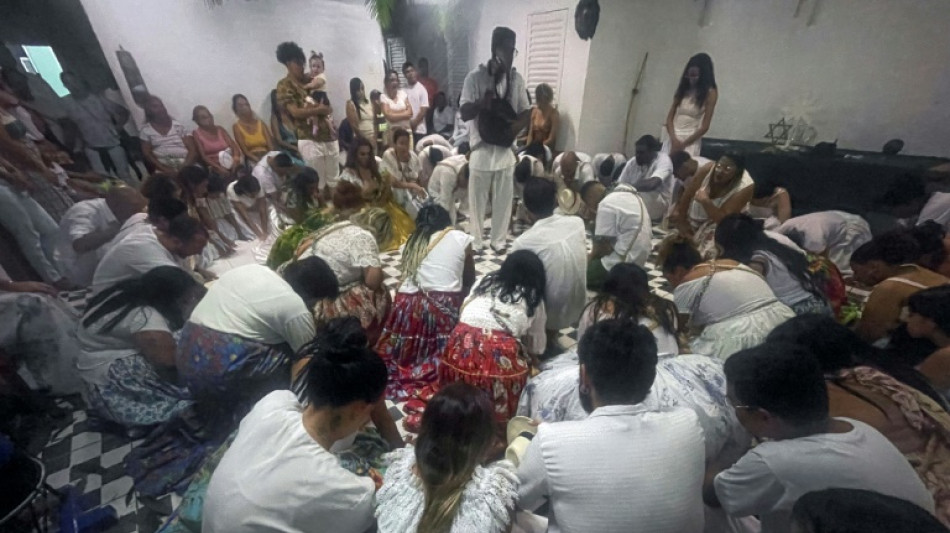
Brazilian ritual root gets second life as potential anti-depressant / Photo: Jose OSORIO - AFP

 Govt takes control of Turkey's most-watched news channel

 FIFA to offer members $6.35-billion development fund windfall

 US consumer inflation hotter than expected as midterms loom

 INmune Bio Inc. and Quantum Computing Inc. Partner to Apply Quantum Optimization and AI to Advance Alzheimer’s Drug Research and Explore New Applications for XPro

 Hot US inflation data dents Wall Street stocks

 India sends 'cockroach' leaders to jail after protest

 'Sinners' director Ryan Coogler to reboot 'X-Files' for Disney

 Lufthansa wins contest for TAP Air Portugal stake

 AI worms, 'major' incident fears spur safety calls at industry summit

 Fuel shortage triggers queues on Indonesia's Bali island

 Evolution Metals & Technologies Corp. Reaffirms $400 Million to $460 Million FY2027 Revenue Guidance, Unveils Eight Sintered Magnet Grades Covering an Estimated 75% of Global NdFeB Revenue, and Moves to Answer U.S. Army Call for Rare Earth Magnets

 Trial defence says Russia used Nord Stream pipelines as 'weapon'

 Israeli settlers set fire to mosque in occupied West Bank

 Macron says French student protesters 'exploited' by political forces: spokeswoman

 Stocks diverge ahead of key US inflation data

 Japan summons Russian ambassador to protest journalist's arrest

 Workers to strike at world's largest copper mine in Chile

 Ukraine accuses US of helping Russia as missiles hit Kyiv

 Drone hits data centre of Russia's largest bank

 Bivial AG Brings Its Complete Dashboard to Mobile

 Mont Blanc nearly two metres taller than in 2023: French surveyors

 Pope recovering after lung cancer operation that rattles Church

 Indonesia haze spikes Singapore pollution, shuts East Timor schools
 Higher borrowing costs an 'alarm signal' for France: finance minister

 Zelensky accuses Putin of disrespecting Trump after latest attacks

Long used in Indigenous Brazilian rituals, the jurema preta plant, which contains a potent psychedelic, is gaining ground as a potential treatment for depression.
At street stalls where medicinal herbs are sold, customers can buy the plant's root which contains dimethyltryptamine (DMT), a hallucinogenic substance that researchers say could be used to alleviate symptoms.
Following instructions he found on the internet, Guaracy Carvajal extracted DMT at home in 2016 from roots he bought on the street.
The 31-year-old software programmer, who had tried various treatment for chronic depression he has suffered since adolescence, said the drug makes it "feel like you've solved something in your life."
Physicist Draulio Araujo, who has conducted extensive research on the drug, said "the response is rapid. One day after treatment, (patients) already showed a significant improvement in their depression symptoms."
Yet he also warned that it "is not a magic cure" and that psychedelics "are not for everyone."
As a researcher at the Brain Institute of the Federal University of Rio Grande do Norte, Araujo and his team treated 14 people with the drug for six months.
The patients inhaled vaporized DMT, under medical supervision.
"It's common for our patients to say that something changed, that a key opened something," he said.
His patients also received psychological therapy, and some continued with conventional pharmaceutical drugs.
Neuroscientist Fernanda Palhano-Fontes, also of the Brain Institute, said "we have patients who improve significantly, others who don't improve at all."
Araujo's findings were published in the scientific journal Nature in April. In 2024, he published another study with promising results in the journal Psychedelic Medicine.
As for Carvajal, who stopped using jurema preta some time ago, he said the drug really allows a person to "start to have a lighter life."
It helped him get through a time when he was in "a state of questioning myself" about "work, day-to-day life," he said.
- Spiritual channels -
Brazil occupies a fairly prominent place in DMT research due to the substance's prominence in society, Araujo said.
While there is no ban on the cultivation or possession of jurema, which is also known as Mimosa tenuiflora, consumption of DMT is prohibited, except for religious and scientific use.
Jurema's roots are combined with other plants in a wine-like beverage that is consumed at rituals that include dancing and drums, part of Indigenous tradition in northeast Brazil where the plant grows.
"It's not hallucination," said Joyce Souza, a young woman attending a jurema ceremony in Planaltina, on the outskirts of Brasília.
"My spiritual channels become more accessible, I can communicate better with myself," Souza said.
Gathered in a house courtyard and dressed in white, the group of mostly novices waited for more seasoned practitioners to enter a trance and bring messages from ancient spirits.
Meanwhile, back in the lab, Araujo is hoping to expand his DMT research to a study of 100 patents.
"Let's say that in five years we'll have... a clear picture on when it will reach a real clinical setting," he said.
Ch.Campbell--AT